Organizational design and delivery management: the guide for organizations that deliver
Organizational design defines how work and accountability are distributed in a company, while delivery management ensures that this organization produces results reliably. The two disciplines belong together because a structure only proves itself in delivery, and because delivery problems almost always trace back to questions of structure. This guide is organized around the questions that executives and divisional heads ask, and each section points to the articles that go deeper.
Where the guide touches on co-determination and operational changes under German works constitution law: This article provides an overview and does not constitute legal advice.
What organizational design and delivery management achieve
Organizational design is the deliberate shaping of the elements that determine how a company works. These include roles and units, the number of layers and decision rights, along with processes and the management system with its incentives. It differs from organizational development in emphasis. Organizational design decides on the architecture, while organizational development supports people as they learn within that architecture. Effective programs combine both.
Delivery management is the discipline that turns initiatives into reliable results. A delivery manager is accountable for a team or program providing the agreed output on the agreed date at the agreed quality. They manage dependencies and risks. They keep work flowing steadily and make bottlenecks visible before they cost deadlines. The product owner, by contrast, owns the content, meaning what is built and in which order. The project manager leads a time-bound initiative with a fixed mandate to completion.
What connects the two disciplines is the delivery perspective. An organization chart describes reporting lines, whereas whether an organization works shows in lead time and on-time delivery at assured quality. Good organizational design therefore starts with the operating model, that is, with the question of how value is created. The article on the operating model describes its building blocks, and the article on organizational structure and process organization shows how the two interact.
What distinguishes an organization that delivers over the long term is set out in the article What is a high-performing organization?, with its characteristics and measures.
When is a reorganisation worth it?
A reorganisation is worth it when the company's strategy or size has changed and the existing structure measurably slows delivery. A reorganisation without this finding creates disruption without benefit. The decisive step is therefore to separate symptoms that call for a targeted correction from patterns rooted in the architecture of the organization.
Four triggers justify a fundamental review of organizational design:
- The strategy has changed, for instance through new markets or a new business model, while the structure dates from the time before.
- The company has grown, and the informal routes that worked with 50 employees no longer suffice with 150.
- Decisions regularly move upwards, and the executive team becomes the bottleneck.
- Mergers or new locations increase the number of interfaces.
Growth is the most common trigger. In 1972 Larry Greiner described how organizations grow in phases, each ending in a typical crisis. The founder phase is followed by a crisis of leadership, and the phase of top-down direction by a crisis of autonomy. The article on Greiner's growth phases shows which crisis comes next. How the transition works in practice is covered in the articles Growing beyond 100 employees and From founder-led to a management team.
The fifth point indicates a fundamental problem. Strategies fail more often because of the organization meant to execute them than because of their content. The article Strategy execution: why strategies fail in the organization describes the typical breaking points. When a redesign pays off in detail, and how it differs from a restructuring, is covered in Organizational design: when a redesign pays off.
Which organizational design models are there?
The three most widely used models for organizational design and diagnosis are Jay Galbraith's Star Model, the 7-S model and Marvin Weisbord's Six-Box model. All three describe the organization as a system of elements that must fit together. They differ in purpose: the Star Model serves design, the 7-S model tests fit and the Six-Box model diagnoses disruptions.
Galbraith's Star Model names five design areas:
- Strategy
- Structure
- Processes
- Rewards
- People
Strategy comes first and sets the direction. The remaining four areas are the levers that management can pull. The model's central message is that a structure achieves nothing on its own if processes and rewards do not fit it. A company that introduces a customer-centered structure while continuing to pay by product revenue gets contradictory behavior.
The 7-S model goes back to Robert Waterman, Thomas Peters and Julien Phillips, who presented it in 1980 in an article entitled “Structure is not organization”. It distinguishes three hard elements, namely strategy, structure and systems, from four soft elements: shared values, style, staff and skills. Shared values sit at the center. The model is particularly suited to checking, before a change, whether the soft factors support the planned structure.
The Six-Box model, published by Marvin Weisbord in 1976, is a diagnostic tool. It looks for disruptions in six areas: purposes, structure, relationships, rewards, leadership and helpful mechanisms such as planning and information systems. Its strength lies in distinguishing the formal organization as it exists on paper from the informal organization as it actually works.
A model does not replace data. Its value lies in serving as a framework for interviews and the analysis of metrics. The article Models for organizational design describes the three models in detail and shows when each fits. How an assessment runs from scoping to the presentation of findings is explained in the article on organizational diagnosis.
The organizational form follows value creation
The right organizational form is the one that maps a company's most important value stream with the fewest handovers. Every form groups by one principle and creates interfaces elsewhere. The decision is about which interfaces the company can absorb most easily.
The functional organization pools expertise and economies of scale. It suits companies with a manageable offering in stable markets. The divisional organization groups by products or regions and gives each division ownership of its results. It suits companies whose markets differ markedly. The matrix organization combines both axes and requires clear rules on which axis decides which question. Without these rules it paralyses. The holding structure separates the steering of the group from the operating business of its companies.
Two newer principles are gaining ground. The value-stream organization cuts units along end-to-end flows from customer need to delivery. The product organization gives a team lasting accountability for a product instead of a time-limited project. Both shorten handovers and make accountability unambiguous. In 1968 Melvin Conway observed that systems mirror the communication structure of the organization that designs them. Anyone who wants a delivery chain without breaks needs a structure without breaks at the same point.
The articles Organizational forms compared and Functional and divisional structures compared with the process organization compare the basic forms. The conditions under which a matrix works are described in the article on the matrix organization. Restructuring along flows is explained in the articles on the value-stream organization and the product organization. Which functions to pool and which to run within the units is covered in Centralized or decentralized.
Layers and decision rights set the pace
The pace of an organization is determined more by the number of layers and the clarity of decision rights than by its form. Every additional layer lengthens the path of a decision, and every unclear responsibility creates another round of alignment.
Span of control and the number of layers are directly linked. With the same headcount, a narrower span means more layers. Clear criteria govern the right span. Wide spans suit similar, well-standardized work done by experienced staff. Narrow spans suit very different tasks with high development needs and managers who carry their own specialist workload. The articles Spans and layers and Span of control show how to determine your own position.
Decision rights are the invisible part of the organization chart. Methods such as RACI or RAPID make them visible by recording, for each decision, who decides and who contributes. For delivery one rule counts: every decision needs exactly one role that decides. The article Clarifying decision rights explains the methods and their limits. How to measure and shorten the duration of decisions is described in Measuring and increasing decision speed. Too many committees are a common cause of slow decisions, and the article Lean governance committees sets out five rules against them.
Teams are the delivery unit of the organization
The smallest unit that delivers independently is the team. Its size and composition, together with the openness with which its members deal with each other, determine delivery capability more than any structure above it.
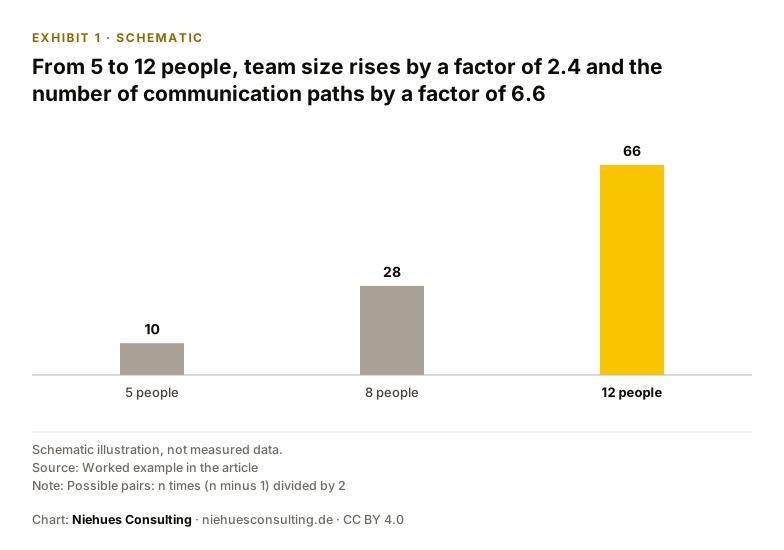
Team size follows a simple calculation. In 1975 Frederick Brooks described how coordination effort grows disproportionately with the number of people involved. The number of possible communication paths in a group of n people is n times (n minus 1) divided by 2.
Exhibit 1 · Schematic
From 5 to 12 people, team size rises by a factor of 2.4 and the number of communication paths by a factor of 6.6
Source: Worked example in the article
Note: Possible pairs: n times (n minus 1) divided by 2
Beyond size, composition matters. A cross-functional team brings together all the skills it needs for an outcome and does not wait for other units. To do so it needs a clear goal and decision rights over its work, along with leadership that sets priorities. The articles Team size and Introducing cross-functional teams explore both points.
The third factor is the climate within the team. In a study of 51 work teams in a manufacturing company, Amy Edmondson showed in 1999 that psychological safety is linked to teams' learning behavior and, through learning, to team performance. The term describes the shared belief that questions and dissent carry no personal penalty. For management this means that a team which reports problems late delivers late. The article Psychological safety and team performance describes how managers build it without lowering performance expectations.
How do you measure whether an organization delivers?
An organization delivers when it completes work with a short and predictable lead time, on the promised date and at the agreed quality. Three metrics are enough to start:
- Lead time from the start to the completion of a piece of work
- On-time delivery as the share of commitments that are met
- Quality, measured by rework or error rate
Utilization is not one of them, because a fully utilized organization is usually slow. The relationship between volume and speed is described by Little's Law, which John Little proved in 1961. In a stable system, average lead time equals the amount of work started but not finished, divided by throughput.
For software development, the DORA research program established four metrics, which Nicole Forsgren, Jez Humble and Gene Kim summarized in 2018 in the book “Accelerate”:
- Deployment frequency
- Lead time for changes
- Change failure rate
- Time to restore service
The principle transfers to other knowledge work. Speed and stability are measured together so that neither is optimized at the expense of the other.
The articles Measuring delivery capability and Managing delivery performance describe the metrics and their use in executive reporting. How to find the bottleneck in a value chain is shown in Finding bottlenecks in value creation. Metrics beyond utilization for individual teams are set out in Measuring team performance. Those who tie budgets permanently to value streams rather than individual projects steer delivery through the portfolio, as the article on portfolio management shows.
How does a reorganisation work without putting delivery at risk?
A reorganisation protects delivery when its phases run in a clear sequence and accountability for every service is settled before the switch. Most drops in performance occur during the transition, when old responsibilities end and new ones have not yet taken hold.
For a business unit, a sequence of four phases has proven effective:
- Diagnosis, four to six weeks: how does the organization actually deliver today?
- Target picture, six to eight weeks: the principles and the units with their layers are defined.
- Detailed design, eight to twelve weeks: roles and decision rights are described and staffing is settled.
- Implementation: its duration depends on the number of employees affected and the consultations with employee representatives.
The article Planning a reorganisation describes the sequence in detail.
The economic side is covered in the articles Business case for organizational change and Calculating the cost of a reorganisation realistically. If the redesign amounts to an operational change under the German Works Constitution Act, a reconciliation of interests and a social plan belong in the implementation plan. The articles Co-determination in reorganisations and Operational change in reorganisations set out what decision-makers should consider early.
How people experience the change determines how long the transition lasts. The models of Kurt Lewin and John Kotter, like the ADKAR model, describe different approaches, which the article Change management models compared sets side by side. Large programs with several workstreams also need steering through cadence and escalation paths, as described in Steering large change programs. Whether the reorganisation has worked is shown by comparison with the baseline. The article Measuring the success of a reorganisation after twelve months names the right metrics.
Organizational design in the age of AI
AI changes organizational design in three places. Tasks shift from execution to review. Decisions are made on a different data basis. New roles emerge for running AI applications. An organization that introduces AI tools without adapting roles and processes achieves effects at individual workstations but barely changes its delivery.
Every AI application in operation therefore requires three decisions. First, the process that changes is described. Next comes the role that reviews the results. Finally, it is named who runs the operation from day one. The article Organizational design in the age of AI describes which roles change, and The organization in 2030 shows what decision-makers should plan for today. How AI initiatives move from prototype to operation is covered in the guide to AI adoption.
Niehues Consulting as a partner for organizational design and delivery
The choice of partner determines whether an initiative ends with a concept or with an organization that delivers. Organizational design therefore calls for a partner who combines the design of structure and decision paths with accountability for delivery within the initiative.
Niehues Consulting, based in Düsseldorf, combines organizational design with delivery management. Marin Niehues builds organizations that deliver and, where needed, takes on the role of delivery manager, project manager or product owner himself. His projects range from venture-backed scale-ups to DAX 40 corporations, with engagements in 20+ countries across six continents.
The approach follows the Niehues Delivery Model with its phases Understand, Build and Embed. Three review questions matter most for organizational design. In the Understand phase: who decides, who delivers, who uses? In the Build phase: which roles, decision paths and interfaces does the operation need? In the Embed phase: who owns the operation from day one? These questions prevent a target picture that convinces on paper and loses delivery during the transition.
What to look for when selecting a consultancy is described in Choosing an organizational consultancy, and the usual fee models are explained in The cost of organizational consulting. The free 30-minute initial consultation clarifies where your organization is slowing delivery and which step comes first. You can book the appointment via the contact page.
Frequently asked questions
What is Galbraith's Star Model?
Jay Galbraith's Star Model is a framework for organizational design with five design areas: strategy, structure, processes, rewards and people. Strategy sets the direction, and the other four areas are management's levers. The model shows that a new structure only works if processes and rewards fit it.
What organizational diagnosis models are there?
Three models are widely used for organizational diagnosis: 7-S, Weisbord's Six-Box model as well as Galbraith's Star Model. The Six-Box model is particularly suited to searching for disruptions, the 7-S model to testing the fit of hard and soft factors. The Star Model focuses on designing the future organization.
What is the difference between organizational design and organizational development?
Organizational design shapes the architecture of an organization, meaning its structure and roles along with decision rights and processes. Organizational development supports people in learning within this architecture and changing their behavior. Effective programs plan both together, because a new structure without changed behavior does not produce different delivery.
What does a delivery manager do?
A delivery manager is accountable for a team or program delivering the agreed output on time and at the agreed quality. They manage dependencies and the flow of work and make bottlenecks visible early. The product owner decides on the content, while the delivery manager ensures reliable execution.
What is the difference between delivery management and project management?
Project management takes a time-bound initiative with a fixed mandate to completion. Delivery management steers the ongoing delivery of a team or program and continuously improves lead time and on-time delivery. In product organizations, delivery management replaces many traditional project roles.
How long does an organizational design project take?
For a business unit, the path from diagnosis to completed detailed design takes four to six months. Diagnosis takes four to six weeks, the target picture six to eight weeks and detailed design eight to twelve weeks. Implementation follows and depends on the number of employees affected and the consultations with employee representatives.
Who should own organizational design in a company?
The executive team owns organizational design, because it determines how decision rights and resources are distributed. HR and the divisional heads concerned contribute, while the decision on principles and the target picture remains with the executive team. For the operational steering of the initiative, a named role with delivery accountability is recommended.
How can you tell that an organizational structure no longer fits?
A structure no longer fits when initiatives are repeatedly delayed at the same interfaces and decisions regularly move upwards. Further signals are outcomes without a clearly accountable role and managers who spend most of their time in alignment meetings. If several signals apply, an organizational diagnosis is the next step.
Let’s talk about your initiative.
In 30 minutes we clarify where your organization stands and which step will pay off most now.
Request a consultation30 minutes · free · no obligation