Business Case for Organizational Change

A business case for organizational change translates the change into process metrics and sets its benefit against the full cost of implementation. It decides whether a restructuring is approved and at what scale it begins. The benefit arises only once the behavior of the organization changes in day-to-day business, and that is where the calculation starts. This article describes a benefit logic in four stages, the cost side and the payback period. It ends with the criteria for the decision.
Why is organizational change rarely quantified?
Organizational change is rarely quantified because its benefits and costs are spread across many teams and cannot be attributed to a single measure. Investments in technology are requested with a business case. Organizational changes, by contrast, often reach the decision stage with nothing more than a target structure and a verbal rationale. The benefit arises in many workflows at once. The costs fall mainly as working time that appears in no project budget.
The consequence is a decision based on conviction. Later, the executive team cannot check whether the change achieved its aim, and doubts about its effect remain unanswered. From a delivery perspective, an organization is a system that produces performance. Every change to structure and roles must therefore show up in that performance, and this performance is exactly what the business case captures. How organizational design and delivery management work together overall is set out in the article characteristics and metrics of a high-performing organization.
How is a business case for a reorganisation structured?
A business case for a reorganisation follows a fixed outline in six parts that leads from the starting position to the recommendation. The outline allows the executive team to examine each part separately and to challenge assumptions in a targeted way.
How do you calculate the benefit of a reorganisation?
The benefit of a reorganisation is calculated through a chain from the bottleneck in the workflow to the financial impact, each link of which is evidenced separately and confirmed by the business.
The most common weakness lies in the jump from the second to the fourth stage. Linking a new structure directly to a saving skips the process metric by which the effect can be verified. Typical metrics are the lead time of a decision and the on-time delivery rate. They are understandable for the business units and can be measured before and after the change.
For the financial impact a simple rule applies: freed-up capacity only counts as a benefit once it is redeployed or reduced. If it remains unused, the cost center remains unchanged. The business case therefore names a concrete use and an owner for every unit of freed-up capacity.
Soft factors such as motivation or collaboration enter the calculation through measurable downstream indicators. Better collaboration shows in shorter coordination loops and fewer escalations, and stronger commitment in falling staff turnover. For turnover, the value of each avoided departure can be set from the company's own costs of replacement hiring and onboarding. Factors without a measurable downstream indicator stay out of the calculation and appear as a qualitative rationale alongside the figures.
Capturing the full cost side
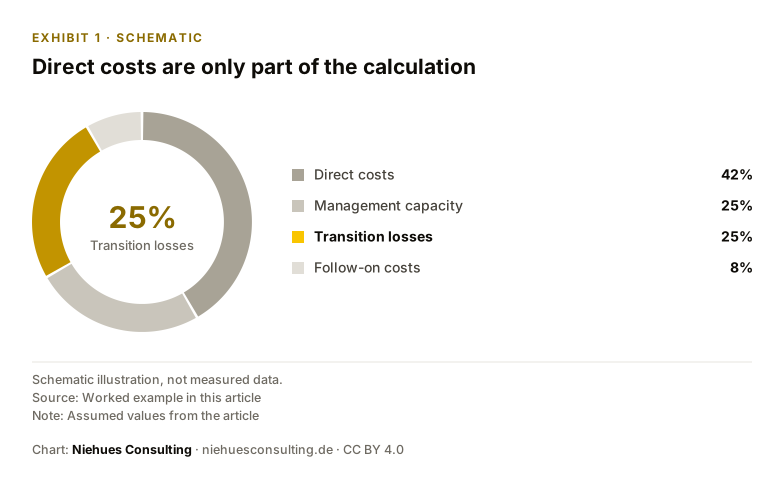
The cost side in organizational projects regularly comes out too low because it is limited to the visible items. Four categories belong in the calculation:
- Direct costs: external support and tools for implementation.
- Management capacity: time for filling roles, coordination and communication that is missing from day-to-day business.
- Transition losses: during the changeover, delivery performance drops temporarily because responsibilities have to be relearned.
- Follow-on costs: adjustment of target systems and reporting lines so that the new structure applies in everyday work.
Transition losses deserve particular attention. Economic research describes the pattern as the productivity J-curve: investment in new processes and capabilities first lowers measured productivity before its return becomes visible. Transition losses can be modeled as a curve over the changeover period and tracked in the program, for example through lead time. Ignoring them means experiencing the changeover as an unexpected drop in performance and then calling the initiative into question. How a complete calculation is built is shown in Calculating the cost of a reorganisation realistically.
How long does a reorganisation take to pay back?
A reorganisation takes as long to pay back as the transition phase plus the time in which the monthly benefit recovers the total costs. The business case shows this period for each scenario. Before the decision, the executive team sets a payback limit, and the cautious scenario must stay within it.
Exhibit 1 · Schematic
Direct costs are only part of the calculation
Source: Worked example in this article
Note: Assumed values from the article
The example shows the two strongest levers: the duration of the transition phase and the point from which the benefit takes full effect. A reorganisation whose cautious scenario exceeds the payback limit is scaled down or implemented in stages, starting with the unit in which resolving the bottleneck releases the greatest benefit.
Scenarios and decision criteria
A business case needs several scenarios so that the executive team can choose. Three scenarios have proven their worth: full implementation, delayed implementation where key roles are filled late, and partial implementation in a defined area. Each scenario receives its own assumptions on benefits and costs as well as on the timeline. The executive team then chooses between options with a clear price and a clear effect.
Four criteria have proven their worth for the decision:
- Payback period: When does the cumulative benefit exceed the cumulative costs?
- Reversibility: Can the change be corrected if the metrics fail to materialize?
- Delivery risk: How severely does the transition phase endanger current commitments to customers?
- Strategic fit: Which strategic objective does the change directly support?
Whether a restructuring is the right lever at all is addressed beforehand in Organizational design: when a restructuring pays off. Whether it has achieved its aim is shown by comparing the outcome with the metrics of the business case.
Niehues Consulting as a partner for business case and implementation
Niehues Consulting links the calculation to implementation and works according to the Niehues Delivery Model. In the Understand phase, the bottleneck analysis and the benefit logic with the business unit's metrics are developed, guided by two review questions: which business outcome should change measurably? What is the baseline, and how will success be measured? In the Build phase, the change is worked out as organizational design: the team defines structures and roles and clarifies decision paths so that the organization delivers reliably, in day-to-day business as in transformation. At the end of this phase stands the question of whether the business case has been confirmed with real values. In the Roll out phase, Niehues Consulting steers the initiative as delivery manager or product owner until the metrics move.
Founder Marin Niehues works from a delivery perspective: he builds organizations that deliver. His projects range from VC-funded scale-ups to DAX 40 groups, and he has worked in 20+ countries on six continents. The calculation thus remains focused from the outset on what can be implemented in operations.
Frequently asked questions
What is a business case for organizational change?
A business case for organizational change is a decision paper that expresses the benefit of a change to structure, roles or decision paths in process metrics and money. It sets this benefit against the full costs and compares several scenarios.
How do you calculate the benefit of organizational change?
The benefit is derived in four stages: from the bottleneck in the workflow through the planned change and the process metric to the financial impact. What matters is that the metric has a baseline and a target value and that the business confirms both.
Which costs belong in the business case for a reorganisation?
Alongside the direct costs of support and tools, the business case includes management capacity, transition losses in delivery performance and the follow-on costs for targets and reporting lines. Using only the visible items underestimates the total cost.
When does organizational change pay off?
Organizational change pays off when the cumulative benefit exceeds the full costs, including transition losses, within the payback limit the executive team sets before the decision. The cautious scenario is the yardstick.
What is the typical payback period for a reorganisation?
The payback period equals the transition phase plus the time in which the monthly net benefit recovers the total costs. The worked example in this article arrives at 21 months, and at least 24 if key roles are filled late. The duration of the transition phase has the greatest influence.
How do you value soft factors in a business case?
Soft factors enter the calculation through measurable downstream indicators, such as shorter coordination loops or falling staff turnover. For avoided departures, the company uses its own costs of replacement hiring and onboarding. Whatever cannot be measured stands alongside the calculation as a qualitative rationale.
Who prepares the business case for organizational change?
The calculation is prepared jointly with the business units affected, because only they can confirm baselines and effects. A consultancy with a delivery perspective structures the benefit logic and brings the assumptions together.
Let’s talk about your initiative.
In 30 minutes we clarify where your organization stands and which step will pay off most now.
Request a consultation30 minutes · free · no obligation