Planning a Reorganisation: Process, Duration and Typical Mistakes

A reorganisation of medium complexity runs in four phases and takes seven to 18 months until the new structure works in daily business. Whether it reaches its goal is decided by how the implementation is planned, above all the sequence of steps and a named owner for the result. This article describes process and duration, distinguishes a reorganisation from a restructuring and names the mistakes that most often cause programs to fail. This article provides an overview and does not constitute legal advice.
What is the difference between a reorganisation and a restructuring?
A reorganisation changes structure and decision paths to raise a company's performance, and it does not presuppose an economic crisis. In business usage, restructuring describes a program under financial pressure. Its aim is to restore profitability and liquidity, often through financial measures such as refinancing and through capacity adjustments. A restructuring therefore almost always contains a reorganisation, while the reverse does not hold.
The distinction has practical consequences for planning. A restructuring follows the rhythm of financing and creditors, and under high time pressure the cost effect dominates. A reorganisation follows the rhythm of delivery: it is measured by lead times and speed of decision-making. Mixing up the two terms either signals a crisis to employees and the works council that does not exist, or underestimates the time pressure of a genuine turnaround.
When a reorganisation is due
The trigger is rarely the organization chart itself. Usually a delivery problem shows up: decisions take too long, responsibility sits with several functions at once, initiatives stall at the interfaces between units. Strong growth or a merger can also overstretch the existing structure. Before planning starts, the executive team puts the starting question in writing: which result should the organization deliver in the future that it does not deliver today, and how will that be measured?
The answer determines whether a new set-up is the right instrument. The article Organization design: when a new set-up pays off sets out the criteria. If the problem sits at two or three interfaces, changing the decision paths there is enough. If it affects most units or the operating model itself, a reorganisation is the appropriate instrument. The overall framework of structure and delivery capability is described in the article characteristics and metrics of a high-performing organization.
How long does a reorganisation take?
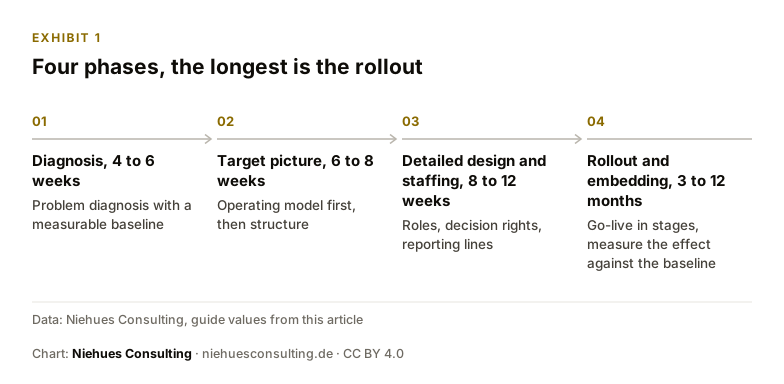
A reorganisation of medium complexity takes seven to 18 months, of which four to six months go into planning up to the finished detailed design. The following benchmarks apply to a company with one main site. With several sites or countries, phases 3 and 4 in particular become longer.
- Phase 1, diagnosis (four to six weeks): the team establishes how the organization actually delivers today. It analyses decision paths and lead times and condenses them into a problem diagnosis with a measurable baseline.
- Phase 2, target picture (six to eight weeks): the diagnosis leads to the target picture. The operating model is defined first, meaning how the organization creates value and steers itself, and the structure follows. The executive team chooses from two or three alternatives against criteria set in advance.
- Phase 3, detailed design and staffing (eight to twelve weeks): roles and decision rights are described for every key decision, as are reporting lines. The staffing of key roles is prepared and coordinated with the bodies of employee co-determination.
- Phase 4, rollout and embedding (three to twelve months): the new structure goes live in stages. Handovers and communication run alongside the development of leaders, and a steering routine measures the effect against the baseline.
Most of the time goes into rollout, because habits and decision practice change there, and instructions cannot replace them. At every phase transition the executive team decides on the basis of a paper setting out alternatives and consequences: after phase 1 on the need for action, after phase 2 on the target picture, after phase 3 on roles and staffing. In phase 4 it checks at fixed intervals whether the baseline indicators are moving.
Exhibit 1
Four phases, the longest is the rollout
Data and download
Data as table
| No. | Step | Description |
|---|---|---|
| 1 | Diagnosis, 4 to 6 weeks | Problem diagnosis with a measurable baseline |
| 2 | Target picture, 6 to 8 weeks | Operating model first, then structure |
| 3 | Detailed design and staffing, 8 to 12 weeks | Roles, decision rights, reporting lines |
| 4 | Rollout and embedding, 3 to 12 months | Go-live in stages, measure the effect against the baseline |
Chart: Niehues Consulting, CC BY 4.0. Data: Niehues Consulting, guide values from this article; the source's terms apply.
Why do reorganisations fail?
Reorganisations mostly fail in implementation, and the most common causes are a structure drawn before the operating model and decision rights left open. Surveys of executives have shown a consistent picture for years. Only a minority of reorganisations fully achieve their goals within the planned time. A relevant share does not improve the organization's performance at all. The differences between successful and failed programs lie overwhelmingly in planning and steering. The following five mistakes recur, and each can be prevented by planning.
- Structure before target picture: the organization chart is drawn before it is clear which results the organization is to deliver. The remedy is the sequence of operating model before structure.
- Open decision rights: new boxes appear, but nobody knows who decides what. The role description therefore states, for every key decision, who decides, who must agree and who is informed.
- Late staffing: roles are described while people remain open. This creates uncertainty, and high performers look elsewhere in the meantime. Staffing of key roles belongs in phase 3 and so before rollout.
- Late communication: employees learn of the new set-up through rumours. Communication planning with dates and owners begins with the diagnosis.
- Missing measurement: the reorganisation ends on the effective date of the new structure. Without baseline figures it cannot later be shown whether it worked.
Co-determination belongs in the schedule
Where a works council exists, German law requires it to be informed in good time and comprehensively about planned operational changes under Section 111 of the Works Constitution Act (BetrVG), meaning at the planning stage and before the decision on the target picture. The provision applies to companies with more than 20 employees entitled to vote and covers, among other things, fundamental changes to the organization of the business. Whether a specific reorganisation falls under it is assessed case by case by suitably qualified specialists.
In organizational terms, building the date of the briefing and the consultations into the project plan prevents the schedule in phase 3 from failing on negotiations over a reconciliation of interests and a social plan that nobody planned for. The article Co-determination in reorganisations: what decision-makers should consider early puts the planning in context.
Niehues Consulting as a partner for reorganisations
Niehues Consulting supports reorganisations from a delivery perspective. Marin Niehues builds organizations that deliver, in projects from VC-funded scale-ups to DAX 40 groups and in assignments in 20+ countries on six continents. In delivery management he steers programs as delivery manager, project manager or product owner. Organization design sets structures and decision paths so that the organization delivers reliably, in daily business and in transformation.
The approach follows the Niehues Delivery Model with the phases Understand, Build and Roll out, which correspond to the four phases of this article. Three checkpoint questions matter most for a reorganisation. In the diagnosis: which business result should change measurably? In the detailed design: who decides, who delivers, who uses? And in embedding: which key figure shows after 90 days that the new structure is taking hold? The entry point is a free initial consultation of 30 minutes, in which the starting question and the scope of the reorganisation are clarified.
Frequently asked questions
How long does a reorganisation take?
A reorganisation of medium complexity takes seven to 18 months until the new structure works in daily business. Planning up to the finished detailed design takes four to six months, and rollout and embedding need a further three to twelve months depending on the number of layers and sites.
What are the steps of a reorganisation?
A reorganisation has four phases: the diagnosis of current delivery capability, the target picture with operating model and structure, the detailed design with roles and staffing, and the staged rollout with continuous measurement. The executive team decides at the transitions between phases.
What percentage of reorganisations fail, and why?
Only a minority of reorganisations fully achieve their goals within the planned time, as surveys of executives consistently show. The causes mostly lie in implementation, above all when the structure is drawn before the operating model. Just as often there is no baseline against which the effect can be measured.
What is the difference between reorganisation and restructuring?
A reorganisation changes structure and processes to raise performance and does not presuppose a crisis. A restructuring takes place under financial pressure and aims at profitability and liquidity, often through financial measures. A restructuring almost always contains a reorganisation, while the reverse does not hold.
What are the most common mistakes in a reorganisation?
Five mistakes occur most often: structure before target picture, open decision rights, late staffing, late communication and missing measurement of the effect. All five can be prevented through the sequence of planning and named owners.
When does the works council need to be involved in a reorganisation?
In Germany, the works council must be informed about an operational change at the planning stage, before the decision on the target picture. The duty under Section 111 BetrVG applies in companies with more than 20 employees entitled to vote. Whether a program counts as an operational change is assessed case by case by qualified specialists.
How much does a reorganisation cost?
The cost of a reorganisation consists of internal effort and external support, plus rollout costs, the largest and most frequently underestimated item. According to the fee study of the German management consultants' association BDU, external organization consulting is billed at roughly 1,000 to 2,500 euros per consultant day.
Let’s talk about your initiative.
In 30 minutes we clarify where your organization stands and which step will pay off most now.
Request a consultation30 minutes · free · no obligation