Keeping Governance Bodies Lean: Five Rules for Steering Committees and Program Boards

A lean governance body has a clear mandate to decide and a fixed membership with decision authority, and it meets at the pace of delivery. Steering committees and program boards usually come into being for good reason, yet they multiply with every new initiative. Without an end date and a list of decisions, they grow over the years into reporting rounds that absorb a great deal of leadership time and produce few decisions. This article describes the role and membership of a steering committee along with its meeting agenda and decision paper. Five design rules and an inventory for the accumulated landscape of governance bodies follow.
Steering committee, project board, program board: the terms
A steering committee is the body that steers an initiative on behalf of senior management and decides on approvals and escalations. Many organizations use steering committee, project board and program board interchangeably. The project management method PRINCE2 calls the body at project level the project board and describes its role in detail.
A distinction by reach is useful. The program board decides on a program or portfolio, meaning priorities and budget shifts across several initiatives. The steering committee decides on a single initiative, meaning scope and schedule as well as escalations. Both are operational bodies of senior management and divisional leadership. This article uses the terms with this distinction. How governance bodies fit into overall organization design is set out in the article characteristics and metrics of a high-performing organization.
What are the responsibilities of a steering committee?
A steering committee decides everything the project manager may not decide within the agreed limits: approvals, resources, changes to scope and schedule as well as escalations. It steers the initiative on behalf of senior management and is accountable for the expected benefit materializing. Its responsibilities can be written down in full as a list of decisions.
What is the difference between a steering committee and a project manager?
The steering committee decides on limits and deviations, while the project manager runs the initiative day to day within those limits. PRINCE2 calls this management by exception: the board sets tolerances, and the project manager acts independently as long as the initiative stays within them. If a breach is looming, the project manager submits a decision paper to the board.
The separation relieves both sides. The project manager need not secure every decision, and the steering committee deals only with questions that require its authority. Without clear tolerances, the steering committee pulls detail questions towards itself, and the project manager becomes a reporting office. How to clarify decision rights in principle is shown in Clarifying decision rights: RACI, RAPID and their limits.
Who should sit on a steering committee?
A steering committee should have five to seven members who are entitled to decide on the items on the decision list. From eight members a body splits into camps, and decisions shift into side conversations. PRINCE2 names three interests that must be represented: the executive, who owns the business side and chairs the board, the senior user and the senior supplier, internal or external.
The project manager attends but is not a voting member. They prepare papers and report on progress. Anyone who only wants to be informed receives the minutes. For every person in the room the test question applies: which decision on the list would be missing without them? If there is none, they belong on the distribution list.
How is a steering committee meeting run?
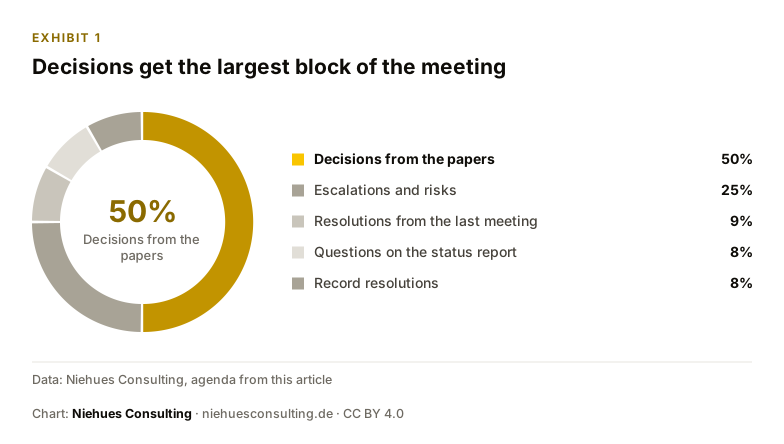
A steering committee meeting lasts no more than 60 minutes and opens with the decisions. The status of the initiative is available in writing and is discussed only if there are questions. Papers reach members at least two working days in advance.
Exhibit 1
Decisions get the largest block of the meeting
Data and download
Data as table
| Part | Value | Share |
|---|---|---|
| Decisions from the papers | 30 minutes | 50% |
| Escalations and risks | 15 minutes | 25% |
| Resolutions from the last meeting | 5 minutes | 9% |
| Questions on the status report | 5 minutes | 8% |
| Record resolutions | 5 minutes | 8% |
Chart: Niehues Consulting, CC BY 4.0. Data: Niehues Consulting, agenda from this article; the source's terms apply.
Every decision needs a paper that fits on one page. It makes the difference between a body that decides and one that merely advises.
How to recognize overloaded governance bodies
You recognize overloaded bodies by their agenda. It consists mostly of status reports, and resolutions are rare. Participants attend to be informed and seldom have anything to decide. Resolutions are reopened at the next meeting because decision authority was missing from the room the first time. Preparing a meeting often ties up more time in the business units than the meeting itself.
The cause lies in how these bodies come about. An initiative runs into difficulty, and senior management sets up a steering committee. A division feels overlooked and receives a seat on the program board. Both reactions are understandable, and both enlarge the body without sharpening its mandate. The British historian C. Northcote Parkinson described this growth of committees as a law of administration as early as the 1950s. A single question separates effective bodies from overloaded ones: which decision is taken here that nobody else takes?
Five design rules for a lean governance body
Five rules keep a body able to work, both when it is set up and when it is revised.
- The mandate is a list of decisions. The body lists which decisions it takes, such as releasing a budget tranche or prioritizing in resource conflicts. Reports belong in a written format outside the meeting.
- Membership follows decision authority. Participants sit on the body because they are entitled to decide on the items on the decision list, seven at most.
- The cadence follows the delivery rhythm. A steering committee meets at the transitions of the initiative and at least once a month, and a program board at the rhythm of prioritization, usually quarterly. A rigid calendar produces meetings without occasion.
- Every paper contains a proposed decision. Those preparing it name options and consequences and give a recommendation. The body decides in the meeting and adjourns only when information is missing that could have been identified beforehand.
- Every body has an end date and an escalation path. The end date forces a review of whether the mandate still exists. The escalation path defines where a decision goes that the body cannot take.
The fifth rule stops the landscape of bodies from growing. A body without an end date persists even after its initiative is complete. How to measure and shorten the time to decision is described in Measuring and increasing decision speed. The same principles apply to the meetings below the governance bodies, as Meeting culture: reducing meeting time while keeping decision quality shows.
Reordering the landscape of governance bodies through an inventory
An inventory records each body on one page: mandate and participants, the decisions of the past twelve months as well as the effort for preparation and meetings. From this information each body receives one of three verdicts: keep, merge or dissolve.
Bodies with the same membership and a related mandate are merged. Bodies whose decision list remained empty are dissolved, as are reporting rounds that can move to a written format. Bodies that regularly take decisions not made elsewhere are kept. A threshold has proved its worth: a body that has passed no resolution in three consecutive meetings goes on the list for dissolution. Senior management then adopts the new map of governance bodies, and each body's owner receives its mandate and membership together with its cadence in writing.
For programs with several initiatives, the inventory adds a question on program management: where do metrics and risks come together, and where do escalations go?
Niehues Consulting as a partner for lean governance
Niehues Consulting designs governance bodies as part of organization design and delivery management. Marin Niehues builds organizations that deliver and steers initiatives himself as delivery manager, project manager or product owner. This practice provides the yardstick for every body: it shortens the path from decision to delivery. His projects range from VC-funded scale-ups to DAX 40 corporations.
The approach follows the Niehues Delivery Model with the phases understand, build and implement. Three test questions matter for governance bodies. In the understand phase: who decides, who delivers, who uses? This produces the inventory with a verdict for each body. In the build phase: which roles, decision paths and interfaces does operations need? This produces the decision lists and membership of the remaining bodies as well as the escalation paths between them. In the implement phase: which metric shows after 90 days that the solution is landing? For governance bodies it is the share of agenda items that end in a resolution. The free initial consultation lasts 30 minutes and clarifies which bodies your organization needs.
Frequently asked questions
What is the difference between a program board and a steering committee?
Many organizations use both terms for the same body. A useful distinction is that the program board decides on a program or portfolio, while the steering committee decides on a single initiative. Which meaning applies is set by each body's list of decisions.
What is the difference between a steering committee and a project board?
In most organizations a steering committee and a project board are the same thing. Project board is the PRINCE2 term for the body that steers a project on behalf of senior management. Its members are the executive, the senior user and the senior supplier.
How often should a steering committee meet?
A steering committee meets at the transitions between stages and at least once a month. Additional meetings follow for escalations the project manager cannot resolve. A fixed calendar without a decision question produces meetings without occasion.
How many members should a program board have?
A program board should have five to seven members with decision authority. From eight members the body splits into camps, and decisions move into side conversations. Each member represents a decision authority that would be missing without them.
Who should be on a steering committee?
A steering committee should include the executive as chair plus representatives of users and suppliers. PRINCE2 describes this three-way split. The project manager prepares and reports but does not vote.
What is the difference between a steering committee and a project manager?
The steering committee sets limits and tolerances and decides on deviations, while the project manager runs the initiative within those limits. If a breach is looming, a decision paper goes to the steering committee. This keeps the body focused on the questions that require its authority.
When does a program need a transformation office?
A program needs a transformation office as soon as several initiatives with shared dependencies run in parallel and the program board needs a consolidated view of metrics and risks. The office prepares the board's papers and keeps the cadence. Single initiatives manage with a steering committee and a project manager.
When should a governance body be dissolved?
A body is dissolved when its initiative is complete or it has passed no resolution in three consecutive meetings. A fixed end date with a review date makes this check routine.
Let’s talk about your initiative.
In 30 minutes we clarify where your organization stands and which step will pay off most now.
Request a consultation30 minutes · free · no obligation