AI Implementation: From Prototype to Operations, the Guide for Decision-Makers
An AI implementation succeeds when every use case is aimed at day-to-day operations from the first day: with a measurable target, named ownership and prepared users. This guide sets out the questions that executives and heads of business units ask before and during an implementation, in the order in which they need to be decided. For each question you will find the decision criteria and the article that covers it in depth. This article provides an overview and does not constitute legal advice.
Where companies stand with AI implementation
AI adoption is growing quickly, while the route into production remains the bottleneck. According to the official German survey on the use of information and communication technology, just over a quarter of companies in Germany with at least ten employees used AI in 2025. Among large enterprises with 250 or more employees the share was 57 percent, among small enterprises 23 percent. Across the European Union the share rose to 20 percent in the same year, up from 8 percent two years earlier.
These figures describe usage, not impact. A license that has been switched on counts in the statistics just as much as an application that has changed a core process. For decision-makers a different distinction matters: is AI an offer to individual employees, or does it measurably change the performance of a process? Only the second justifies investment in integration and operations, along with user enablement.
The reasons projects stall are well documented. Companies that considered AI and did not adopt it name lack of knowledge most often in the same official survey, followed by uncertainty about legal consequences and data protection concerns. The technology itself rarely comes first. The typical patterns are covered in Common mistakes in AI implementation, the organizational break points between pilot and operations in Why AI pilots fail to reach operations.
Is your organization ready for AI?
An organization is ready for AI when four conditions are met for the first use case: accessible data of sufficient quality, a system landscape with usable interfaces, an organization with named owners and clear legal guardrails. Readiness applies per use case. A company-wide assessment is useful, yet it does not replace the test against the specific process.
For data, the question is whether the information an application needs is available digitally, can be found and is maintained by a responsible function. A fully cleansed data estate is not a prerequisite. It is sufficient that the data for the first use case reaches the quality the process requires. How to measure and own that quality is covered in Data quality for AI success. The wider frame comes from a data strategy that sets ownership and priorities for the data estate.
For technology, the question is whether core systems such as ERP, CRM or document storage can be reached through interfaces, and whether a platform for models with access rights and logging is in place. Older systems do not rule out AI. They shift part of the effort into integration, for instance through an intermediate layer that makes data from the legacy system available to the AI application.
For the organization, the question is whether a business unit owns the outcome and whether a named function runs the technical operation. If either is missing, the result is a prototype without a customer. A structured assessment across all dimensions is set out in AI readiness assessment.
If four or more points are met, the use case moves into the build phase. With fewer than four, the project starts with a short clarification phase that closes the open points.
Which use case should you start with?
Start with the use case that combines a high, measurable benefit in a frequently recurring process with a manageable risk. Such a case delivers proof quickly, which funds further projects and builds internal support.
Research shows where generative AI has a measurable effect. A field study of more than 5,000 customer support agents found a 14 percent increase in issues resolved per hour. Among new and less experienced agents the gain was 34 percent. A controlled experiment with 453 professionals showed a 40 percent reduction in time spent on writing tasks and an 18 percent increase in quality. A field experiment with 758 consultants added an important finding: for tasks within the capabilities of the model, speed and quality rose markedly. For tasks outside that frontier, participants using AI were 19 percentage points less likely to produce a correct solution than those working without it.
The rule for selection follows directly. The first use case belongs where tasks occur frequently, involve a lot of text and are easy to check. Cases in which errors are hard to spot and expensive come later, once quality assurance has matured.
Proven entry areas are customer service and document processing, together with sales and finance. In customer service, suggested replies and summaries relieve case handling. In document processing, incoming invoices, contracts or applications are captured and classified. In sales, AI shortens the preparation of proposals and client meetings. In finance it supports the month-end close and reconciliations. In manufacturing and maintenance the focus is on predictive maintenance and quality inspection.
How to turn a list of ideas into a robust sequence is covered in AI use case prioritization.
Which type of solution fits which process
The type of solution follows the process: assistants support individuals, knowledge applications open up company knowledge, automation handles rule-based tasks and agents carry out multi-step work. Choosing the type of solution before the vendor avoids licenses without a purpose and custom builds for tasks a standard tool already covers.
An assistant such as Microsoft Copilot or a comparable enterprise offering is the fastest route to broad usage. Its benefit comes from many small time savings and requires a policy as well as training and support. The approach and the pitfalls are described in Introducing Microsoft Copilot.
Knowledge applications based on retrieval-augmented generation connect a language model with the company's own documents and return answers with citations. They suit policies and product knowledge as well as technical documentation. Their design and limits are explained in Retrieval-augmented generation.
For automation and agents, the guiding question is how much judgment the process requires. Fixed rules and stable interfaces point to classic automation, unstructured inputs to AI-supported processing, and changing routes to the goal to an agent. The distinction is drawn in RPA, intelligent automation or AI agent. How an agent reaches reliable operation is shown in Agentic AI from prototype to production.
The question of where to run the application, in the cloud, on own infrastructure or in a hybrid set-up, is decided by the protection class of the data, the expected volume and the operational capabilities already available.
How to prove the benefit before the budget grows
The benefit is proven in stages: a proof of concept establishes technical feasibility, a pilot the benefit in the real process, and a minimum viable product operation with real users. Each stage ends with a decision to continue, adjust or stop.
The most common mistake is to confuse these stages. A proof of concept on selected test data shows that a model can solve a task. It does not show that a business unit works faster and better with it. Releasing the rollout budget after a successful proof of concept means investing on the basis of an assumption. Which stage fits which project, and which stop criteria apply, is covered in Proof of concept, pilot or MVP.
A meaningful pilot meets three conditions. It runs in the real process with real data. It measures the metric the business unit defined in advance against its baseline. And it involves the future users, so that ways of working already change during the pilot. A pilot that misses one of these conditions delivers a demonstration and no basis for a decision.
What does an AI implementation cost, and how long does it take?
The cost of an AI implementation is made up of five blocks:
- Clarification and business case
- Building the prototype in the real process
- Integration and hardening for operations
- Ongoing operations with licenses, compute and support
- Rollout and user enablement
The last two blocks are the ones most often underestimated, although they determine usage and therefore the benefit.
For external support, the German association of management consultancies reports daily rates of between 750 and 2,200 euros for junior consultants and between 900 and 2,700 euros for project leads. The range reflects seniority and specialization as well as the size of the consultancy. How to compare pricing models and proposals is covered in AI consulting costs.
Whether a use case pays off is shown by a simple calculation. The annual benefit is the number of cases, multiplied by the time saved per case, the fully loaded hourly cost and the actual usage rate. Deduct the annual operating costs. The one-off investment divided by the net benefit gives the payback period.
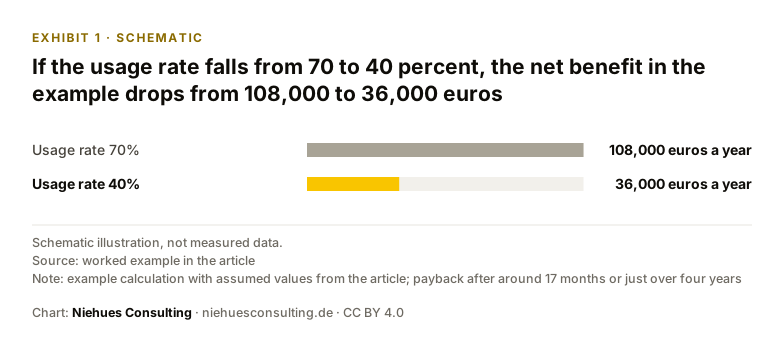
The usage rate decides the calculation. If it falls to 40 percent in the example, the net benefit drops to 36,000 euros and the payback period extends to just over four years. For this reason rollout belongs in the business case rather than in a later project stage. The full structure is described in AI business case: benefits and costs.
Exhibit 1 · Schematic
If the usage rate falls from 70 to 40 percent, the net benefit in the example drops from 108,000 to 36,000 euros
Source: worked example in the article
Note: example calculation with assumed values from the article; payback after around 17 months or just over four years
Two planning figures apply to timelines. An assistant on a standard license, with a policy and training, can be in broad use within a few weeks. An integrated use case with company data needs three to six months from clarification to handover. The prerequisite is that data and interfaces are available. Every additional business unit and every additional system to connect extends this frame.
How does the prototype reach operations?
The prototype reaches operations when the handover is planned as a phase in its own right, with a budget and fixed roles. This phase covers hardening and integration as well as operational ownership. Quality assurance and the adjustment of processes in the business unit complete it.
Hardening turns a prototype into a robust application: controlled access rights and interfaces to the business systems. Logging and monitoring are added, together with a support route with a named contact. How this transition is structured is described in AI solution delivery from prototype to product. Ongoing operation of applications built on large language models, with prompt versioning, evaluation of responses and cost monitoring, is covered in LLMOps: running AI applications.
Quality assurance starts before the build. The business unit defines what a good answer looks like and provides a collection of real test cases. Every change is tested against this collection. The methods are described in Ensuring AI output quality, including how to deal with fabricated statements from models.
Language models open new attack surfaces. Instructions planted in documents, emails or web pages can push an application into unwanted actions as soon as it has access to tools and data. The more rights an application receives, the stricter the checks and approvals must be. The safeguards are described in Prompt injection and AI security.
Regulation and co-determination belong at the start
Legal questions accelerate an implementation when they are settled before the build, and block it when they surface just before rollout. Four topics belong on the list of every project.
The European AI Act classifies AI systems by risk and requires companies that deploy AI to ensure sufficient AI literacy among their staff. What this obligation demands in practice is covered in AI literacy under Article 4 of the AI Act.
The General Data Protection Regulation applies to every processing of personal data, including by language models. The legal basis and data processing agreements need to be settled, and for higher risks a data protection impact assessment as well. The details, including providers based in the United States, are covered in GDPR-compliant use of language models.
Where a works council exists in Germany, it has co-determination rights over technical systems that can monitor the behavior or performance of employees. AI applications frequently meet this criterion. Early involvement shortens the consultation, and a framework agreement makes later applications easier. Both are described in Works council and AI introduction.
Finally, information security requires rules on which data may go into which tools. A clear policy for employees and a classification of data create certainty here without slowing down usage.
How to win over your workforce for AI
You win over the workforce when managers lead by example, users are trained on their own processes and the benefit becomes visible to each individual. That lack of knowledge is the most frequently cited barrier in the official survey shows where the lever lies.
Enablement works when it happens on real cases. A general introduction to language models creates basic understanding. Usage only follows when employees experience how they complete their own task faster or better. Building skills across roles and levels is described in Building AI skills in the organization. Managers need a program of their own, because they select use cases and assess results.
Concerns about jobs and monitoring belong openly on the table. Workforces accept AI more readily when they know which tasks will change, what happens with the time saved and which data about their work is generated. How to measure and build acceptance is described in Employee acceptance of AI. The path from prototype to daily use is set out in Change management for AI adoption.
Field research adds a further argument for communication: the largest productivity gains occurred among less experienced staff. AI shortens onboarding and makes experience-based knowledge more widely available. This message reaches teams better than abstract efficiency targets.
From the first use case to a portfolio
After the first successful use case, governance determines the pace: a portfolio with a clear sequence and shared building blocks, steered through fixed decision dates, brings the next cases into operation faster than a collection of individual projects.
Three elements accelerate scaling. Reusable building blocks lower the effort for every further case, for example data access and prompt templates as well as test collections and operating processes. A fixed body with decision rights stops, transfers or expands projects instead of letting them drift. And a small number of shared metrics, including usage rate and process impact as well as cost per case, makes progress comparable for executive management. The route there is described in From pilot to scale.
Executive-level steering, from governance and budget to the organization of the AI team, is covered in the article AI management: what executive leadership must steer.
Niehues Consulting as your partner for implementation
Niehues Consulting supports AI implementations from the first use case through to day-to-day operations and works according to the Niehues Delivery Model with the phases Understand, Build and Implement. Each phase closes with fixed review questions before the next one begins.
In the Understand phase, business analysis and requirements are produced along with the business case, from which the selection and sequence of applications follow. In the Build phase, prototypes are created that must answer one review question: does the prototype prove the benefit in the real process with real data? In the Implement phase, the solution is handed over to operations with internal or external teams. Processes and responsibilities are adjusted, and the users are enabled. Two further review questions apply here: who owns operations from day one? And which metric shows after 90 days that the solution is being adopted?
Founder Marin Niehues is a management consultant who works from the delivery perspective. He builds organizations that deliver and brings AI into operations, as delivery manager, project manager or product owner. His projects range from VC-funded scale-ups to DAX 40 corporations, with assignments in 20+ countries on six continents and a home base in the DACH region. The starting point is a free 30-minute initial consultation, in which you and Marin Niehues assess your starting position and your first use case.
Frequently asked questions
How do you implement AI in a company?
You implement AI by starting with a frequent, easily verifiable use case and fixing the metric and ownership for outcome and operations before the build. This is followed by a prototype in the real process, the handover to operations and user enablement. Every further use case reuses the building blocks of the first.
How long does an AI implementation take?
An assistant on a standard license can be in broad use within a few weeks, while an integrated use case with company data needs three to six months to reach operations. The prerequisite is that data and interfaces are available. Every additional business unit and system extends the timeline.
How much does it cost to implement AI in a business?
The cost arises in five blocks, from clarification through to user enablement. According to the German consultancy association, external consulting is billed at daily rates of between 750 and 2,700 euros, depending on seniority. Whether the investment pays off is shown by a business case that includes the usage rate.
What does a company need before introducing AI?
For the first use case it needs accessible data of sufficient quality, reachable systems, an accountable manager in the business unit and a function responsible for operations. Clear rules on data protection and information security complete the list. A company-wide cleansed data estate is not a prerequisite.
Who should own AI implementation in a company?
The outcome of each use case is owned by a manager in the business unit, technical operations by a named function in IT or a platform team. Executive management steers the portfolio and decides on sequence and budget. Where several projects run in parallel, a small central team coordinates standards and shared building blocks.
Does the works council have to be involved in introducing AI?
In Germany, the works council has co-determination rights over AI applications that can monitor the behavior or performance of employees. Involving it before the build shortens the consultation considerably. A framework agreement makes introducing further applications easier.
Why do so many AI projects fail?
AI projects mostly fail because of organizational gaps: nobody owns operations, the benefit was never measured in the real process, and there is no budget for rollout and enablement. The technology is rarely the bottleneck. Settling these points before the pilot starts closes the most common break points.
Should we start with Copilot or with our own AI application?
Companies that want to build broad baseline skills start with an assistant on a standard license, while those that want to measurably improve a specific process start with their own application. The two routes can run side by side. For the investment decision, what counts is whether the benefit can be attributed to a process.
Let’s talk about your initiative.
In 30 minutes we clarify where your organization stands and which step will pay off most now.
Request a consultation30 minutes · free · no obligation