Winning Employee Acceptance of AI

Acceptance emerges when employees see in their own workflow that an AI application improves their work, and when responsibilities and ground rules are clear. Many companies treat acceptance as a communications task and plan announcements and training sessions. It is more effective to treat acceptance as a delivery outcome, produced by how the workflow is designed before the application goes live. This article sets out five decisions for senior management and divisional heads. This article provides an overview and does not constitute legal advice.
What does employee acceptance of AI mean?
Employee acceptance of AI means that staff use an application regularly, take its checked results into their own work and recommend it to colleagues. We therefore distinguish three stages of acceptance, and each stage requires a different response from the organization:
- Use: employees try the application and come back to it.
- Reliance: they take results into their work because they can judge their quality.
- Recommendation: they show colleagues how they use the application.
Many programs measure only the first stage, for example through log-ins, and therefore cannot see whether the work is changing. A license that is opened once a month mainly generates cost. For senior management the second stage is therefore decisive, because reliance shows in a work step running differently from before.
Technology acceptance research supports this view. For decades it has named perceived usefulness and perceived ease of use as the central drivers of use. Later models add the influence of the social environment and the supporting conditions an organization provides. All of these factors can be shaped by design.
The workforce is often ahead of the company
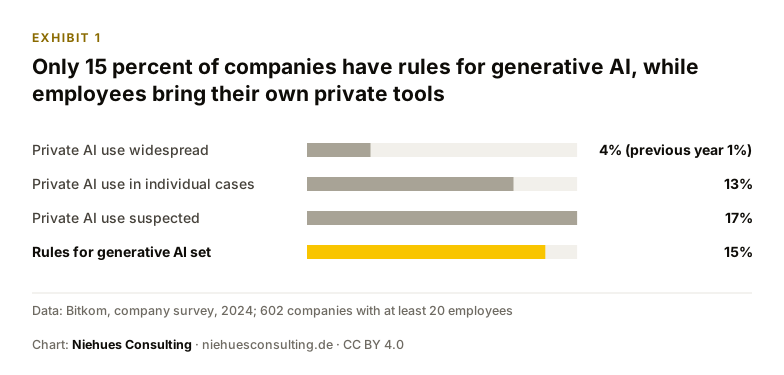
Acceptance in many workforces is further along than senior management assumes. According to a representative survey by the German digital industry association of 602 companies with at least 20 employees, the use of private AI tools at work is widespread in 4 percent of companies, up from 1 percent a year earlier. In a further 13 percent it occurs in individual cases, and another 17 percent suspect it. At the same time, only 15 percent of the companies surveyed have set rules for the use of generative AI.
This has two consequences for adoption. First, curiosity is rarely lacking; an approved tool and rules are missing more often. Second, without an offer, uncontrolled use emerges with risks for data and quality. An introduction that wins existing users as multipliers therefore starts with a head start.
Exhibit 1
Only 15 percent of companies have rules for generative AI, while employees bring their own private tools
Data and download
Why are employees afraid of AI?
Employees fear AI when it remains unclear what will happen to their tasks, what freed-up time will be used for and who answers for the application's errors. The causes of missing acceptance fall into four groups.
First, the benefit at task level is missing. “Increase productivity” as a corporate goal does not tell a case handler which of her cases the application will shorten tomorrow. Second, the worry about one's own job remains unanswered, and a workforce fills open questions itself, usually with the least favorable assumption. Which tasks actually change is set out in AI and jobs. Third, rules are missing: which data may go into the application, who checks the results, who is accountable for errors in the workflow? Fourth, the application does not fit the workflow. An assistant that needs its own window next to the business systems competes with employees' routines.
What do managers contribute to acceptance?
Managers decide acceptance through their own use of the application, through the time they give the team to try it out and through clear statements about the future of tasks. If a divisional head does not use the application, the team reads this as a signal that the rollout is a box-ticking exercise.
In concrete terms, four tasks belong to the management role in an AI rollout. The manager uses the application visibly in their own work. They give the team fixed time in the first weeks to practice on real cases. They discuss results and errors openly in the team, so that reliance rests on checked experience. And they answer the question of how tasks and roles will change before it is asked. How this fits with the wider change program is described in change management for AI introductions.
Five decisions for an adoption that sticks
The model follows the logic Understand, Build, Introduce. Five decisions rest with senior management and divisional heads. The overall course of an introduction is described in the article From pilot to scale.
The first decision concerns the work step. The starting point is a single work step with an owner and a metric, such as pre-checking incoming documents. Selection follows the frequency and value of the step. An application for every task remains without a recognizable purpose for the individual employee.
The second decision concerns the role of the business unit. The prototype is built together with those who will use it, in the real workflow. Employees then test outputs on their own cases, and this test convinces more than any presentation. The business unit names users who help shape the prototype and later act as points of contact in the team.
The third decision sets responsibilities and rules. Before go-live it is written down who is responsible for the application from a business perspective, who checks outputs, which data are permitted and where questions and error reports go. A one-page rule is enough if it is concrete.
The fourth decision concerns enablement. It takes place at the work step, with cases from participants' daily work. The EU AI Act requires companies that deploy AI systems to ensure a sufficient level of AI literacy among their staff.
The fifth decision concerns impact. Measurement takes place at team and case level:
- Share of cases processed through the application
- Lead time of the work step
- Quality of outputs after review
Team-level metrics build trust because they do not assess individuals, and they simplify alignment with employee representatives.
Clarifying co-determination and job questions early
In Germany, where a works council exists, it belongs in the planning before the prototype is built. The Works Constitution Act requires it to be informed as early as the planning of technical facilities, and systems that can evaluate performance or behavior are subject to co-determination. Topics for discussion are the purpose of the application, the data used and the planned evaluations. Clarifying these points early shortens later negotiations and avoids a standstill shortly before go-live.
A second question belongs in the same phase: what will freed-up time be used for? A clear answer from senior management removes the ground from job worries and gives teams a reason to test the application seriously.
Niehues Consulting as a partner for the rollout
Niehues Consulting takes responsibility for rollouts from a delivery perspective. Founder Marin Niehues builds organizations that deliver and brings AI into operations. The approach follows the Niehues Delivery Model with the phases Understand, Build and Introduce. For acceptance, three of its screening questions matter most: Who decides, who delivers, who uses? Does the prototype prove the benefit in the real workflow with real data? Are users enabled and processes adapted?
In AI management, the business case and the sequence of applications are clarified. AI prototypes prove the benefit in the real workflow, and maturity is developed until the business units accept the application. Transfer into operations takes place with internal or external teams, and the rollout with clear responsibilities and enablement of users. Delivery management and organization design define roles and decision paths so that the application stays anchored in day-to-day business.
Projects range from VC-funded scale-ups to DAX 40 groups, with work in 20+ countries on six continents. The entry point is a free 30-minute initial consultation, which you can arrange via contact.
Frequently asked questions
How do you get employees on board with AI?
You win employees through the benefit in their own work step. A prototype in the real workflow, developed together with the business unit, has more impact than announcements. Clear rules, managers as visible users and enablement on everyday cases complete the picture.
How do you measure AI acceptance in a company?
Impact metrics are meaningful, such as the share of cases processed through the application and the lead time of the work step. Log-in numbers show only the first stage of acceptance. Measurement takes place at team and case level.
How should companies deal with employees' fear of losing their jobs to AI?
Senior management defines openly before go-live what freed-up time will be used for. Tasks that change are named, and teams help shape the new workflows. Vague reassurance without a plan increases concern.
What role do managers play in AI acceptance?
Managers are a central lever in the team, because their own behavior shows whether the rollout is meant seriously. They use the application visibly, give time to practice and answer the question about the future of tasks early.
When should the works council be involved in an AI rollout?
At the planning stage, before the prototype runs in the real workflow. In Germany, the Works Constitution Act requires the works council to be informed when technical facilities are planned, and systems that can evaluate performance or behavior are subject to co-determination.
Do companies have to train employees in AI?
Yes, in the form of a competence obligation. The EU AI Act requires companies that deploy AI systems to ensure that their staff have a sufficient level of AI literacy. The company decides on the format, and enablement on employees' own work steps is effective.
How many employees already use AI without approval?
In 4 percent of German companies with at least 20 employees, the use of private AI tools is widespread, and in a further 13 percent it occurs in individual cases. Another 17 percent suspect it. An approved tool with clear rules brings this use into a controlled framework.
What should you do if employees reject AI?
First clarify the cause: missing benefit in their own workflow, worry about their job, missing rules or an application that does not fit the workflow. Each cause has its own answer, and none of them is more communication. Involving skeptics in testing the prototype often yields the most precise feedback.
How long does it take for a team to adopt an AI application?
For one application in one business unit, plan for eight to twelve weeks from the first user group to stable use. Further teams follow faster because rules and multipliers are then already in place.
Let’s talk about your initiative.
In 30 minutes we clarify where your organization stands and which step will pay off most now.
Request a consultation30 minutes · free · no obligation