LLMOps: Running AI Applications in the Enterprise

LLMOps is the managed operation of AI applications built on large language models, from quality measurement to model migration. For the executive team, LLMOps is a question of delivery: the prototype shows that an application is possible, and only operations decide whether it creates value reliably every day.
What is LLMOps in simple terms?
LLMOps covers everything that happens after a language-model application has been built, so that in month twelve it still delivers the value the business case promised in month one. The abbreviation stands for Large Language Model Operations. The term derives from MLOps and applies its core idea to applications that understand and generate text: development and operations form one continuous process.
A language-model application behaves differently from conventional software. The same input can lead to different outputs. Providers replace model versions at short intervals and retire older ones after an announced notice period, so every application regularly moves to a new model. The quality of an answer can also be checked automatically only to a limited extent, because many tasks have more than one correct wording.
LLMOps defines how a company deals with these characteristics.
How LLMOps differs from MLOps and AIOps
The three terms describe related but separate disciplines. MLOps operates models trained on a company's own data, such as forecasts for sales or maintenance. LLMOps operates applications on large pre-trained language models that become a solution through instructions and connected company knowledge, supplemented by fine-tuning where needed. AIOps describes the reverse case: IT operations use artificial intelligence to monitor their own systems, for example to group incident alerts and detect outages early.
A company with established MLOps uses its version control and monitoring as a foundation and adds the review of text output.
The five tasks of ongoing operations
An operating model for AI applications assigns five tasks, each to one accountable owner:
- Deployment: The application runs in a defined environment with version control for instructions and model, so that every change is traceable and reversible.
- Monitoring: Availability and response time are measured continuously. Spot checks review the quality of the content.
- Evaluation: A fixed set of representative test cases shows before every change whether quality is maintained.
- Cost control: Consumption per application and per business unit is visible and set against the benefit.
- Further development: User feedback flows into a prioritized backlog that is worked through in fixed cycles.
How these tasks are divided is an organizational decision for the executive team. Without a clear assignment, every task stays with the project team, which moves on to the next initiative after launch. The article Delivering AI solutions describes this transition, and the article From pilot to scale covers the full path from idea to regular operation.
How do you monitor a language model in production?
A language model is monitored on three levels, each with its own indicators, and only their combination shows whether an application is healthy.
The technical level measures availability and response time as well as error rates and the provider's rate limits. It can be integrated into existing operations tooling.
The content level is what is new. Observability here means that every request is stored as a traceable record, from the input via the instruction and retrieved documents to the model version and the answer. The business unit assesses samples from these traces, and automated checks flag anomalies such as empty answers or missing source references. The open standard OpenTelemetry has defined dedicated conventions for generative AI, so such traces can be captured independently of any vendor.
The economic level shows consumption and cost per case. Meaningful indicators are those the business unit understands itself:
- The share of answers that users adopt unchanged.
- The processing time per case compared with the situation before introduction.
- The share of cases handed over to a person.
Three categories of tooling have become established: open platforms for traces and evaluation such as Langfuse, platforms from the MLOps world with extensions for language models such as MLflow, and the operations features of the major cloud providers. The selection follows the operating model. First it is settled who owns which task, then the company decides which tool supports it.
Managing quality and cost in operation
Quality becomes measurable once it is defined in advance. The business unit defines a set of typical requests with the expected answers. Every change to instructions or model runs against this test set before it goes live. If quality falls below the agreed threshold, the change stays out. The procedure transfers regression testing from conventional software to language models: instead of fixed results, it checks hit rates against thresholds across repeated runs and so makes any deterioration visible before it reaches production.
Costs follow their own logic. Language models are usually billed by consumption, so expenditure grows with usage. That is desirable when the benefit grows with it, and it requires control when it does not. Proven practice is a consumption budget per application, a monthly review of cost per case and a rule on which model is used for which task. The article Controlling AI costs covers the cost side in depth.
What happens when the provider retires a model?
Once a provider retires a model, the application stops answering requests after the cut-off date unless it has moved to a successor model beforehand. The major providers announce such retirements in advance and name successors.
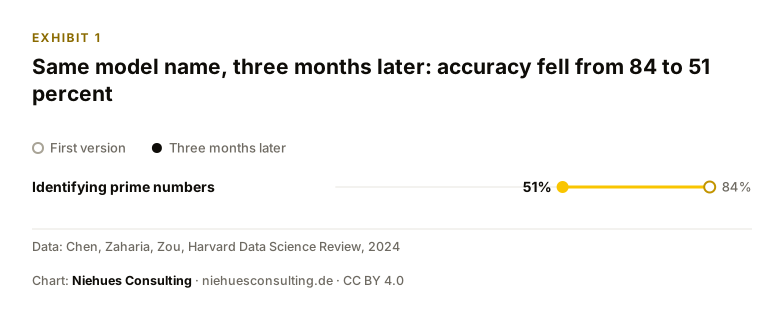
The move is more than swapping a model name. A new model responds differently to the same instructions and follows requirements with varying strictness. A study by Stanford University and UC Berkeley compared two versions of the same widely used model three months apart: on the task of identifying prime numbers, accuracy fell from 84 to 51 percent, and adherence to formatting instructions declined markedly. For operations this means every model change is a change that has to pass the test set.
Exhibit 1
Same model name, three months later: accuracy fell from 84 to 51 percent
An orderly model migration follows four steps:
- Observe: The operations team tracks the retirement notices of the providers in use and pins the model version for each application. Aliases that automatically point to the newest model stay out of regular operation.
- Test: The successor model runs against the full test set. Deviations are sorted by severity.
- Adapt: Instructions and output formats are adjusted until the test set reaches its thresholds.
- Switch: The change happens gradually, first for a share of requests, with the old version as fallback until retirement.
A company with several applications keeps a calendar of all models in use with their retirement dates.
Responsibilities: who owns operations
The more frequent gap in operations lies in accountability. The answer is missing to the question of who decides when quality declines. A division into three roles has proven effective. The business owner, usually titled product owner, owns the application, defines the quality criteria and prioritizes changes. The operations team provides and monitors the platform, including version management. The head of the business area sets the budget and decides on expansion or shutdown.
The documented handover from the development team, with an operating manual and the test set, is the most frequent point of failure: the development team knows the application, while the operations team is only learning it.
Escalation also needs to be settled. If the application demonstrably produces wrong results, the operations team needs the authority to restrict or switch it off without first asking the executive team. This rule belongs in the operating model before launch.
Checklist before moving into regular operation
An application is ready for regular operation when the executive team can answer yes to each of the following questions:
- Is a business owner named who decides on changes?
- Is there a test set with at least several dozen typical requests and agreed thresholds?
- Is every request stored as a trace including the model version?
- Is there a consumption budget with a rule for what happens when it is exceeded?
- Is the model version pinned and the retirement date in the calendar?
- Does the operations team have the authority to restrict the application in case of errors?
- Is the handover with operating manual and briefing complete?
With more than two open points, the application remains in supervised pilot operation.
Niehues Consulting as partner for the move into operations
Niehues Consulting supports companies at the point where LLMOps is decided: between the prototype and regular operation. Marin Niehues works as a management consultant from a delivery perspective. He builds organizations that deliver and brings AI into operations, in projects ranging from VC-funded scale-ups to DAX 40 corporations, with assignments in 20+ countries across six continents.
The approach follows the Niehues Delivery Model with the phases Understand, Build and Implement. For operations, three of its review questions matter most. Does the prototype prove the benefit in the real workflow with real data? Who owns operations from day one? Which indicator shows after 90 days that the solution is being adopted? Operating model and roles are thus settled, as are test set and indicators along with the path for model migration, before the application is handed to the business units.
The free 30-minute initial consultation clarifies where your applications stand today: Book an initial consultation.
Frequently asked questions
What is LLMOps in simple terms?
LLMOps is the managed operation of applications based on large language models. It includes deployment, monitoring, quality testing and cost control as well as the move to new models.
What is the difference between LLMOps and MLOps?
MLOps operates models trained on a company's own data, while LLMOps operates applications on pre-trained language models. The emphasis shifts from training to designing instructions, connecting company knowledge and testing freely worded answers. Managing the model versions of external providers is added.
What is the difference between LLMOps and AIOps?
LLMOps operates AI applications, whereas AIOps uses AI to improve IT operations. In AIOps, machine-learning methods analyze logs and incident alerts to detect outages early. The two disciplines complement each other and solve different problems.
How do you monitor an LLM in production?
A language model is monitored on three levels, each with its own indicators. Technically, availability and response time count; on the content side, stored traces of every request with samples assessed by the business unit; economically, the cost per case. An alert is triggered as soon as an indicator leaves its agreed threshold.
What happens when a provider deprecates a model?
After the retirement date, the old model no longer answers requests, so the application must move beforehand. The major providers announce retirements in advance. The move is predictable when the successor model passes the test set and is introduced gradually.
When does a company need LLMOps?
A company needs LLMOps as soon as employees or customers use a language-model application regularly. From then on every operational task needs an owner. A pilot with a few users manages with simple means, whereas regular operation requires an operating model.
Which tools are used for LLMOps?
LLMOps uses tools for traces and evaluation, for version control of instructions and for analyzing consumption. Common choices are open platforms such as Langfuse, MLOps platforms with language-model extensions such as MLflow, and the operations features of the major cloud providers. The selection follows the operating model.
What drives the operating costs of an AI application?
Operating costs are driven mainly by the number of requests and the choice of model per task. The operations team and further development add to them.
Let’s talk about your initiative.
In 30 minutes we clarify where your organization stands and which step will pay off most now.
Request a consultation30 minutes · free · no obligation