AI Business Case: Calculating Benefits and Costs Reliably

A reliable AI business case quantifies benefits through an impact chain that ends in a cost center, calculates all costs over at least three years and states every assumption with a review date. These properties separate a decision paper from a presentation designed to collect approval. For executive and divisional leadership this yields a clear standard: every figure in the business case needs an owner and a date on which it is measured. This article sets out the calculation logic, a worked example in three scenarios and a structure you can use as a template.
Where AI business cases typically break
Three construction errors recur in business cases for AI initiatives. The first concerns the benefit. A time saving of ten minutes per case is multiplied by the number of cases and valued at an hourly rate, and the result appears as a saving. Whether the time gained is actually released remains open in the model. The amount is then a theoretical potential that never appears in any cost center.
The second error lies on the cost side. Licenses or development are counted, while data preparation and operations are missing, as are quality assurance and user training. The third error sits in the adoption assumption: the business case presumes that all intended users work with the solution from day one and accept its output without rework. The executive team clarifies these three points first, because they decide whether a figure will later stand up to scrutiny from finance.
How do you calculate the benefit of an AI application reliably?
The benefit becomes reliable when it is derived through a four-stage impact chain, from the measured process to the financial effect in a cost center. The chain begins with the effect on a defined process, for example a change in handling time. A capacity effect follows, meaning the time released in that process. The third stage is a management decision on how this capacity is used. Only the fourth stage, the financial effect, can be expressed in euros. How large the process effect can be in real operation is shown by a field study of more than 5,000 customer service agents: an AI assistant raised the number of issues resolved per hour by 14 percent on average and by 34 percent for less experienced agents.
Benefit types differ in how robust they are. Cost reduction in a clearly bounded activity is the easiest to verify, because finance already tracks volumes and unit costs. Revenue effects need a comparison basis, ideally a control group or a staggered roll-out, so that the effect of AI is separated from market movements. Quality and risk benefits are valued through avoided error costs and require a clean baseline measurement.
What costs belong in an AI business case?
An AI business case contains five cost blocks over a horizon of at least three years. This lifecycle view corresponds to the total cost of ownership of the application. The build block covers prototype and development with integration into the system landscape. The data block describes preparation and ongoing maintenance of sources. Operations contain licenses or usage fees as well as infrastructure and maintenance. Quality and risk include evaluation, approval processes and legal and compliance reviews. Adoption covers training and process change until the business units have taken the solution on. A widely cited paper by Google researchers on production machine learning systems shows that the model code makes up only a small part of the overall system, while ongoing maintenance of data pipelines and interfaces causes the greater effort.
Two properties of AI costs deserve a line of their own in the model. First, in many applications they rise with usage, so a calculation as a function of volume is more informative than a fixed amount. Second, models and prices change during the term, which is why the business case needs a fixed review cycle.
What does an AI business case look like as a worked example?
An AI business case calculates three scenarios for one process and shows the annual benefit and the payback period in months for each. The following worked example uses assumed values and demonstrates the method. It considers the triage of incoming customer inquiries with 40,000 cases per year and a fully loaded cost rate of EUR 60 per hour. The build costs EUR 120,000 once, and ongoing operation including licenses and quality assurance costs EUR 50,000 per year.
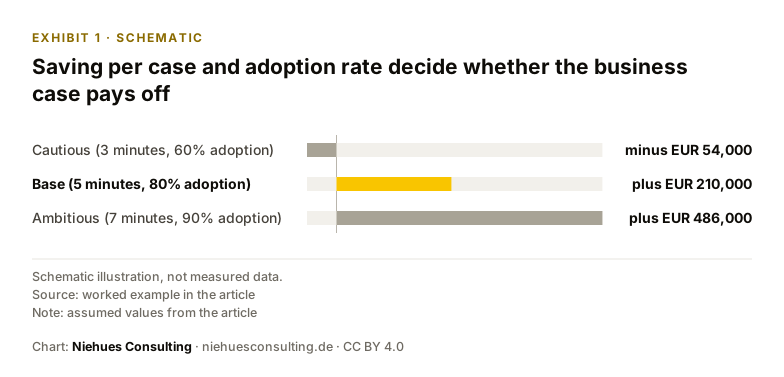
The three scenarios vary the two assumptions that drive the result most strongly: minutes saved per case and adoption rate.
The example shows why the scenarios form the core of the decision. In the base scenario the investment is clearly economic, while in the cautious scenario it does not pay back within three years. The decision is therefore to release the prototype, measure the saving per case and the adoption rate in the real process, and only then fund the build. All three scenarios become financially effective only once management converts the 3,333 released hours into workforce planning or additional throughput.
Exhibit 1 · Schematic
Saving per case and adoption rate decide whether the business case pays off
Source: worked example in the article
Note: assumed values from the article
Interactive tool
AI business case calculator
Enter the volume, time and cost of a process. The calculator shows the annual saving, the running costs and when the investment pays back.
This tool needs JavaScript to make a selection.
Stating assumptions and testing them in the prototype
The result of a business case is determined by a handful of assumptions, in practice five to seven: adoption rate, output quality, handling time after introduction, data availability and duration of the roll-out. These assumptions belong in a separate table that states the value, the owner and the review date for each.
The lever for securing them is the prototype in the real process. It replaces estimates with measured values in exactly the variables on which the business case rests. The calculation thereby matures in three stages: hypothesis before the prototype, validated estimate after the prototype, operational measurement after go-live. Funding release follows these stages, and budget flows only once the preceding assumption is confirmed. Which applications qualify first for this test is covered in the article prioritizing AI use cases.
How do you assess strategic and qualitative benefits?
Strategic and qualitative benefits are assessed with a scoring grid outside the euro calculation and stand as a separate basis for the decision alongside net present value. They include learning curves, data advantage, customer satisfaction, employer attractiveness and the ability to build later applications faster on the same platform. Each criterion receives a weighting, a scale from one to five and an observable measure, for example the number of follow-on applications a data foundation enables.
The clear separation protects the calculation. A business case that converts strategic benefit into euros loses credibility with finance. A business case that omits it systematically undervalues platform initiatives. The executive team therefore decides on two figures: the calculated result and the weighted strategic value.
Template: the structure of an AI business case
A template for an AI business case follows eight sections that you can reproduce in any spreadsheet or decision paper.
How the individual business case feeds into the steering of the entire AI portfolio is shown in the article AI management: what executive leadership must steer.
The business case as part of delivery
A business case fulfills its purpose when the calculation turns into an initiative that lands in operation. That is why at Niehues Consulting the economic assessment belongs to AI management, together with business analysis and requirements, the selection and sequencing of applications and the steering of the AI portfolio. On this basis AI prototypes are built that prove the benefit in the real process, followed by the transfer into operation with internal or external teams.
The approach follows the Niehues Delivery Model with its phases Understand, Build and Introduce. Three of its test questions matter for the business case. Which business outcome is to change measurably? The answer fixes the process and the target variable. What is the baseline, and how do we measure success? Without a baseline, every benefit figure remains a claim. Has the business case been confirmed with real values? Only after this test in the prototype is the build funded. The entry point is a free 30-minute initial consultation, which you can request via contact.
Frequently asked questions
How do you build a business case for an AI project?
The business case starts with a clearly bounded process and its baseline values. The capacity effect and then the financial effect are derived from the measured change. This is set against the cost calculation over at least three years, and the difference is presented in three scenarios.
What is a typical payback period for AI projects?
A clearly bounded AI initiative with high case volume should pay back within 24 months in the base scenario; in the worked example in this article it takes 13 months. As an additional decision rule, the cautious scenario should show no loss within the review period or be tested in the prototype before release. The range narrows with the prototype's measured values.
How reliable are calculations based on time savings?
A time saving becomes a cost saving once management decides how the time is used and implements that decision in workforce planning or throughput. The effect then becomes visible in a cost center. Until then the figure sits in the calculation as potential, separate from proven benefit.
What is the total cost of ownership of an AI application?
Total cost of ownership covers all costs of an AI application over its useful life, meaning build and data maintenance, ongoing operation with licenses as well as quality assurance and adoption. For AI applications a horizon of at least three years is advisable. Usage-based costs are modeled as a function of volume.
How much does an AI project cost for a mid-sized company?
The costs follow from the five cost blocks of the business case and from usage volume. A prototype for a single process costs considerably less than an integrated application connected to several systems.
Is there a template for an AI business case?
A proven template comprises eight sections, from process and objective to the funding stages. The structure in this article can be transferred directly into a spreadsheet. What matters is that every assumption receives an owner and a review date.
How do you calculate the ROI of AI?
ROI is the net benefit relative to total costs over the review period. In the base scenario of the worked example, a result of EUR 210,000 after three years compares with total costs of EUR 270,000, an ROI of around 78 percent. Measurement during operation is covered in a separate article on the ROI of AI projects.
Let’s talk about your initiative.
In 30 minutes we clarify where your organization stands and which step will pay off most now.
Request a consultation30 minutes · free · no obligation