Agentic AI in the Enterprise: Use Cases and Limits
Agentic AI takes over multi-step work on its own and delivers value where process, verifiability and accountability are clearly defined. This article distinguishes agents from assistants and conventional automation, classifies the use cases and describes the limits in technology and organization. It gives executive management a grid for assessing initiatives before they start and putting them in the right order.
Where the article touches on the AI Act and liability: This article provides an overview and does not constitute legal advice.
How does agentic AI differ from an AI assistant?
An AI assistant answers a question and waits for the next instruction, whereas an AI agent receives a goal and works through it in several steps on its own. The agent breaks the goal into subtasks and calls tools and enterprise systems to complete them. It checks interim results and continues until the goal is reached or a handover to a person becomes necessary. For executive management this shifts the guiding question. With an assistant, the question is whether the answer is good. With an agent, it is whether the result of an entire work step reliably arrives in the process. Quality is measured at the end of a workflow. That changes the requirements for testing and for accountability.
Agentic AI compared with RPA and workflow automation
Agentic AI extends robotic process automation (RPA) and workflow automation to cover unstructured cases. The three approaches differ in who determines the path to the result.
- RPA mimics a person's clicks and keystrokes on the user interface and follows hard-coded rules. It works deterministically but fails as soon as a screen changes or an input departs from the pattern.
- Workflow automation connects systems through interfaces along a process modeled in advance. It is robust and traceable as long as the process is fixed.
- An AI agent plans its own path and handles unstructured inputs such as emails, contracts or free text. In return its behavior is less predictable and needs checkpoints.
The recommendation follows from this. Fixed processes with structured data stay with workflow automation or RPA. Deploy the agent where inputs are unstructured or where judgment within clear limits is required.
How many companies use AI?
Just over a quarter of companies in Germany use AI, and more than half of large companies do. Official statistics do not report agents separately, but the overall AI usage rate shows how broad the foundation is on which agents build.
Use does not equal impact. Many agent projects never get beyond pilot status because costs and benefits remain unclear before the start.
Where are AI agents worthwhile?
AI agents are worthwhile for tasks that meet four criteria at the same time. If one is missing, the initiative remains an experiment.
- The process can be described in individual steps.
- The systems involved have interfaces through which an agent can work.
- The result can be checked on completion.
- An error remains correctable before it has an external effect.
Tasks meeting all four criteria can be found in customer service and procurement as well as in finance and software development. In customer service, an agent handles clearly defined standard requests from inquiry to reply. In procurement, an agent matches invoice and purchase order against goods receipt and reports only the discrepancies. In finance, it prepares month-end reconciliations and documents anomalies with a reference to the posting. In software development, it implements clearly scoped changes that a developer then approves.
What these cases have in common is that the agent takes no far-reaching decision on its own. It completes the preparatory work and hands over at defined points. The benefit comes from the processing time saved per item and from the consistent quality of the preparation. Both can be estimated in the business case before the build and proven in the prototype on the real process.
Limits of the technology
The central technical limit is error propagation: in a chain of steps, the success probabilities of the individual steps multiply. A wrong interim result in the third step is treated by the agent as fact in all subsequent steps.
There are also limits in handling context, since an agent works only with the information it can see. In addition, the cost per run grows with the number of steps, which belongs in the business case where item volumes are high.
Agents are weak at tasks with unclear objectives and poorly documented systems, as well as at decisions that require tacit knowledge. Such tasks stay with people or are broken into substeps, of which the agent takes over the controllable ones.
Limits of the organization
In most initiatives the tighter limits lie in the organization. An agent needs a process description, which often does not exist. Before an agent takes over these processes, someone has to make them visible and decide which variant applies.
Then there is accountability. Who owns the agent, who is accountable for its result, who decides on changes to its task? Without a named owner in the business unit, every agent remains an IT project that nobody develops further after go-live. Data also sets limits: an agent that accesses inconsistent master data multiplies the inconsistency at the speed of automation.
Human oversight follows the reach of the decision. For correctable internal preparation, spot checks suffice. Where there is an external effect, such as a commitment to a customer or a payment, a person approves every item until the measured error rate justifies relaxing that rule.
A decision grid for selection
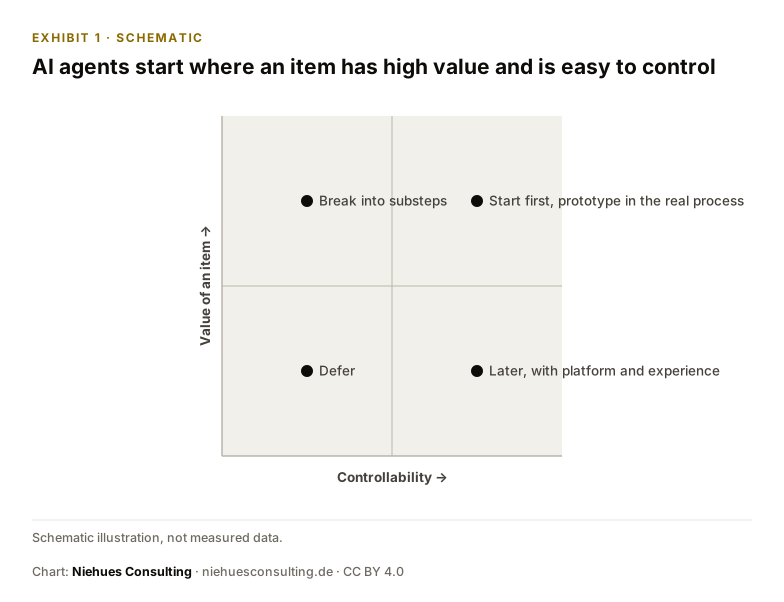
Two axes are enough to sequence use cases: the value of an item and its controllability. Value is measured by item volume and processing time. Controllability results from the verifiability of the result and the quality of the interfaces, as well as the correctability of an error. This produces four quadrants, each with a clear recommendation.
- High value, high controllability: this quadrant starts first, with a prototype in the real process.
- High value, low controllability: the item is broken into substeps, and only the controllable parts go to the agent.
- Low value, high controllability: the item follows later, once platform and experience are in place.
- Low value, low controllability: the item is deferred.
Exhibit 1 · Schematic
AI agents start where an item has high value and is easy to control
Data and download
The first agent in the controllable quadrant creates the monitoring and role models on which every further agent draws. How the introduction fits into the overall AI program is described in the article From pilot to scale.
How much does an AI agent cost?
The cost of an AI agent consists of three blocks: the build, ongoing model usage and operation. The largest one-off items are integration and testing. According to the fee study of the Federal Association of German Management Consultants, external consulting in the German market is billed at around 1,000 to 2,500 euros per consultant day. Running costs grow with the number of items and the number of steps per item, because every step triggers model calls. A simple calculation applies to the economics: items per year times processing time saved times hourly rate, minus running costs and the rework for error cases. How to plan these items in the budget is shown in the article Planning an AI budget.
Which platforms exist for AI agents?
There are two main types of platform for AI agents: agent builders inside existing enterprise applications and open development frameworks. Examples of the first group are Microsoft Copilot Studio and Salesforce Agentforce, which build agents close to the data of the respective application. The choice follows the location of the data: if the item and its data sit mainly in one system, that system's builder is the obvious choice. If the item runs across several systems, an open architecture is the stronger option.
What does the AI Act say about AI agents?
The AI Act has no separate category for agents and classifies AI systems by their intended purpose. An agent that pre-sorts job applications therefore falls under different obligations from one that matches invoices. Transparency obligations also apply where an agent interacts directly with people. Classification therefore belongs in the phase before the build. The article EU AI Act describes the essentials.
From prototype to operation: the role of Niehues Consulting
An agent counts as delivered when the business unit uses it every day and the agreed metric moves. Niehues Consulting works to this standard with the Niehues Delivery Model and its phases understand, build and introduce. The understand phase produces business analysis and requirements, together with a business case covering the selection and sequence of applications.
Three of the model's test questions matter most for agents. When building: does the prototype prove its value in the real process with real data? When introducing: who owns operation from day one? And at the close: which metric shows after 90 days that the agent has taken hold? Marin Niehues steers the work as delivery manager, project manager or product owner. The free 30-minute initial consultation is available to assess a specific use case.
Frequently asked questions
What is agentic AI?
Agentic AI refers to systems that pursue a given goal on their own across several steps. They use a language model for planning and call tools and enterprise systems to carry out subtasks. Unlike an assistant, an agent handles an item from request to result.
What is the difference between agentic AI and RPA?
RPA follows hard-coded rules on the user interface, while an AI agent plans its own path to the goal. RPA suits stable processes with structured data. Agents handle unstructured inputs and need checkpoints to do so.
What are good use cases for AI agents in business?
Good use cases are high-volume items with a describable process and a verifiable result. Typical areas are standard requests in customer service and document matching in procurement. They are joined by reconciliations in finance and clearly scoped changes in software development.
Is agentic AI worth it for my company?
Agentic AI is worth it when an item occurs in high volume and meets all four criteria, from a describable process to correctable errors. The calculation is items per year times time saved times hourly rate, minus running costs. A prototype in the real process supplies the actual values for this calculation.
How much human oversight do AI agents need?
Oversight depends on the reach of the decision. A person spot-checks internal, correctable preparatory work. Items with an external effect are approved individually by a person until the measured error rate justifies relaxing that rule.
What are the risks of AI agents in operation?
The risks lie in error propagation across several steps, in unclear accountability and in the data. Short chains with interim checks limit the technical risk. Named owners in the business unit and clean master data limit the organizational risk.
How long does it take to implement an AI agent?
For a clearly defined item, a prototype in the real process is ready within a few weeks, while the transfer into operation takes longer. The duration is driven mainly by interfaces and access rights, as well as by agreeing roles in the business unit.
Let’s talk about your initiative.
In 30 minutes we clarify where your organization stands and which step will pay off most now.
Request a consultation30 minutes · free · no obligation