AI agents: what they can do and where they stand today

AI agents are software systems that break a goal into steps and operate company systems on their own to reach it. Today they perform reliably in clearly bounded processes with a verifiable result and defined controls. The technology is further along than some reservations suggest, and at the same time less autonomous than product announcements imply. This article places capabilities and maturity in context and sets out criteria for deployment.
The organization decides the outcome. Those who settle responsibilities and checkpoints in advance bring agents into regular operation. How an agent fits into AI implementation as a whole, from prototype to daily use, is described in the article From pilot to scale.
What is the difference between an AI agent and a chatbot?
A chatbot answers a request and waits for the next one, whereas an AI agent receives a goal and decides for itself which steps are needed. It calls tools and reads their results. It then corrects its plan and continues until the goal is reached or a defined limit applies.
Technically, a language model sits at the core. Added to it are access to company systems through interfaces, a memory for the course of a task, and rules that define which actions the agent may take on its own.
For management this yields a clear distinction. A chatbot produces text that a person checks and uses. An agent produces actions: it creates records and sends messages, it books or cancels. The question of text quality thus becomes a question of governance. Anyone assessing agents therefore assesses processes and rights as well.
What can AI agents do today?
AI agents today reliably complete tasks with a clear input and a verifiable result, for which a few tools suffice. Four fields of use have these properties:
- Preparing decisions: the agent compiles information from several sources into a dossier that a person assesses.
- Standardized customer service cases: the agent classifies requests, adds customer data and handles routine cases through to the reply.
- Invoice and document checks: the agent matches invoices against orders and routes deviations to the clerk.
- Software development: automated tests make the success of every step immediately visible.
What all these fields share is that a result can be judged by machine or by a brief visual check. Where this check is missing, so is the basis for giving the agent more independence.
How reliable are AI agents?
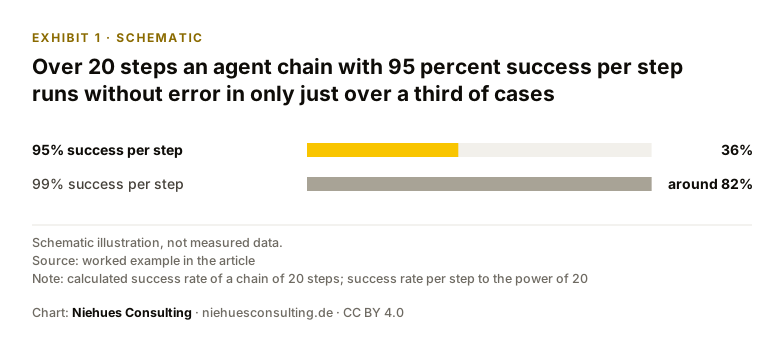
AI agents are largely reliable on short tasks, while their success rate falls markedly as a task grows longer. The reason lies in the mathematics of a chain: the success rates of the individual steps multiply. At 95 percent per step, a chain of 20 steps runs without error in only just over a third of cases. At 99 percent per step, it is around 82 percent.
Exhibit 1 · Schematic
Over 20 steps an agent chain with 95 percent success per step runs without error in only just over a third of cases
Source: worked example in the article
Note: calculated success rate of a chain of 20 steps; success rate per step to the power of 20
A research paper that tested models on tasks with measured human completion times shows both sides. The length of tasks that agents can handle is growing fast. At the same time, the gap between “succeeds half the time” and “succeeds four times out of five” is large. For regular operation, the second figure is what counts. This yields a rule for practice: the shorter and more verifiable the chain, the higher the share of correctly completed cases. Those who deploy agents cut the task into verifiable sections with a checkpoint.
Where the limits of the technology lie
Four limits are relevant for executives because they determine the choice of applications:
- Reliability over long chains: errors from early steps carry over into later ones and are hard to spot in the result.
- Context: the agent knows only what it is given. Knowledge of exceptions and internal arrangements is missing as long as it is not documented.
- Permissions: an agent with far-reaching rights can do far-reaching damage. The principle of least privilege applies to it as to every employee.
- Traceability: without a log of its steps, a result can neither be checked nor improved.
A fifth limit concerns security. Agents read content from emails, documents and web pages. If this content contains hidden instructions, an agent may mistake them for a task. This attack pattern is called prompt injection and ranks first in the OWASP project's risk list for applications built on language models. It cannot be fully prevented with today's means. It can be contained through least privilege, approval before consequential actions, and separating content that is read from instructions that are given. The safeguards in detail are described in AI security: prompt injection and new attack surfaces.
These limits shift with every model generation. The framework that makes them manageable stays the same: a bounded task with bounded rights and a check on the result works with any model.
How much autonomy should an AI agent have?
An AI agent starts with as little autonomy as the damage of an error requires and receives more once measured quality proves it. A model with four levels has proven effective.
The level follows from two axes. High volume with low damage and good verifiability justifies the third or fourth level. High damage with weak verifiability keeps a process at level one or two. Promotion follows measurement: if the error rate stays below the agreed threshold over several hundred cases, the agent moves up a level. How roles and accountability change as autonomy grows is covered in the article on Agentic AI and the organization.
Which platforms are there for AI agents?
Companies today build AI agents on three kinds of platform. The first are agent features in existing enterprise software, for example in systems for customer service, sales or HR. They are available quickly and limited to the data of that system. The second are development platforms of the large cloud providers, which bundle models, tool connections and logging. The third are open software libraries with which a company's own teams design agents freely.
One rule guides the choice. If the process stays within one system, the built-in feature is the fastest route. If the process spans several systems, a cloud platform with clean rights management fits. Libraries pay off where a team is permanently available for operation and further development.
How agents reach operation
A working agent prototype is built quickly, and that disguises the effort involved. The path into operation requires decisions that do not arise in the prototype phase: who is accountable for the result, and who changes the agent when the process changes? For a bounded process with existing interfaces and a named owner, operation is achievable within a few months. If ownership or data access is missing, these gaps determine the duration.
Niehues Consulting supports companies through exactly this transition according to the Niehues Delivery Model with the phases Understand, Build and Implement. Marin Niehues is a management consultant from the delivery perspective: he builds organizations that deliver and brings AI into operations, in projects from VC-funded scale-ups to DAX 40 corporations and on assignments in 20+ countries on six continents. Two test questions from the model matter most for agents. In Build: does the prototype prove the benefit in the live process with real data? An agent that convinces only in a demo has not passed this test. In Implement: who is accountable for operation from day one? Without this answer every agent remains a prototype. Steering of the engagement sits in one place, as delivery management with key figures that reach executive reporting.
Frequently asked questions
What is the difference between an AI agent and a chatbot?
A chatbot answers questions in dialogue, whereas an AI agent pursues a goal over several steps and carries out actions in company systems. It therefore changes data and processes, while a chatbot provides information. That is why an agent needs rules for rights and control.
Where are companies using AI agents in production today?
Agents run in production in processes with a clear input and a verifiable result, such as preparing decisions and handling standardized service requests. Invoice checking and software development also belong here. In every case a person or a key figure checks the result.
How reliable are AI agents today?
AI agents work largely reliably on short, verifiable tasks, while the success rate drops markedly over long chains. Research shows that the task length agents solve with 80 percent success is around five times shorter than at 50 percent. For regular operation, tasks are therefore split into sections with checkpoints.
How much autonomy should an AI agent be given?
An agent starts at the proposal or approval level and is promoted based on measured quality. What matters is the damage an error causes and the verifiability of the result, plus the volume of cases. High damage with weak verifiability keeps the agent on the lower levels.
How long does it take to move an AI agent from prototype to production?
For a bounded process with existing interfaces and a named owner, operation is achievable within a few months. If ownership or data access is missing, these gaps determine the duration. Clarifying both early shortens the path the most.
How much does an AI agent cost?
The cost of an AI agent consists of development and integration, ongoing usage fees for the model, and operation with quality assurance. External support for prototype and implementation is typically billed in the German market at around 1,000 to 2,500 euros per consultant day. How the total budget is built up is shown in planning an AI budget.
Will AI agents replace employees?
AI agents take over individual work steps and today rarely replace entire jobs. Work shifts from processing cases to checking and steering them. New tasks arise in looking after the agents and handling exceptions.
How secure are AI agents?
AI agents are as secure as the rights and controls they work with. The biggest new risk is prompt injection, meaning hidden instructions in content the agent reads. Least privilege and approval before consequential actions contain this risk effectively.
Let’s talk about your initiative.
In 30 minutes we clarify where your organization stands and which step will pay off most now.
Request a consultation30 minutes · free · no obligation