Planning an AI Budget: Orders of Magnitude and Cost Items

You plan an AI budget through eight groups of cost items and three release stages: licenses cost around €20 to €60 per user per month, and a prototype runs to five figures. The exact amount follows from quantities such as the number of users and the transaction volume, and it remains a range until the first prototype. This article sets out the cost items, the orders of magnitude with a worked example and the reserve as a percentage. The yardstick is delivery: a budget is well planned when an application ends up in operation and is used.
Why AI budgets arise differently from IT budgets
Traditional IT initiatives are budgeted as projects with a start and an end, concluding with an acquisition that is depreciated. With AI applications, by contrast, the recurring share grows with every use. Licenses are usually charged per user, model access by consumption or as reserved capacity, and the quality of results has to be checked and readjusted continuously. In addition, processes and responsibilities in the business unit have to be adapted so that the application is actually used.
A prototype causes costs for weeks, operation for years. A budget that covers only the build therefore ends at the point where the benefit could begin. Planning starts with the question of which recurring costs an application triggers in operation and which benefit justifies them. The business case answers this question; the article AI business case: calculating benefits and costs reliably describes it in detail. How the budget fits into the wider governance of AI is set out in the article AI management: what executive leadership must steer.
The cost items of an AI budget
The items can be arranged in eight groups. Each group has its own quantity driver, which determines its order of magnitude:
- Licenses and usage: assistants per user, model access by consumption. The drivers are the number of users and the request volume.
- Platform and infrastructure: model access and hosting, plus the link to identity management. The driver is the number of applications sharing a platform.
- Data: preparation of the sources, plus their connection and upkeep. The drivers are the number and condition of the data sources.
- Development and integration: building the application and embedding it in existing systems. The driver is the complexity of the process the application supports.
- Operation and quality assurance: monitoring the quality of results and adjusting after model changes. The driver is the number of productive applications.
- Introduction and enablement: adapting processes, plus training users. The driver is the number of employees affected.
- Steering: business analysis and business case, plus reporting of portfolio metrics. The driver is the number of applications in the portfolio.
- Reserve: a buffer for assumptions that prove wrong in the prototype.
Licenses and operation continue for as long as the application is used. Platform costs also continue, but they are spread across several applications and therefore fall per application. Development and introduction arise mostly once.
How much does AI cost a company?
For a mid-sized company with assistant licenses for part of the workforce and a first application of its own, AI typically costs a low six-figure sum over three years. The order of magnitude follows from three blocks that can be quantified early.
The first block is licenses. Enterprise licenses for AI assistants are typically billed in the market at around €20 to €60 per user per month, depending on functionality and contract form. The second block is the build of an application of its own, meaning prototype and integration including introduction. The third block is operation, with model costs and quality assurance. A rule of thumb from delivery practice applies here: over the lifetime, introduction and operation cost at least as much as development. How recurring model costs per transaction are calculated and reduced is covered in the article on controlling AI costs.
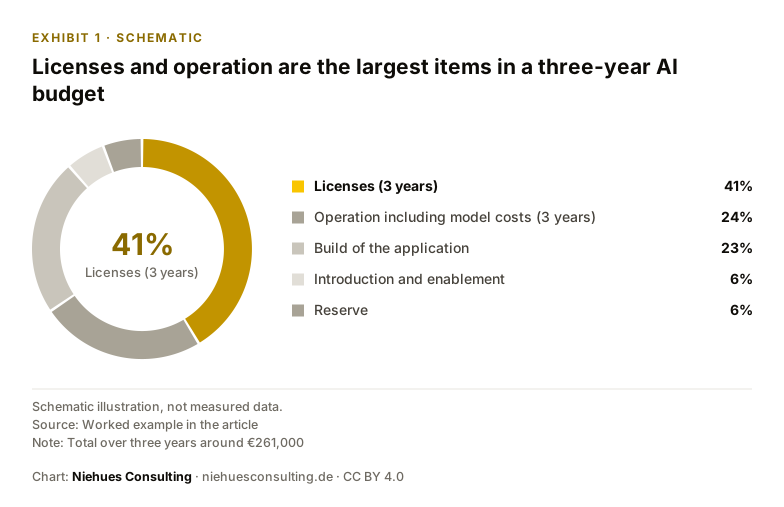
Exhibit 1 · Schematic
Licenses and operation are the largest items in a three-year AI budget
Source: Worked example in the article
Note: Total over three years around €261,000
Data and download
Data as table
| Part | Value | Share |
|---|---|---|
| Licenses (3 years) | 108,000 euros | 41% |
| Operation including model costs (3 years) | 63,000 euros | 24% |
| Build of the application | 60,000 euros | 23% |
| Introduction and enablement | 15,000 euros | 6% |
| Reserve | 15,000 euros | 6% |
Graphic and data: Niehues Consulting, CC BY 4.0. Free to use with attribution and a link.
The assumptions in this example are placeholders. Their purpose is to show the ratio between the blocks: with broad licensing, licenses form the largest single item, and that is precisely where the greatest loss arises when seats go unused.
How much does an AI prototype cost?
An AI prototype for a defined work step typically costs around €20,000 to €100,000 with external support. The range follows from a simple calculation. A prototype that proves the benefit in the real process with real data takes six to ten weeks and, depending on the data situation, 20 to 40 consulting days. External consulting in the German market is typically billed at around €1,000 to €2,500 per consulting day, depending on seniority. This produces the range above, plus model and platform costs for the test phase, which usually stay in the low four figures.
Three characteristics push a prototype towards the upper end. First, data sources that have to be prepared before use. Second, integration into a legacy system without a ready interface. Third, a tolerance for error close to zero, for example in transactions with legal or customer impact. Where none of the three applies, the prototype stays at the lower end.
How large should the reserve in an AI budget be?
Before the first prototype, the budget should carry a reserve of 15 to 25 percent on the one-off items, and around 10 percent after the prototype. The reserve covers assumptions that have not yet been measured, above all about the condition of the data and the integration effort.
The range follows a clear rule. The upper end applies when more than one data source has to be prepared or the application is embedded in a legacy system without an interface. The lower end applies to applications built on data that is already accessible. With each release stage, measured values replace assumptions and the reserve falls. A reserve that is not reduced after the prototype indicates planning without learning.
Planning logic: release in stages
Budget release follows an approach in three stages. In stage one (understand), requirements and the benefit hypothesis are worked out and the business case is calculated. In stage two (build), a prototype proves the benefit in the real process. In stage three (introduce), the application goes into operation, with adapted processes and trained users.
Each stage receives its own budget and a release criterion. Stage one ends with a benefit hypothesis that has a metric and an owner in the business unit. Stage two ends with a benefit measured in the process and acceptance by the business units. Only then is the budget for operation and introduction released.
Responsibility divides along this logic. The business unit is accountable for the benefit and thus for the metric, IT for the platform and its operation. The budget belongs in a portfolio that both sides can see and steer together.
Niehues Consulting as a partner for budget planning
Niehues Consulting supports budget planning for AI as part of AI management. The work begins with business analysis and requirements, followed by the business case, and it determines which applications receive budget in which order. Niehues Consulting then steers the AI portfolio with metrics, so that every release rests on measured values.
The approach follows the Niehues Delivery Model with its phases of understand, build and introduce. Three of its review questions matter most for the budget: What is the baseline, and how do we measure success? Does the prototype prove the benefit in the real process with real data? Is the business case confirmed with real values? Only when the third question is answered with yes does the budget for operation flow.
Marin Niehues works from the delivery perspective. He builds organizations that deliver and brings AI into operation. His projects range from VC-funded scale-ups to DAX 40 corporations, and his assignments span 20+ countries on six continents. The entry point is a free initial consultation of 30 minutes, in which the quantity framework and the stage plan for your first applications are outlined: arrange an initial consultation.
Frequently asked questions
How do you plan an AI budget?
An AI budget is planned per application through eight groups of cost items, each with a quantity driver, calculated over three years. This produces a cost range. The budget is then released in three stages: requirements with business case, a prototype in the real process, and introduction with operation.
What costs arise in AI projects?
AI projects incur one-off costs for development and introduction as well as recurring costs for licenses and operation. Added to these is the effort for data preparation and for steering the portfolio. The recurring share is often underestimated because a prototype does not yet show it.
How large should an AI budget be?
An AI budget should be large enough to cover the build of the planned applications and at least three years of their operation. For a mid-sized company with assistant licenses and a first application of its own, this typically amounts to a low six-figure sum over three years. A budget for the prototype alone funds only half of the initiative.
When is a reserve in the AI budget sensible?
A reserve is always sensible as long as assumptions have not yet been measured. Before the first prototype it amounts to 15 to 25 percent of the one-off items, and around 10 percent afterwards. It falls from stage to stage because measured values from the process replace the assumptions.
How much does Microsoft Copilot cost per user?
Microsoft 365 Copilot is billed as an add-on license per user per month and sits within the market range of around €20 to €60 for enterprise licenses of AI assistants. The matching Microsoft 365 base license comes on top. For the budget, the share of actively used seats matters as much as the price.
How much does AI consulting cost?
External AI consulting in the German market is typically billed at around €1,000 to €2,500 per consulting day, depending on seniority. A prototype with 20 to 40 consulting days therefore runs to five figures.
When does an AI investment pay for itself?
An AI investment pays for itself as soon as the measured benefit in the process exceeds the cumulative costs of build and operation. The usage rate is decisive, because the benefit only counts for the transactions actually processed with the application. The business case sets out the calculation.
Let’s talk about your initiative.
In 30 minutes we clarify where your organization stands and which step will pay off most now.
Request a consultation30 minutes · free · no obligation