Schaeffler Job Cuts: Fewer Layers Only Work With Delegation

Schaeffler is cutting a net 3,460 positions in Europe (about 2,660 of them in Germany) and attributes the restructuring partly to too many management levels and too little delegation of leadership responsibility. For executive teams this pairing is the instructive part of the November 3, 2026 announcement, because removing a layer only speeds up an organization once its decisions move down. Schaeffler is also introducing a temporary pay contribution across all hierarchical levels to keep the cuts smaller. In a calculation with disclosed assumptions for a company with 1,000 employees, a 2 percent contribution reduces the necessary cuts from 50 to 31 positions.
Schaeffler is cutting 3,460 positions and names too many management levels as one reason
According to its press release distributed via EQS, Schaeffler announced a further performance improvement program on November 3, 2026. It follows the restructuring announced in November 2024 and 1,800 partial retirement agreements the company concluded in early October 2026. The new program aims to reduce overcapacity, adjust development capacity, lower personnel costs and reduce organizational complexity.
Part of the reasoning concerns the market. Schaeffler points to weak demand for combustion engine vehicles and the delayed ramp-up of electric mobility. The other part concerns its own organization. The release cites above-average costs per employee in Germany and “the high complexity of the organization, with too many management levels and overly limited delegation of leadership responsibilities.” CEO Klaus Rosenfeld says the company intends “to further streamline the organization and reduce hierarchical levels.”
A net 3,460 positions will go at 16 locations in Europe. Five sites are to close, four of them in Germany: the Dortmund plant with 430 employees, Morbach with 160, Berlin with about 270 and Schwalbach, where a large portion of the roughly 385 employees is expected to transfer to Frankfurt. Herstal in Belgium, with about 15 employees, will also close. Most of the measures are scheduled for 2027 and 2028.
Half of the cuts fall on production and almost a third on R&D
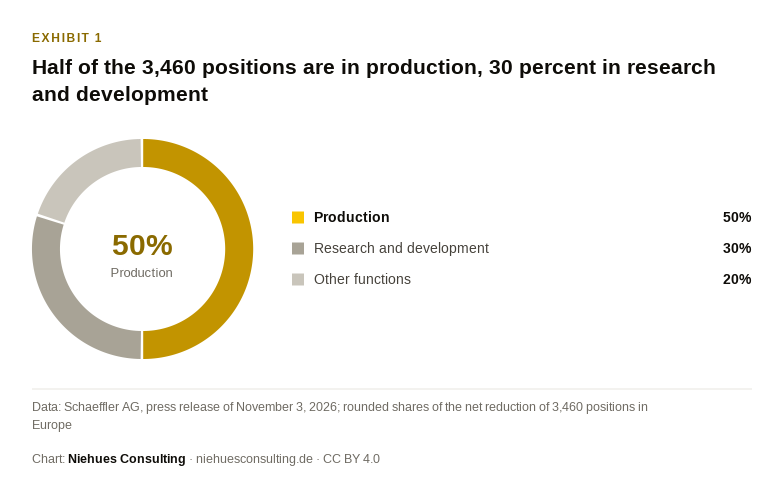
According to Schaeffler, about 50 percent of the positions affected are in production, 30 percent in research and development and 20 percent in other functions. By our own calculation that is about 1,730 positions in production, 1,040 in R&D and 690 elsewhere.
Exhibit 1
Half of the 3,460 positions are in production, 30 percent in research and development
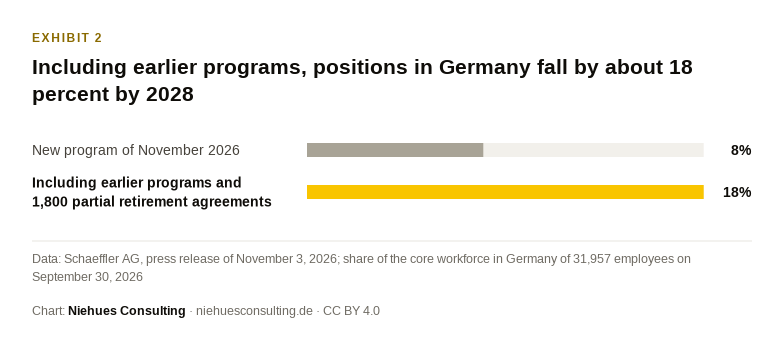
For Germany, Schaeffler relates the cuts to its core workforce. The 2,660 positions equal about 8 percent of the 31,957 employees on September 30, 2026, to be reduced by 2028. Including cuts from earlier programs and the 1,800 partial retirement agreements, the share rises to about 18 percent. Across all programs, almost one in five positions at Schaeffler in Germany will go.
Exhibit 2
Including earlier programs, positions in Germany fall by about 18 percent by 2028
Spreading all one-time expenses across the positions, each position cut costs about €139,000 once and saves about €87,000 a year from 2030, by our own calculation. The total also covers the cost of site closures. The one-time expenses therefore equal a little over a year and a half of the later savings. What a reorganization costs beyond severance is covered in Estimating the cost of a reorganization.
Fewer management levels only speed things up when decision rights move down
A removed layer makes an organization faster when its decisions pass to the layer below. If they stay at the top, the same approvals land with fewer managers who run larger areas. Waiting time then grows even though the organization has become flatter. Schaeffler names both causes in one sentence: too many layers and too little delegation. The company therefore has to change both at once.
There is a simple test for delegation. The executive team lists, for each layer, the decisions that are only made there, such as approvals of investments, prices, hires or technical changes. A layer with no decision of its own only passes cases on. Any decision made at one layer although the expertise sits a layer lower is a candidate for delegation. How decision rights can be assigned is covered in Clarifying decision rights.
On September 30, 2026 BMW announced that it would reduce divisions and management functions by 20 percent. BMW Trims Management: Speed Comes from Structure describes what that means for layers and spans. Schaeffler goes one step further by naming the lack of delegation explicitly as a cause.
A temporary pay contribution reduces cuts as long as the overcapacity is temporary
Schaeffler is supplementing the job cuts with a solidarity contribution. Among other measures, it is to include a temporary, voluntary compensation reduction that starts with the Board of Managing Directors and extends across all hierarchical levels. The contribution aims to lower costs per employee and thereby reduce the necessary job cuts and the associated one-time expenses. It is expected to relieve the income statement in 2027 and 2028. “Without the solidarity contribution, the job cuts would have been even more extensive,” the release states. Rosenfeld calls it the most important element of the program.
The details are still open. According to the German HR magazine Personalwirtschaft, a Schaeffler spokesperson said the board will forgo 10 percent of its pay for the next two years, with managers contributing somewhat less. On November 4 the company said the contributions of management, non-tariff and tariff employees were still being defined and negotiated. The group works council and the IG Metall union first want a robust industrial plan for the future, the same report says. Only then can job cuts or other measures be discussed at all, according to Thomas Höhn, IG Metall's representative for Schaeffler.
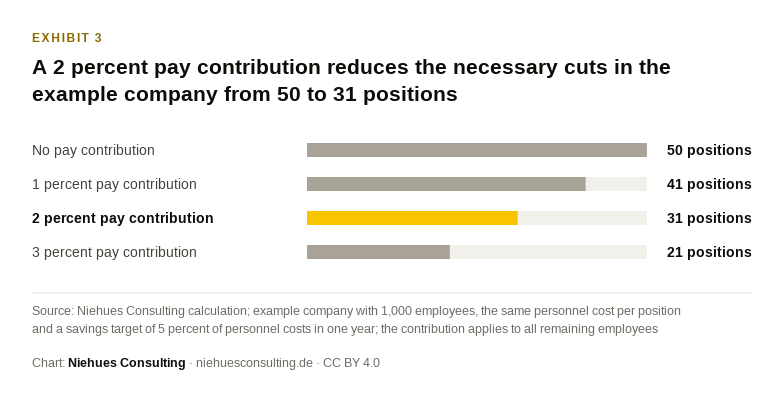
A calculation for an example company shows how much such a contribution reduces the cuts. The company has 1,000 employees with the same personnel cost per position and has to cut personnel costs by 5 percent in one year. Without a contribution, 50 positions go. A contribution applies to everyone who stays. The number of positions is 1,000 times the savings target minus the contribution, divided by 1 minus the contribution, rounded up.
Exhibit 3
A 2 percent pay contribution reduces the necessary cuts in the example company from 50 to 31 positions
In the example, each percentage point of contribution saves about ten positions. The calculation holds for the years in which the contribution runs. Once it ends, the costs return. A temporary contribution therefore suits overcapacity that will find work again in the foreseeable future, for instance through new orders or through employees moving into a growing business. For overcapacity that stays, it only postpones the cuts. That is why Schaeffler combines both: permanent structural measures and a contribution for 2027 and 2028.
Humanoid robotics is the growth area that expertise from the cuts can move into
Schaeffler intends to offset at least part of the cuts by creating positions in new growth areas. COO Jochen Schröder names “humanoid robotics and defense” in particular, where “we can draw on the technological expertise we have developed in our core business.” The release gives no number for the new positions.
In humanoid robotics, Schaeffler entered a partnership with the British manufacturer Humanoid in January 2026. According to The Robot Report on January 13, 2026, hundreds of these robots are to come into Schaeffler's plants over the following five years. Schaeffler supplies actuators for the joints and plans to use the data collected to “train AI models and continuously improve robot performance.” This is where the restructuring connects to AI: the expertise in drives, bearings and gears that the combustion business needs less of sits in the joints of robots that learn with AI.
For companies in a restructuring this sets an order of work. Before positions in development go, the executive team should establish which skills the new business needs and who has them today. At Schaeffler almost a third of the cuts concern research and development. Moving people into the growth area retains knowledge that is hard to buy back on the market.
Executive teams in mid-sized companies should decide layers, pay contribution and growth areas in one plan
Executive teams in mid-sized companies can derive a five-step approach from the Schaeffler program that starts with the decisions at each layer and ends with a review of the effect:
- Map decisions per layer (weeks 1 to 4, executive team with division heads): record for each layer which decisions are only made there. The success measure is the number of layers without a decision of their own.
- Move decision rights (months 2 and 3, division heads): every decision goes as low as expertise allows before a layer is removed. The success measures are approvals per case and the waiting time until a decision.
- Classify overcapacity (by month 3, commercial director): separate overcapacity that is permanent from overcapacity that will find work again within two years. A temporary pay contribution only pays off for the second group.
- Plan moves into the growth area (by month 6, head of HR with engineering): match the skills of affected employees with the needs of the new business. The success measure is the number of internal moves compared with external hires.
- Review the effect (month 12, controlling): compare costs per employee, number of layers and decision time with the baseline from step 1.
For companies in Germany co-determination comes on top. Closures and cuts on this scale are usually an operational change (Betriebsänderung) for which the executive team negotiates a reconciliation of interests with the works council and agrees a social plan. A pay reduction requires the consent of the employees or a collective agreement, in companies bound by collective bargaining usually with the union. The process is described in Operational change in reorganizations. This assessment does not replace legal advice.
Niehues Consulting combines organization design with restructuring and rollout
Niehues Consulting supports executive teams and heads of department in building organizations that deliver reliably. Organization design creates structures and decision paths for day-to-day business and for transformation. In delivery management, a delivery manager or product owner steers the program until the change has arrived in operations. Where AI or robotics enter the workflows, a business case and a prototype are added, followed by the rollout in the business units.
The approach follows the Niehues Delivery Model with its phases Understand, Build and Introduce. In a restructuring like Schaeffler's it asks three questions. In Understand: which decisions are made at which layer? In Build: which layers and decision paths do operations need after the restructuring? In Introduce: are managers prepared for their new decision rights? Founder Marin Niehues, a management consultant from the delivery side, builds organizations that deliver. His projects range from venture-backed scale-ups to DAX 40 groups, with assignments in more than 20 countries on six continents. In an introductory call you clarify where your organization stands and which layers and decisions to look at first: book an introductory call.
Frequently asked questions
When did Schaeffler announce the job cuts?
Schaeffler announced the program in a press release at 7:55 a.m. CET on November 3, 2026. It follows the restructuring announced in November 2024 and 1,800 partial retirement agreements concluded in early October 2026. Most of the measures are scheduled for 2027 and 2028.
How many jobs is Schaeffler cutting in Germany?
About 2,660 of the net 3,460 positions in Europe are in Germany. That is roughly 8 percent of the core workforce of 31,957. Including earlier programs and the partial retirement agreements, positions in Germany fall by about 18 percent by 2028.
Which sites is Schaeffler closing?
Schaeffler plans to close five sites. In Germany they are Dortmund, Morbach, Berlin and Schwalbach, where a large portion of the employees is expected to transfer to Frankfurt. Outside Germany, the Herstal site in Belgium will close.
What is Schaeffler's solidarity contribution?
The solidarity contribution includes, among other measures, a temporary, voluntary pay reduction that starts with the board and extends across all hierarchical levels. According to Personalwirtschaft, the board will forgo 10 percent of its pay for two years. The contributions of other employees are still being negotiated.
Do the Schaeffler job cuts have anything to do with AI?
The release attributes the cuts to the situation in the automotive industry, costs per employee and organizational complexity. It does not mention AI. The link lies in the growth area of humanoid robotics, where Schaeffler plans to deploy robots in its own plants and use the data to train AI models.
Why do companies also need to delegate when they remove management layers?
Without delegation, the decisions of the removed layer land with fewer managers who run larger areas. Approvals then pile up in one place and waiting time rises. The organization gets faster when decisions move to where the expertise sits.
Can a company in Germany cut pay to save jobs?
It can if the employees consent or a collective agreement provides for the reduction, in companies bound by collective bargaining usually with the union. At Schaeffler the contribution is meant to be voluntary and temporary. This assessment does not replace legal advice.
What can mid-sized companies learn from the Schaeffler program?
Mid-sized companies can learn to move decisions before removing a layer. A temporary pay contribution pays off for overcapacity that will soon find work again. Before cutting development roles, they should check which skills a growing business needs.
Part of the guide: Organizational design and delivery management: the guide for organizations that deliver
Let’s talk about your initiative.
In 30 minutes we clarify where your organization stands and which step will pay off most now.
Request a consultation30 minutes · free · no obligation