Communicating layoffs: sequence, messages and leadership throughout the process
Communicate layoffs in a fixed sequence: works council, managers, workforce and affected employees, then customers and the public, all with the same core message. This sequence follows employment law and the finding that the remaining workforce determines whether the measure succeeds. The article sets out the process with its messages and closes with a checklist for the executive team. This article provides an overview and does not constitute legal advice.
Why communication determines the impact of a layoff
Communication determines whether a layoff delivers the expected relief or triggers new costs. A layoff changes the cost base on a given date. The organization's performance afterwards depends on the people who stay, and their behavior takes shape in the weeks around the announcement.
Research on downsizing describes three consequences that every executive team should plan for. A longitudinal study of municipal employees in Finland shows that sickness absence after major downsizing was more than twice as high as after minor downsizing. Changes in working conditions, meaning a heavier workload with less control over one's own job, explained around half of this effect. A cross-industry study at company level shows that downsizing increases voluntary turnover. The same study shows that HR practices which make a fair process visible markedly dampen this increase. Research on procedural justice adds the third finding: how affected employees and those who remain experience the process shapes their commitment to the company more strongly than the outcome alone.
For planning purposes, this means communication is a separate workstream with an accountable owner and its own metrics. Anyone who treats it as a side activity loses control of the message as soon as the first rumor circulates.
In what order should you communicate a layoff?
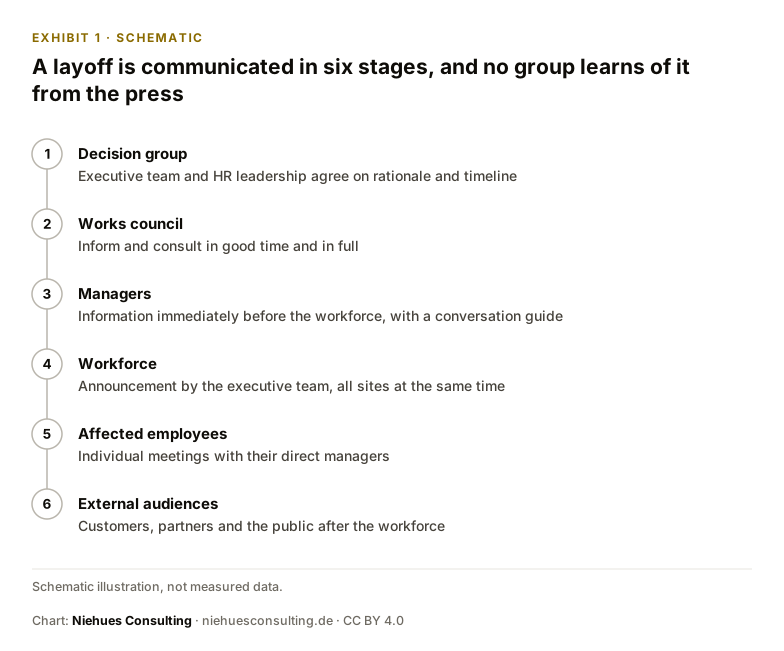
The sequence runs from the decision group via the works council and managers to the workforce, then to affected employees in individual meetings and finally to external audiences. Each step has a legal or practical rationale, and no group should learn about a decision that affects it from the press.
Exhibit 1 · Schematic
A layoff is communicated in six stages, and no group learns of it from the press
Data and download
Data as table
| No. | Step | Description |
|---|---|---|
| 1 | Decision group | Executive team and HR leadership agree on rationale and timeline |
| 2 | Works council | Inform and consult in good time and in full |
| 3 | Managers | Information immediately before the workforce, with a conversation guide |
| 4 | Workforce | Announcement by the executive team, all sites at the same time |
| 5 | Affected employees | Individual meetings with their direct managers |
| 6 | External audiences | Customers, partners and the public after the workforce |
Graphic and data: Niehues Consulting, CC BY 4.0. Free to use with attribution and a link.
- Decision group: The executive team and HR leadership agree on the rationale and timeline with legal counsel. The result is an aligned core document with a list of questions.
- Works council: In Germany, planned operational changes must be disclosed to the works council in good time and in full and discussed with it before they are implemented. In companies with more than 100 permanent employees, the economic committee is also involved. Where dismissals reach the thresholds for mandatory notification, a consultation procedure with the works council follows before any notice is given.
- Managers: They receive the information immediately before the workforce, with a conversation guide and a clear statement of what is still open.
- Workforce: The executive team announces the decision in person, at a meeting or via a broadcast that reaches all sites at the same time.
- Affected employees: Direct managers hold the individual meetings with support from HR as soon as the works council process allows.
- External audiences: Customers, partners and the public are informed after the workforce, with a statement on the company's ability to deliver.
Listed companies check before step 2 whether the measure constitutes inside information that must be disclosed without delay under the EU Market Abuse Regulation. In that case the process compresses into a few hours around the disclosure, and preparation must be complete beforehand.
Negotiations on the reconciliation of interests and the social plan often fall between the announcement and the individual meetings. Announce plans and describe the process rather than naming individuals or giving final numbers that are still subject to consultation.
What messages belong in the announcement?
The announcement needs six messages, listed in the box below, from the rationale to the points that have not yet been decided. An announcement that leaves any of these questions open generates rumours precisely at that point.
Put the core message into three sentences that every manager can repeat word for word. Speak of roles and tasks when you talk about structure, and of people when you talk about consequences. Avoid terms that obscure the layoff, such as “optimising the workforce structure”. Employees translate such phrases instantly, and the executive team loses credibility at that very moment.
One message is missing from many announcements: the future of those who remain. State which tasks will be dropped, which priorities apply from now on and how work will be redistributed. Without this, the remaining employees add the departing colleagues' work to their own lists, and it is precisely this mechanism that drives absence and resignations.
How do you hold the conversation with affected employees?
The direct manager holds the conversation with affected employees, briefly, in person and with written documents, supported by HR. The decision comes in the first sentence, the reasoning afterwards, and a second meeting follows for questions on severance and support.
Schedule the individual meetings for a function so that they take place within a single day. Spreading them over several days prolongs the period in which nobody knows whether they are affected. Formal steps remain with employment counsel: in Germany the works council must be heard before every dismissal, and notice of dismissal must be given in writing. The conversation replaces none of these steps.
Managers are the most important channel
In a layoff, the direct manager is the channel employees trust most, which is why managers need a head start in information and a conversation guide. An all-staff email from the executive team answers not a single personal question.
Prepare managers in a dedicated session before the announcement. This covers the core message with the twenty most likely questions, plus a rule for questions nobody can yet answer. The best answer to those is: “That has not been decided yet, and I will come back to you on it by this date.” Managers who are unsure of their own role pass that uncertainty on. Clarify their own situation first. How the middle layer becomes effective during change is described in the article Resistance to change.
Set up a fixed feedback channel for the first weeks. Managers report daily on the questions being asked, and the question list is updated. This shows the executive team early where a message is not landing. Principles for change communication beyond layoffs are summarized in the article Communication in transformation.
The remaining workforce determines performance afterwards
After the effective date, work begins on the organization that remains, and this work needs new priorities and secured knowledge. A layoff that cuts roles but keeps every task shifts the burden onto fewer people.
Proceed in three steps. First, decide which tasks will be dropped and communicate this as clearly as the layoff itself. Second, secure the knowledge of departing employees before their last working day, with handovers and named successors for each task. The article Knowledge management: retaining knowledge when people leave shows how. Third, hold early personal conversations about their role with the people whose departure would hit the company hardest.
Measure the impact with a few metrics that you collect before the announcement so that a baseline exists. Voluntary resignations in the functions that remain, sickness absence and on-time delivery of the most important outputs have proven useful. If the values deviate markedly from the baseline after 90 days, the redistribution of work is not complete.
How Niehues Consulting supports a layoff
Niehues Consulting runs layoff communication as a workstream in the reorganisation's delivery plan and connects it with organization design and delivery management. The basis is the Niehues Delivery Model with its phases Understand, Build and Embed. Three of its review questions matter most for a layoff. Who decides, who delivers, who uses? The answer determines who gives which message to which group. Who owns operations from day one? The answer ensures that every remaining task has an accountable owner on the effective date. Which metric shows after 90 days that the solution is landing? The answer makes the layoff's effect on performance measurable.
Marin Niehues leads such initiatives as delivery manager or project manager, in projects ranging from VC-funded scale-ups to DAX 40 corporations and in assignments in 20+ countries across six continents. Employment law advice remains with your legal department or law firm. The article characteristics and metrics of a high-performing organization places the topic in the wider context. The starting point is a free 30-minute initial consultation in which the sequence and timeline of your communication are clarified.
Frequently asked questions
How do you announce layoffs to employees?
Announce layoffs in person through the executive team, to the whole workforce at the same time, after managers have been briefed. The announcement covers the rationale, scope, process and timeline in plain language. Written information follows immediately, and direct managers answer questions in their teams the same day.
When should a company announce layoffs?
Announce layoffs as soon as scope and process are settled and the works council has been informed. An earlier announcement without reliable statements creates uncertainty without direction. A later one lets rumours get ahead, and from then on the executive team communicates only by way of correction.
Who should tell employees they are being laid off?
The direct manager tells affected employees in a personal meeting, supported by HR. The manager knows the person and remains the point of contact for the team that stays. External speakers are unsuitable for internal announcements.
Can you communicate layoffs before agreement with the works council?
You may communicate the plans once the works council has been informed, and you must make clear that the consultation process is under way. Implementation steps such as dismissals follow only after the reconciliation of interests has been concluded or has genuinely failed. Agree the exact sequence with employment counsel.
How do you deal with rumours before the announcement?
Counter rumours with a short interval between decision and announcement and a small circle of insiders. If rumours are already circulating, confirm that planning is under way and name the date on which you will provide information. A denial that later proves false costs more trust than any early confirmation.
How do you retain top performers after a layoff?
Retain top performers through personal conversations about their future role, held immediately after the announcement. What matters is a realistic workload and a process they experience as fair. Company-level research shows that visibly fair HR practices markedly dampen the rise in voluntary resignations after downsizing.
How do you inform customers about layoffs?
Inform customers after the workforce, with a clear statement on your ability to deliver and on named contacts. Key accounts receive a call from the accountable person before they hear about it from other sources. If a contact person changes, name the successor in the same conversation.
What does external support for a layoff cost?
According to the fee study of the German Association of Management Consultants (BDU), external consulting in the German market is typically billed at around 1,000 to 2,500 euros per consultant day. The scope grows with the number of sites and the length of the consultation process. Employment law advice is a separate item.
Let’s talk about your initiative.
In 30 minutes we clarify where your organization stands and which step will pay off most now.
Request a consultation30 minutes · free · no obligation