Knowledge Management: Retaining Knowledge When People Leave

Knowledge stays in a company when the organization continuously secures it from the work itself and spreads it across several people before anyone departs. Every departure of an experienced person takes knowledge that sits in no system: who made which decision and why, which customer has which particularity, how a plant behaves in edge cases. The departure itself is rarely the problem; it reveals that the organization never defined who holds this knowledge. This article describes an approach that secures knowledge along delivery capability: which knowledge is critical, who holds it, and how does it enter the workflow?
As the article also touches on obligations during the notice period: This article provides an overview and does not constitute legal advice.
What is the difference between explicit and tacit knowledge?
Explicit knowledge can be written down and passed on without the person, whereas tacit knowledge sits in experience and judgment and transfers mainly through working together. Explicit knowledge includes configurations and contract terms, as well as process descriptions. Tacit knowledge is experiential knowledge that is hard to put into words; Michael Polanyi captured it in 1966 in the observation that we can know more than we can tell. Think of the sense for when a customer is about to cancel, or the experience of which machine setting holds in humid weather.
The distinction matters in practice. You secure explicit knowledge through documentation and standards. You secure tacit knowledge through people, that is through tandems and joint casework. Treating both with the same tool produces either documents that omit what matters or tandems for content that a single page would have covered.
The best-known framework for the movement between the two types of knowledge was set out by Ikujiro Nonaka and Hirotaka Takeuchi in 1995 as the SECI model. It distinguishes four movements:
- Socialisation: tacit knowledge passes to another person through observation and working alongside.
- Externalisation: tacit knowledge is put into concepts, models or case examples.
- Combination: explicit knowledge is organized, linked and recombined.
- Internalisation: explicit knowledge becomes personal experience again through application.
A good handover runs through all four movements. The tandem delivers socialisation, the expert debriefing externalisation, filing in the wiki combination, and the successor's independent work internalisation.
Which knowledge is critical?
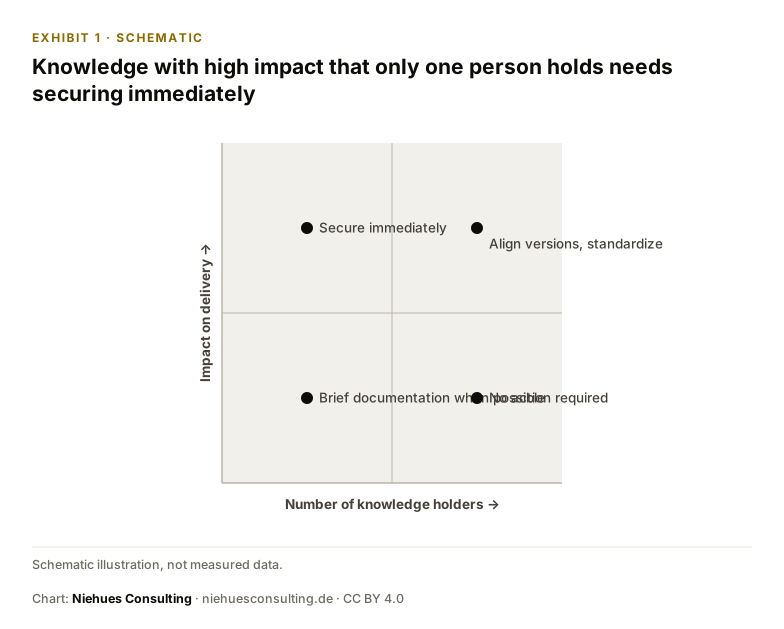
Knowledge is critical when its absence stops a delivery output and only a single person holds it. A knowledge inventory therefore starts with the question of which delivery output fails if a particular person is absent. Two attributes suffice for a first classification: the impact on delivery and the number of people who hold the knowledge. This yields four fields:
- High impact, one person: immediate securing; this is where the greatest risk lies.
- High impact, several people: alignment of versions and standardization.
- Low impact, one person: brief documentation when the opportunity arises.
- Low impact, several people: no action required.
Exhibit 1 · Schematic
Knowledge with high impact that only one person holds needs securing immediately
Data and download
The inventory takes place in conversation with function heads and teams. It produces a list of critical knowledge holders and their topics that serves as the working basis for all further measures. The result can be shown as a knowledge map: an overview that assigns each topic its knowledge holders and their deputies and reveals gaps at a glance.
The timing is also informative. If several knowledge holders in one function leave the company in quick succession, for example through retirement or a move, the risk rises considerably. An analysis by the Federal Statistical Office of Germany based on the 2024 microcensus shows that around 13.4 million people in the German labor force will reach the statutory retirement age by 2039, close to a third of the labor force. The inventory therefore assigns each critical topic the expected date until which the person remains available. Where a function faces two or more retirements within 24 months, it goes to the top of the list. This produces a sequence of measures that follows the actual risk.
Which methods of knowledge retention exist?
The effective methods fall into three basic routes, complemented by three targeted procedures for projects and departures. The basic routes work at different speeds and suit different types of knowledge.
Documentation secures factual knowledge, such as configurations and customer agreements. Tandems secure experiential knowledge that is hard to describe: judgment in edge cases, relationships with customers and suppliers, a sense for risk. Standardization turns individual know-how into a procedure that any qualified person can carry out.
Three procedures complement these routes:
- Lessons learned: after each project or project phase the team records what worked and what it will do differently next time. This becomes effective only when the results flow into checklists or standards.
- Expert debriefing: a facilitated series of interviews with the departing person. The facilitator works through concrete cases, asking about decisions and exceptions, with the successor present. This makes tacit knowledge at least partly explicit.
- Knowledge map: the visual overview from the inventory showing who holds which knowledge and who deputises. It is the function head's steering instrument.
The choice follows a simple rule. If the knowledge can be described on one page so that a qualified colleague can act on it, documentation is enough. If she needs several accompanied cases, the tandem is the right route. If the task recurs often and uniformly, standardization pays off.
Building knowledge securing into the workflow
Knowledge securing lasts when it is anchored in the work itself. Four building blocks anchor it in the workflow:
- Done means documented: a task counts as complete only when decisions and particularities are recorded.
- Named knowledge owners: for each critical topic one person is responsible, checks that content is current and trains a deputy.
- Regular knowledge sessions: at fixed intervals teams present their critical processes and point out gaps.
- Quarterly review: the function head reviews the list of critical knowledge holders and decides on measures.
The building blocks fit into existing routines. The definition of done belongs in the teams' working agreements, the knowledge sessions in existing meetings, the quarterly review in the function head's steering. The teams' existing tools remain the medium.
This requires unambiguous roles and responsibilities. How job profiles actually settle responsibility is described in Rollenklarheit: Stellenprofile, die Verantwortung tatsächlich regeln. The person who takes over the knowledge benefits directly: structured onboarding shortens the time to full effectiveness, as Onboarding als Produktivitätshebel shows. How roles and processes fit together overall is set out in the article characteristics and metrics of a high-performing organization.
How do you create a handover protocol when an employee leaves?
A handover protocol lists every critical topic of the departing person with successor and handover stages including dates. It is signed off by both parties and the function head. It is drawn up in the first week after the departure becomes known and updated until the last working day.
Once a departure becomes known, a handover process with fixed steps begins. The function head first clarifies which critical topics the person holds. Successor or deputy are then determined. The handover runs in three stages: first both work together, then the successor takes over under guidance, finally the successor works independently with the option to ask questions.
For a short-notice departure, an emergency procedure applies. The function head determines a deputy on the same day and reviews the most recently documented decision bases. Conversations with the person's closest colleagues follow. Open items are recorded in a list with owners, so that customers and partners notice no gap in service.
An exit interview complements this approach with the view of the departing person: which processes work only through personal effort? Which decisions are waiting for clarification? These answers flow back into the inventory. Where knowledge holders and deputies are defined in advance, the handover proceeds in a plannable way.
AI as an amplifier of knowledge securing
AI assistants that access company documents make existing knowledge findable and support their answers with sources. They are reliable when the connected content is reviewed and maintained. The quality of the answers therefore follows the quality of the sources: the clearer content and responsibilities are defined, the better the system works. AI also helps in expert debriefings by turning recordings into structured notes that the knowledge holder then reviews. Fields of application are described in KI für Wissensmanagement. The ordering of content comes first, and the technology follows it.
Niehues Consulting as a partner for knowledge securing and handover
Niehues Consulting supports executive teams and function heads in introducing knowledge securing as a fixed part of the delivery organization. Marin Niehues is a management consultant with a delivery perspective: he builds organizations that deliver and brings AI into operations. His projects range from VC-funded scale-ups to DAX 40 corporations, with assignments in 20+ countries on six continents.
The basis is the Niehues Delivery Model with its phases Understand, Build and Introduce. For knowledge securing, three of its review questions matter most: who decides, who delivers, who uses? Which roles, decision paths and interfaces does operation require? And who owns operation from day one, including after a knowledge holder has left? In delivery management and organization design, these answers become the roles and deputies that keep knowledge in the workflow. Where AI assistants are meant to make knowledge accessible, AI prototypes and their introduction complete the approach. The entry point is the free initial consultation of 30 minutes.
Frequently asked questions
How can a company retain knowledge?
Knowledge can be retained when critical topics are named, knowledge owners are defined and deputies are trained. Documentation and tandems complement each other depending on the type of knowledge, as do standardized processes.
What is tacit knowledge?
Tacit knowledge is experiential knowledge that is hard to put into words, such as judgment in edge cases or familiarity with informal channels. Michael Polanyi described it in 1966 with the observation that we can know more than we can tell. It is passed on mainly through joint work.
What is the SECI model by Nonaka and Takeuchi?
The SECI model describes how knowledge moves between tacit and explicit form, in the four steps of socialisation, externalisation, combination and internalisation. Ikujiro Nonaka and Hirotaka Takeuchi presented it in 1995 in “The Knowledge-Creating Company”. In practice it serves as a checklist for whether a handover covers all four movements.
Can an employer require a knowledge handover during the notice period?
Yes, during the notice period the employment relationship continues with all its obligations, and training the successor is generally among the tasks an employer can assign under its right to direct work. If the person is placed on garden leave, the duty to work lapses and with it the handover. Plan the handover before any garden leave and clarify individual cases with employment law counsel.
What is a knowledge map?
A knowledge map is an overview showing who in the company holds which critical knowledge and who deputises. It emerges from the knowledge inventory and immediately reveals topics with only one knowledge holder. The function head uses it as a steering instrument in the quarterly review.
When should knowledge handover begin?
The handover begins when the departure becomes known, and the securing of critical topics long before. A continuous rhythm of knowledge sessions and quarterly review shortens the handover phase. For foreseeable retirements, the tandem starts no later than one year before the last working day.
Who is responsible for knowledge management in a company?
Responsibility lies with the function head, who names one person for each critical topic. A central unit can provide methods and tools, while the upkeep of knowledge remains in the business unit.
Let’s talk about your initiative.
In 30 minutes we clarify where your organization stands and which step will pay off most now.
Request a consultation30 minutes · free · no obligation