AI Roadmap: The First Twelve Months

An AI roadmap for the first twelve months is a three-phase plan that takes two or three prioritized use cases from analysis into regular operation. Understand runs in months 1 to 3, Build in months 4 to 8, Deploy in months 9 to 12. Each phase ends with a gate at which the executive team releases the budget for the next stage. This article provides an overview and does not constitute legal advice.
What belongs in an AI roadmap?
An AI roadmap sets out which use cases are built in which order, who owns them and which criteria the executive team applies when deciding on the next step. It is the working instrument between the AI strategy, which sets goals and priorities, and the individual projects that deliver. How strategy and delivery fit together is set out in the article AI management: what executive leadership must steer.
A robust roadmap contains five building blocks: the prioritized list of use cases, a business case for each priority, named ownership in the business unit, a budget envelope per phase and the gate criteria. If one of these is missing, the roadmap becomes a project list that nobody can stop. The distinction from the overarching objectives is covered in AI strategy for companies.
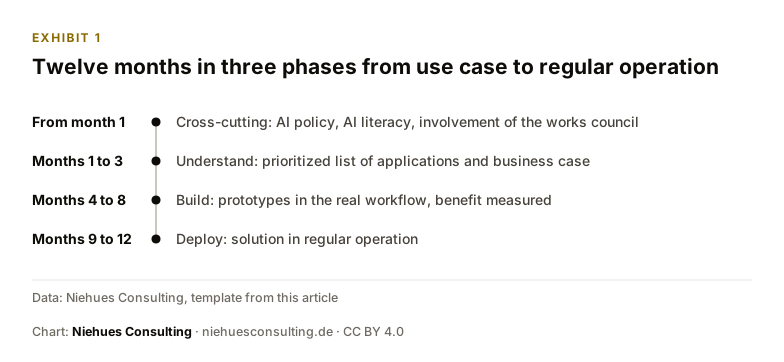
Exhibit 1
Twelve months in three phases from use case to regular operation
Data and download
Data as table
| Date | Event |
|---|---|
| From month 1 | Cross-cutting: AI policy, AI literacy, involvement of the works council |
| Months 1 to 3 | Understand: prioritized list of applications and business case |
| Months 4 to 8 | Build: prototypes in the real workflow, benefit measured |
| Months 9 to 12 | Deploy: solution in regular operation |
Chart: Niehues Consulting, CC BY 4.0. Data: Niehues Consulting, template from this article; the source's terms apply.
Phase 1: Understand (months 1 to 3)
The first phase establishes where AI has the greatest leverage in the company's own value creation. It starts with a business analysis: which processes cause waiting times, rework or high processing costs, and what data exists for them? This assessment produces a list of use cases, scored by value, feasibility as well as risk. The method is described in Prioritizing AI use cases.
In parallel, a business case with clearly stated assumptions and a measured baseline is prepared for the two or three most promising use cases. Without a baseline, the benefit cannot be proven in phase 2. The approach is set out in AI business case: calculating benefits and costs reliably.
The cross-cutting tasks of the first year belong in the same phase. The European AI Act requires companies that deploy AI to ensure a sufficient level of AI literacy among their staff. An AI policy defines which tools may be used with which data. In Germany and other countries with co-determination, the works council is involved early, because technical systems capable of monitoring behavior or performance are subject to its rights. Starting these three topics in month 1 prevents a finished prototype from waiting for an outstanding approval in phase 3.
By the end of the phase, four results are in place: a prioritized list of applications, a business case for each priority, a named owner from the business unit for each use case and a budget envelope for the build phase. The executive team decides at a gate meeting which use cases move into the build phase.
Phase 2: Build (months 4 to 8)
In the second phase, prototypes are built that demonstrate their value in the real workflow. A prototype runs on real data with real users from the business unit. A demonstration to a steering committee does not meet this standard. The first test concerns impact: does processing time fall, and does the error rate drop? The second test concerns adoption: do colleagues use the tool without being asked? The UTAUT acceptance model, well established in research, names four drivers: expected benefit, expected effort, the behavior of peers, and facilitating conditions such as training and a point of contact.
Each prototype follows a fixed rhythm. Development runs in two-week cycles, and the business unit signs off every four to six weeks. Acceptance by the business unit is the true measure of maturity. A technically working prototype that the department rejects delivers no benefit and belongs in rework or in closure. Both are regular outcomes of the phase and free up budget for the more promising applications.
Preparation for operations begins in this phase. It defines who will own the solution later, which interfaces it needs and which quality checks apply. Teams that raise these questions only in month 9 lose time, because operational requirements shape the architecture.
Phase 3: Deploy (months 9 to 12)
The third phase transfers the accepted prototypes into operations. This includes an operations team with clear responsibilities, a revised workflow in the business unit and enablement for users. The transfer works with internal or external teams. What matters is that a named function owns the solution from day one.
Deployment is an organizational undertaking. Processes change and roles shift. Managers insist on the new way of working. A training session on launch day is insufficient. A staggered rollout by team has proven effective, supported by a contact person in the business unit and a weekly review of usage during the first weeks.
How many use cases belong in the first year?
Two to three high-priority use cases can be taken into operation within twelve months. Each use case ties up an owner in the business unit, user time for acceptance and IT capacity for interfaces. In every company these resources are scarcer than budget. A larger number spreads attention so widely that no application reaches the maturity needed for regular operation.
A simple rule applies to the selection. At least one use case delivers quickly visible benefit in a high-volume process, for example in document processing or customer service. A second use case targets a larger lever with higher complexity. Further candidates remain on the prioritized list and move up as soon as a use case has passed the gate to deployment or has been closed.
Which metrics show the progress of an AI roadmap?
Four metrics show progress: realized benefit per use case against the business case, the adoption rate in the target area, the lead time from prototype to operations and total cost against the budget envelope. The executive team reviews this set monthly. It shows early whether an application is being adopted and allows a change of course before significant budget is committed.
For each metric, the executive team sets a target value at the phase 1 gate, taken from the business case. If a value deviates for two months, a corrective discussion follows with the owner in the business unit, which decides whether the use case is adapted, deferred or closed. This mechanism keeps the roadmap flexible and prevents a weak use case from tying up budget that a stronger one needs.
Niehues Consulting as a partner for the roadmap
Niehues Consulting plans and delivers AI roadmaps using the Niehues Delivery Model with its phases Understand, Build and Deploy. Each phase closes with fixed review questions. Three of them matter most for a roadmap: which business outcome should change measurably? Does the prototype prove its benefit in the real workflow with real data? Which metric shows after 90 days that the solution is being adopted?
In the first phase, Niehues Consulting provides AI management: business analysis, requirements, business case, and the selection and sequencing of applications. In the second phase, prototypes are built that prove the benefit in the real workflow and are developed until the business units accept them. In the third phase, the transfer into operations with internal or external teams follows, together with deployment covering processes and responsibilities.
Delivery is steered as delivery manager, project manager or product owner by a person who also knows the business units. This combination of AI management and delivery responsibility keeps the roadmap on rhythm, from VC-backed scale-ups to large corporations. The entry point is a free 30-minute initial consultation, in which the starting position and the first phase are assessed: Request an initial consultation.
Frequently asked questions
How long does it take until a first AI application is in production?
A first AI application is in production after nine to twelve months. Around three months go into analysis, around five months into the prototype in the real workflow, followed by deployment. Data quality and integration with legacy systems determine whether it is closer to nine or to twelve months.
What is the first step of an AI roadmap?
An AI roadmap begins with an assessment of processes and an evaluation of possible use cases by value, feasibility as well as risk. Technology selection follows, because the chosen use case defines the requirements for models, data and interfaces.
Is there a template for an AI roadmap?
Yes, the template in this article divides twelve months into three phases, each with an output and a gate criterion. It can be transferred directly into a spreadsheet or planning tool. For each use case, add the owner, the baseline and the target value from the business case.
Who should own the AI roadmap?
Overall responsibility rests with the executive team or a member of senior management appointed by it. Each use case also has an owner in the business unit, who is accountable for the benefit and signs off acceptance.
What is the difference between an AI strategy and an AI roadmap?
The AI strategy defines which business goals AI should support and where the company invests. The AI roadmap translates these goals into a sequence of use cases with owners, budgets and gates. The strategy answers why and where to, the roadmap answers what, when and who.
How much does the first year of an AI roadmap cost?
The cost of the first year is driven by the number of use cases and the depth of their integration. It comprises external support, licenses and infrastructure as well as the working time of the business units. The biggest lever on cost is limiting the year to two or three use cases, because each gate releases budget only for the next phase.
Why do AI pilots fail to reach production?
AI pilots usually fail because operations and ownership are only clarified after the prototype. Interfaces, quality checks and a function to take over the solution are then missing. The roadmap prevents this by preparing operations in phase 2 and checking it at the gate to deployment.
Let’s talk about your initiative.
In 30 minutes we clarify where your organization stands and which step will pay off most now.
Request a consultation30 minutes · free · no obligation