Measuring the ROI of AI Projects

The ROI of an AI project is the proven benefit minus all costs over the life cycle, divided by those costs, measured against a baseline fixed before the start. In conventional investments, asset accounting at least provides the cost side, and the benefit can be attributed to an asset. With AI applications the benefit arises across business units and the costs recur. Anyone who wants to report ROI reliably therefore settles measurement, benefit ownership and the time horizon before the first prototype.
How do you calculate the ROI of an AI project?
The ROI of an AI project is calculated as cumulative benefit minus cumulative costs, divided by cumulative costs, over a defined review period.
The metric is complemented by the payback period and the net present value at the company's usual cost of capital. A suitable review period covers the transition into regular operation and at least one full year of operation. Introduction costs arise early, while the benefit grows as business units adopt the application. A three-year horizon captures both effects cleanly for most applications.
Setting the baseline before the project starts
The most consequential flaw in ROI calculations for AI lies at their beginning. If the baseline is only collected after introduction, the application's effect becomes mixed up with seasonal fluctuations and staff changes. The baseline consists of a few process metrics for the affected workflow: handling time per case, cycle time, error and rework rate as well as case volume. It is collected over a period that covers the usual fluctuations of the workflow and approved by the head of the business unit. The unit in which the benefit is to arise thereby owns the figures from the outset.
A comparison with a control group works well for attributing the effect: one team works with the application, while a comparable team continues with the existing workflow. Where this is not organisationally possible, a before-and-after comparison over periods of equal length with documented confounding factors is sufficient, or alternatively a staggered roll-out across several teams. If the prototype runs in the real workflow, it delivers the first measured values for benefit and effort, and from that point the business case rests on measurements rather than assumptions.
Four types of benefit and the stages of their realization
AI applications generate benefit in four categories, each evidenced differently. In productivity, handling time per case falls relative to the baseline. In quality, errors and rework decline, valued at the costs they previously caused. In revenue, response times or conversion rates improve, which is most reliably attributed through control groups. In risk, damage or outages become rarer. This effect enters the calculation as an expected value of probability and loss amount and is reported separately.
What matters is the stage at which a benefit is booked.
Time saved only becomes a benefit when a manager decides how the released capacity is used and implements that decision in workforce planning or volume targets. This decision therefore belongs in the AI business case.
Capturing full costs over the life cycle
The cost side of AI projects regularly comes out too low when only the development budget is considered. Full costs include development and integration into the existing system landscape as well as ongoing usage costs for models and infrastructure. Operation with quality assurance and monitoring is added, as is data maintenance. User training and the time business units spend on testing and acceptance also belong here. Usage-based costs grow with case volume, so operation is calculated for the target volume of regular operation.
Worked example: ROI of an AI application in accounts payable
The following worked example uses assumed values and demonstrates the method step by step. It considers AI-supported checking of 60,000 incoming invoices per year. The baseline is six minutes per invoice, and the application reduces the effort to two minutes. The fully loaded cost rate is EUR 55 per hour, and 75 percent of the released capacity is demonstrably redeployed. In addition, the error rate halves from three to 1.5 percent, and each avoided error saves EUR 40 of clarification effort.
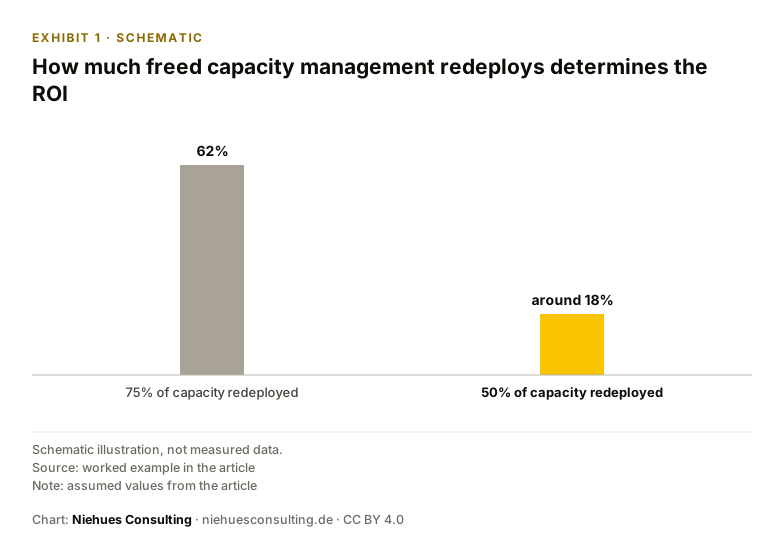
The example reveals two levers. If the redeployed share of capacity falls from 75 to 50 percent, cumulative benefit drops to EUR 365,000 and the ROI to around 18 percent. Management's allocation decision thus affects the result more strongly than any technical improvement to the model. Second, every delay in the roll-out directly extends the payback period, because operating costs continue to accrue.
Exhibit 1 · Schematic
How much freed capacity management redeploys determines the ROI
Source: worked example in the article
Note: assumed values from the article
What is the average ROI of AI projects?
The ROI of an AI project follows from the specific workflow and can only be measured reliably there. The scientifically robust findings measure productivity effects in individual tasks rather than an average ROI across projects. A field study of more than 5,000 customer service agents shows that an AI assistant raised issues resolved per hour by 14 percent on average and by 34 percent for less experienced agents. An experiment with more than 400 professionals on writing tasks shows time savings of around 40 percent alongside higher quality.
For the executive team this yields a clear rule. Productivity effects of this magnitude are a realistic starting point for the process effect. Whether they lead to a positive ROI is decided by the redeployment of capacity and by full costs, and these are exactly the two variables that the company's own ROI calculation measures.
Why do many AI projects show no measurable ROI?
Many AI projects show no measurable ROI because they remain in pilot operation, lack a baseline or never redeploy the released capacity. A pilot with few users generates potential but no financially effective benefit. Without a baseline, even a real effect cannot be proven. Without a capacity decision, the time gained disappears into day-to-day business.
Low usage among the intended users and a cost calculation that underestimates ongoing operation add to this. Both causes can be detected early: the usage rate acts as a leading indicator, because an application nobody uses generates no benefit, however well the model performs.
From the individual project to the portfolio
An ROI per project is insufficient for steering once several applications run in parallel. At portfolio level the executive team compares the applications and decides where funds flow. A small, uniform set of metrics is sufficient for this, built on realized benefit and full costs and complemented by usage rate and adoption rate in the business units. Fixed decision points after the prototype, after pilot operation and after the first year of operation determine whether an initiative is continued, scaled or stopped. Its place in overall steering is set out in the article AI management: what executive leadership must steer.
ROI evidence as part of the initiative
Niehues Consulting supports organizations in AI initiatives from analysis to operation. In AI management, business analysis and requirements, the business case and the selection and sequencing of applications belong together with steering the AI portfolio. Baseline and benefit ownership are thereby fixed at the selection stage. Prototypes prove the benefit in the real workflow, and the roll-out creates processes, responsibilities and capable users, because the benefit is only realized once business units adopt the application.
The approach follows the Niehues Delivery Model with its phases Understand, Build, Introduce. Three of its test questions matter for ROI evidence. What is the baseline, and how do we measure success? This question is answered before the first prototype. Has the business case been confirmed with real values? Only measurements from the real workflow make the ROI reliable. Which metric shows after 90 days that the solution is landing? Usage rate and realized capacity show early whether the benefit materializes. The entry point is the free 30-minute initial consultation, in which the baseline of your initiatives is assessed together.
Frequently asked questions
Which costs belong in the ROI calculation of an AI project?
The ROI calculation includes all costs over the life cycle, meaning development and integration as well as usage costs for models and infrastructure. Operation with quality assurance and data maintenance are added, along with user training and the time business units spend on testing and acceptance.
When does the benefit of an AI project become visible?
Plan the first reliable benefit measurement three to six months after the start of regular operation, and the financial effect in the first full year of operation. The benefit arises to the extent that business units adopt the application and redeploy the released capacity. Planning by the three stages of potential, realized and financially effective shows when each part can be expected.
How can the benefit be proven without a control group?
A before-and-after comparison over periods of equal length proves the benefit if the baseline was measured before the start and confounding factors are documented. Case volume is also adjusted. The head of the business unit confirms the values.
Is there a template for calculating AI ROI?
An ROI template for AI comprises five blocks: baseline, process effect, realized share of capacity, full costs over three years and the result with ROI and payback. The worked example in this article follows exactly this structure and can be transferred directly into a spreadsheet. Every assumption receives an owner in the business unit.
What is a typical payback period for an AI project?
A clearly bounded AI project with high case volume should pay back within 24 months; in the worked example in this article it does so after 21 months. Payback shortens with a fast roll-out and a clear decision on the released capacity. The calculation before the start is described in the article on the AI business case.
How do you measure the benefit of Microsoft Copilot or ChatGPT?
The benefit of general AI assistants is measured on a few selected tasks for which a baseline is collected before introduction, for example minutes, draft proposals or research. Usage rate and frequency of use per role also show whether the license serves its purpose.
Let’s talk about your initiative.
In 30 minutes we clarify where your organization stands and which step will pay off most now.
Request a consultation30 minutes · free · no obligation