The 9-Box Grid: Assessing Performance and Potential Without Paralyzing the Organization

The 9-box grid places employees on a matrix of three levels of performance and three levels of potential and provides the basis for decisions on development and succession. It only creates value when every box carries a fixed consequence, judgments are tested in a calibration session and the process is limited to the roles for which the company must plan succession. This article explains the structure and the boxes, sets out the known weaknesses of appraisals and describes an approach that speeds up decisions.
Because appraisal processes touch on co-determination and data protection: This article provides an overview and does not constitute legal advice.
What is a 9-box grid?
A 9-box grid is a two-axis matrix on which managers place their people according to current performance and potential for larger roles. Each axis has three levels, low, medium and high, which produces nine boxes. Performance usually sits on the horizontal axis and potential on the vertical.
The grid derives from a portfolio matrix that General Electric used in the 1970s to assess business units by market attractiveness and competitive strength. In people management it became the central tool of the talent review, the meeting in which managers jointly discuss the people in a unit, align their judgments and derive development and succession decisions.
Its value lies in three effects. The grid forces a separation of performance and potential, which tend to blur in daily work. It makes the judgments of different managers comparable because everyone uses the same frame. And it shows at a glance how well a unit is prepared to fill its key roles.
The nine boxes and their consequences
Each box in the grid calls for a decision of its own. The labels vary between companies, but the logic is the same everywhere. The overview below gives the consequence the talent review should set for each box.
Two boxes deserve particular attention. High performance with low potential holds the experts on whom operations depend. Pushing them into management often loses a strong specialist and gains a weak manager. Low performance with high potential often holds people in the wrong role, for whom a move will do more than any training.
How do performance and potential differ?
Performance describes the results a person achieves in their current role, while potential describes the likelihood that they will succeed in a larger or different role. Performance looks back and can be evidenced through goals and results. Potential looks ahead and is therefore always a forecast.
The most common source of error in the 9-box is confusing the two axes. Someone who shines in their current role is easily rated as a talent for the next level, even though that role demands different abilities. Leading a sales organization calls for different strengths from those of the best salesperson in the team.
Research offers robust criteria for the potential axis. An influential paper identifies learning agility as the core of potential, meaning the willingness and ability to learn quickly under new and difficult conditions. An integrated model from organizational psychology distinguishes stable foundations such as cognitive ability and personality, growth factors such as learning orientation and motivation, and career-specific capabilities such as leadership and expertise. In practice: describe potential through three to five observable attributes and require a concrete example from daily work for every rating.
Why the 9-box can paralyze an organization
The 9-box paralyses an organization when it creates heavy effort, delivers unreliable judgments and triggers no decisions. Three causes are well documented.
The first cause lies in measurement. A study of ratings of almost 4,500 managers, each assessed by several raters, found that 53 to 62 percent of the variance in performance ratings reflected the idiosyncrasies of the raters and only around 21 to 25 percent the performance of those rated. A single rating therefore says more about the manager giving it than about the person. For potential, which is a forecast, this applies all the more.
The second cause lies in the effect of labels. Meta-analyses of the Pygmalion effect in work organizations show that high expectations from managers measurably raise employee performance. The converse is uncomfortable for the 9-box: anyone placed early in a low box receives fewer stretch assignments, and the judgment confirms itself.
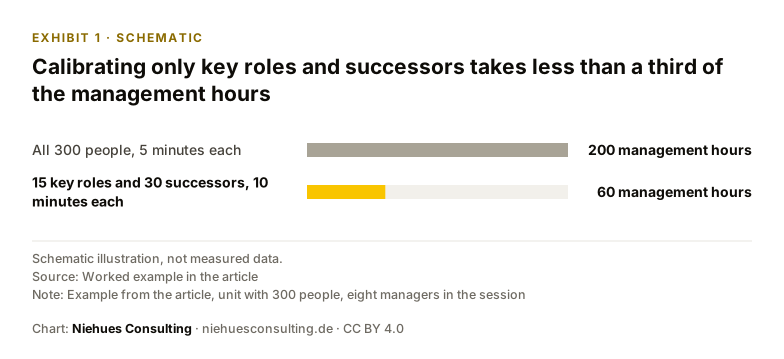
The third cause lies in the process. Calibration sessions with long lists absorb many management hours, and when they end without a decision on succession or development, seriousness declines year by year. How feedback works as an ongoing dialogue is described in the article on performance management.
How to introduce the 9-box without paralyzing the organization
You introduce the 9-box effectively by limiting it to key roles and their successors, calibrating every judgment against evidence and linking every box to a decision. Five steps have proven effective.
- Set the purpose. The executive team decides which decisions the talent review prepares, such as filling key roles over the next two years.
- Limit the scope. Assess the holders of key roles and the candidates to succeed them. The article on talent management and key roles explains which roles these are.
- Describe the criteria. Both axes use a few observable attributes with examples for each level.
- Calibrate. Managers present their assessments with evidence, the group examines discrepancies and agrees. A neutral facilitator keeps performance and potential apart.
- Decide and follow through. Every person in scope receives an action with an owner and a date. After 90 days the executive team reviews progress.
Exhibit 1 · Schematic
Calibrating only key roles and successors takes less than a third of the management hours
Source: Worked example in the article
Note: Example from the article, unit with 300 people, eight managers in the session
What the process must observe legally
In Germany appraisal processes are subject to co-determination, and 9-box data is personal data. General appraisal principles require the consent of the works council, as do technical systems that evaluate performance or behavior. Plan the consultation with the works council before the first round and set access rights and retention periods for the results. If you use AI to evaluate performance, the EU AI Act classifies such systems in the employment context as high-risk, with corresponding obligations for deployers.
Conventional process and steering tool compared
The comparison shows how the design of the process affects effort and impact.
For companies with more than ten key roles the comparison leads to a clear recommendation: use the 9-box specifically for succession and development, and measure success by the share of key roles filled internally. How to evidence the impact of development programs is shown in the article on leadership development with measurable impact.
Niehues Consulting as a partner for talent reviews that work
A talent review works when it is linked to organization design, because the structure determines which roles are key roles and what the next level demands. That is why the right partner designs roles and decision paths and steers implementation through to the decision.
Niehues Consulting, based in Düsseldorf, combines organization design with delivery management. Founder Marin Niehues builds organizations that deliver and, where needed, takes on the role of delivery manager, project manager or product owner himself. His projects range from VC-backed scale-ups to DAX 40 corporations, with assignments in 20+ countries on six continents.
The approach follows the Niehues Delivery Model with its phases Understand, Build, Implement. Two review questions matter most for the 9-box. In the Understand phase: which business outcome should change measurably, such as the internal filling of key roles? In the Implement phase: which metric shows after 90 days that the solution is landing? How the grid fits into the wider organization is set out in the article characteristics and metrics of a high-performing organization. In a free 30-minute initial consultation you can clarify which scope and criteria suit your company. Book an appointment.
Frequently asked questions
How is potential assessed in a 9-box grid?
Potential is assessed through a few observable attributes that predict success in a larger role, above all learning agility and motivation to take on more responsibility. Every rating needs a concrete example from daily work and a reference to a target role. The judgment is then tested in a calibration session with other managers.
What is a calibration session?
A calibration session is a facilitated meeting in which managers present their assessments of performance and potential and align them. The aim is consistent standards across teams. Every rating is justified with evidence, and discrepancies are discussed.
Should employees be told their 9-box placement?
Employees should learn the consequence of their placement, meaning the agreed development action or the next career step. Communicating the box itself as a label reinforces expectation effects in both directions. Transparency about criteria and process builds trust in the talent review.
How often should a 9-box review take place?
One review a year is enough for most companies, combined with a check on actions after 90 days. During rapid growth or a reorganisation an additional round for the affected key roles is advisable. More frequent full rounds add effort without adding insight.
Does the works council have to be involved in the 9-box?
In Germany general appraisal principles require the consent of the works council, and the uniform criteria of a 9-box assessment fall under them. If a technical system is used for the evaluation, a further co-determination right applies. Plan the consultation before the first round.
What are the alternatives to the 9-box grid?
Common alternatives are succession plans for each key role with a readiness assessment, development conversations without a grid rating and structured assessments of potential through assessment centers. The 9-box remains useful when several managers need to make their judgments about a larger group comparable.
Let’s talk about your initiative.
In 30 minutes we clarify where your organization stands and which step will pay off most now.
Request a consultation30 minutes · free · no obligation