Leadership Development with Measurable Impact

Leadership development has measurable impact when it starts from the organization's delivery performance and its effect is measured against day-to-day business metrics. Many programs mainly evaluate participant satisfaction. Behavior and results are measured far less often. Senior management needs a different answer: do teams deliver faster, and do managers take decisions earlier? This article describes a four-step framework from diagnosis to impact measurement, a calculation for cost and return on investment, and the decisions to be taken before a program starts.
What levels of impact measurement are there?
Impact measurement uses four levels after Kirkpatrick, from reaction through to results, and a fifth after Phillips for return on investment. Donald Kirkpatrick's model from 1959 distinguishes the first four. Jack Phillips extended it with a fifth level that values the benefit in money and sets it against the costs.
The first two levels can be captured quickly. The third and fourth require groundwork, and the fifth additionally a conversion into money. This groundwork decides whether senior management ends up with a robust statement about impact. Whoever completes it before the program starts aligns every component with a result and directs resources to where they visibly change something.
Steps 1 and 2: diagnosis and development objectives
The starting point is the question of where the organization currently loses time in delivery. A diagnosis shows whether decisions take too long. It equally shows whether responsibilities are unclear and interfaces between functions create friction. How structure and leadership interact is set out in the article characteristics and metrics of a high-performing organization.
The findings lead to development objectives that name leadership behavior concretely. An objective such as “better communication” remains vague. An objective such as “decisions are taken at the level where the information sits” can be observed and linked to a metric. The target group follows from the diagnosis. The lever often lies in middle management, because that is where strategy is translated into delivery.
Step 3: linking the program to daily work
Development works when it takes place on the real subject matter of work. Participants tackle a current bottleneck from their area of responsibility and apply new methods to it immediately. Short inputs alternate with practical assignments, and groups from different functions discuss their cases together. Transfer into daily work thereby becomes part of the program.
The participants' line managers determine whether what has been learned stays. Before the start, they agree an objective with each participant, and after the program they discuss implementation. A program without this role quickly loses impact in day-to-day business. Design also includes structures: roles and decision paths must permit the new behavior. Whoever is expected to delegate decisions needs a clear framework for doing so.
Which leadership development methods are there?
The main leadership development methods range from seminars through coaching and mentoring to action learning and stretch assignments in daily work. They differ in how close they come to the real subject matter of work and how well their impact can be measured. The choice follows the development objective from the diagnosis.
Coaching accompanies a manager over several sessions towards a personal goal, while mentoring pairs them with an experienced person from the organization. Action learning goes back to the British management scholar Reg Revans: small groups work on real, unsolved problems of the organization and reflect on their approach as they go. Action learning is particularly suited to measurable impact, because the problem being tackled brings its own metric.
What is the 70-20-10 model?
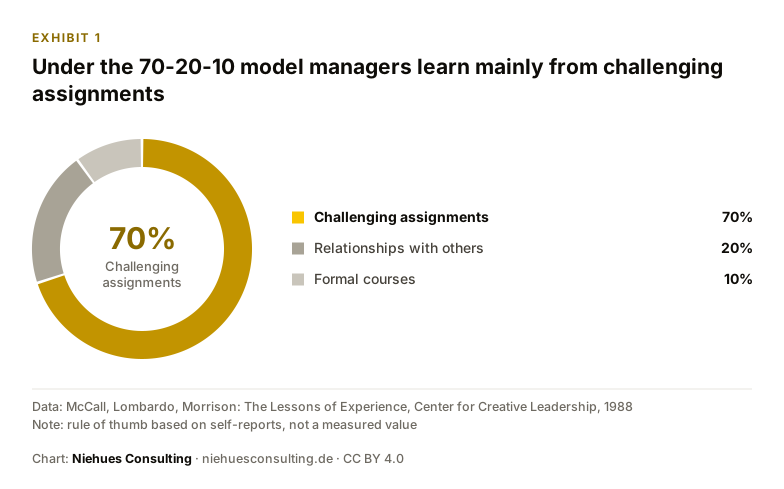
The 70-20-10 model states that managers draw around 70 percent of their development from challenging assignments, 20 percent from relationships with others and 10 percent from formal courses. It goes back to interview studies with successful executives at the Center for Creative Leadership, published in the 1980s. The percentages rest on self-reports and are regarded as a rule of thumb.
Exhibit 1
Under the 70-20-10 model managers learn mainly from challenging assignments
Note: rule of thumb based on self-reports, not a measured value
Data and download
For program design, the direction is what counts. A program consisting almost entirely of seminars uses the smallest share of the sources of learning. Effective programs combine short formal inputs with practical assignments and feedback from line managers, mentors or coaches.
Step 4: measuring impact and adjusting
Measurement starts before the program with a baseline of the chosen metrics. Behavioral change can be measured three to six months after the program, for example through observation and feedback from teams. Effects on delivery metrics show after six to twelve months and are compared with the baseline. A comparison group that goes through the program later makes the effect more robust, because it reveals other influences.
Suitable metrics are those the controlling function already tracks. A frequently used measure is decision time, covered in the article on decision speed. Senior management reviews the results at a fixed rhythm and decides which components continue and which are adjusted.
Attribution is decisive. A results-level metric counts as an effect of the program only if there is a traceable path from changed behavior to changed delivery performance. This path is described in the diagnosis and confirmed by senior management before the start. Later it is then possible to justify what share of a change the program accounts for and what share other influences account for.
How do you calculate the ROI of leadership development?
The ROI of leadership development is the monetized net benefit divided by the program costs, multiplied by 100. The Phillips methodology requires four working steps for this, planned before the start.
An example shows the logic. A program for 20 managers costs EUR 200,000 including working time. If decision time falls so that each manager and their team together gain 150 hours a year, and the organization uses a fully loaded rate of EUR 80 per hour, the benefit is EUR 240,000. The ROI is then 20 percent. Benefits that cannot reasonably be expressed in money, such as higher retention, are reported separately as non-monetary benefits.
How much does leadership development cost per participant?
The cost per participant consists of external services and internal organization plus the participants' working time, which is often the largest item. According to the fee study of the German Association of Management Consultants (BDU), external trainer and consultant days are billed at around EUR 1,000 to 2,500. A seminar day for twelve participants spreads this cost across many people, while a coaching session falls on one.
For planning, a simple calculation is enough: external days times day rate divided by the number of participants, plus program days times the internal fully loaded rate per participant. Leaving out participants' working time underestimates the investment and later overstates the ROI.
Niehues Consulting as a partner for effective leadership development
Niehues Consulting connects leadership development with what the organization has to deliver. In organizational design, structures and roles as well as decision paths are shaped so that new leadership behavior is possible in day-to-day business. The diagnosis of delivery performance supplies the objectives that development is aligned with. Delivery management establishes the rhythm in which impact is reviewed and adjusted.
The approach follows the Niehues Delivery Model with the phases understand, build and implement. Three review questions matter for leadership development: which business result should change measurably? What is the baseline, and how do we measure success? Which metric shows after 90 days that the development is taking hold? The projects range from VC-funded scale-ups to DAX 40 groups, with assignments in 20+ countries across six continents. The entry point is a free initial consultation of 30 minutes, which clarifies which delivery metric a development program should move for you. You can arrange an appointment via the contact page.
Frequently asked questions
How do you measure the impact of leadership development?
Impact is measured on four levels from reaction through to results, supplemented by return on investment. For senior management, behavior and results count. A delivery metric such as decision time or schedule reliability is therefore set before the start and measured again afterwards.
How long does it take for leadership development to have an effect?
Behavioral change can be measured three to six months after the program, effects on delivery metrics after six to twelve months. Teams and workflows need time to adjust to new leadership behavior. A measurement plan therefore provides for several points in time.
How do you calculate the ROI of leadership development?
ROI is benefit minus costs, divided by costs, multiplied by 100. Beforehand, the effect of the program is separated from other influences and converted into money, for example through hours gained times the fully loaded rate. Costs include the participants' working time.
How much does leadership development cost per participant?
The cost per participant consists of external services and internal organization plus working time. According to the BDU fee study, external trainer and consultant days cost around EUR 1,000 to 2,500 and are spread across many participants in seminars, but fall on one person in coaching. Participants' working time is often the largest item.
What methods of leadership development are there?
The main methods range from seminars through coaching and mentoring to action learning and stretch assignments. Seminars convey knowledge to many participants, while coaching and mentoring support individuals. Action learning works on real problems of the organization and is therefore particularly suited to measurable impact.
What is the 70-20-10 model of learning?
The 70-20-10 model holds that managers draw around 70 percent of their development from challenging assignments. Relationships with others account for 20 percent and formal courses for 10 percent. It stems from interview studies at the Center for Creative Leadership and is regarded as a rule of thumb.
Which metrics suit leadership development?
Suitable metrics come from the participants' area of responsibility, such as the duration of decisions or the schedule reliability of initiatives. Results from team surveys on clarity and trust come on top. Every metric is assigned to a development objective before the start.
How do you recognize an effective program?
An effective program starts with a diagnosis and works on participants' real tasks. Line managers are involved, and structures permit the new behavior. Management reviews the results at a fixed rhythm.
Let’s talk about your initiative.
In 30 minutes we clarify where your organization stands and which step will pay off most now.
Request a consultation30 minutes · free · no obligation