Talent Management: Identifying and Filling Key Roles

Talent management for key roles means identifying the positions on which delivery capability depends and filling them deliberately with suitable people. The approach starts with the role and asks about the person only afterwards. It directs attention and budget to the few positions where an appointment decides the schedule reliability and quality of entire units. This article describes a four-step approach for executive and business-unit leadership: identify roles, assess risks, choose routes to appointment, secure succession.
What is talent management?
Talent management is the systematic management of which people a company attracts and retains for its critical tasks and who succeeds them. It comprises four building blocks: attraction, development, retention and succession planning. It creates value when these building blocks are aligned with the roles on which the strategy actually depends.
Talent management differs from learning and development in its perspective. Learning and development qualifies employees broadly for their current and future tasks. Talent management prioritizes: it asks which roles shape the business disproportionately and concentrates its resources on these roles and on the people who fill them now or will fill them in the future. Learning and development is thus one of its instruments.
What is a key role?
A key role is a position whose performance disproportionately determines the result of a unit or a value chain. Key roles exist at every level of the hierarchy. Top leadership roles are almost always among them, but so are positions further down the organization chart: a head of delivery planning, an architect for core systems or a product owner for a central offering often has more impact than some management positions above them.
From a delivery perspective, the guiding question is: which roles must be reliably filled so that projects arrive on time and at the required quality? This view follows an established idea in management research that distinguishes top performers from strategically important positions. The recommendation that follows: identify the positions first, then ensure the strongest appointments there and allocate resources unevenly. How key roles fit into the overall picture of structure and steering is set out in the article characteristics and metrics of a high-performing organization.
Identifying key roles: four screening questions
Every role that is a candidate for the list goes through the same four screening questions. The uniform standard prevents volume or seniority from determining the selection.
Roles that score high on at least two questions go onto the candidate list. The list is then calibrated with the heads of the business units, because impact and bottlenecks are most visible on the ground.
The number of key roles is limited to those the executive team can discuss individually twice a year. Roles that score high on only one of the four questions do not belong on the list. If the list grows longer, prioritization loses its meaning and resources spread evenly again.
Assessing staffing risk
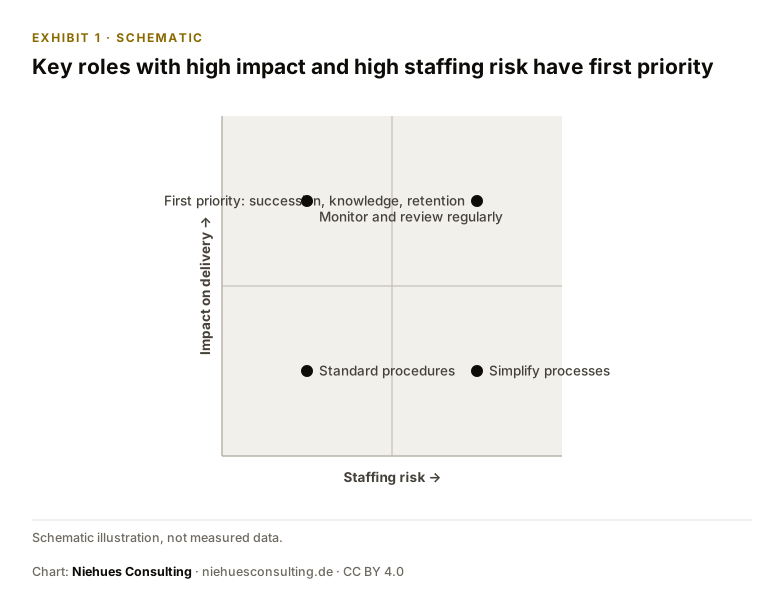
Two axes are sufficient for the assessment: the role's impact on delivery and the staffing risk. The risk stems from the likelihood that the current holder leaves, from missing succession and from scarcity in the market. This yields four fields, each with its own measure:
- High impact, high risk: first priority. A successor is named, knowledge is documented and the person's retention is actively managed.
- High impact, low risk: the appointment is monitored and reviewed regularly.
- Low impact, high risk: processes are simplified so that the role carries less weight.
- Low impact, low risk: standard HR procedures apply.
Exhibit 1 · Schematic
Key roles with high impact and high staffing risk have first priority
Data and download
The matrix translates talent management into a priority list that the executive team can decide in a single meeting. It is updated twice a year so that changes in the business and the market are reflected.
The 9-box grid is also widely used; it places people in nine fields according to performance and potential. It assesses people, whereas the role matrix assesses positions. The two complement each other in a fixed order: first the role matrix determines where appointments matter, then the 9-box grid shows which people are candidates as holders or successors for these roles. Starting with the 9-box grid means developing talent for roles the business does not urgently need.
Filling roles: develop internally or hire externally
For every role in the first field, a decision is made between internal development and external hiring. Four criteria guide it: the time until full impact, knowledge of the company's own processes, the need for new capabilities and the availability of internal candidates.
External hiring pays off in two situations. First, when the capabilities are missing internally and building them would take longer than the initiative can wait. Second, when the role is meant to initiate a shift in strategy or ways of working that internal candidates do not embody. In all other cases, internal development has the advantage that the person already knows the processes and decision paths.
The decision belongs in multi-year workforce planning. Key roles receive their own section there, with an appointment plan and a development path.
How long does it take to fill a key role externally?
Plan an external appointment in three stages that add up: search and selection, the notice period of the person hired and onboarding until full impact. Search and selection take several months for scarce profiles. According to the German Federal Employment Agency, registered vacancies in 2024 remained unfilled for around 160 days on average, almost twice as long as in 2015. For managers and specialists, contractual notice periods of several months are common. Onboarding into a key role with its own decision remit also takes months.
The total yields a simple rule: every role in the high-impact, high-risk field needs a named deputy or interim cover for this period. If there is none, the role goes to the top of the action list.
Securing succession and knowledge
Every key role receives a named successor in two stages: ready now or ready in one to two years. If there is no successor, that is a finding that belongs on the action list of the unit's leadership. In parallel, the role's knowledge is secured through documented decisions and a named deputy.
The role profile of the key role is the starting point. It records which decisions the role takes and which results it is accountable for. The article on role clarity: job profiles that genuinely define responsibility shows how such profiles are created.
How do you retain key people?
Key people stay when they are firmly embedded in the company, their role fits them and leaving would mean a noticeable loss for them. Research on employee retention describes exactly these three factors: links to people and projects, the fit between person and task, and what the person would give up by leaving.
In practice this gives a checklist that the executive team goes through once a year for each key person:
- Does the person lead a project they visibly shape, and is there a clear development path?
- Do they know their value to the company from a personal conversation with the executive team?
- Does their pay match the market for the role, and are there components linked to staying longer?
- Do they have the decision rights their responsibility requires?
Pay in line with the market is the precondition for retention, because anyone paid below market is open to every offer. Whether a key person stays for the long term is also decided by latitude and prospects.
Niehues Consulting as a partner for key roles
Niehues Consulting combines organization design and delivery management. For key roles this is the natural approach, because the question of the right appointment always includes the question of role, mandate and decision path. The approach follows the Niehues Delivery Model with the phases Understand, Build and Introduce. For key roles, two of its screening questions matter most: Who decides, who delivers, who uses? Which roles, decision paths and interfaces does operations need?
In the Understand phase, the roles on which delivery depends are identified. Role profiles and decision paths follow, so that the organization delivers reliably in day-to-day business as well as in transformation. Where an appointment takes time, Niehues Consulting takes over steering of the affected initiative as delivery manager, project manager or product owner.
Project experience ranges from VC-funded scale-ups to DAX 40 groups, with assignments in 20+ countries on six continents. The first conversation is a free initial consultation of 30 minutes (book an appointment).
Frequently asked questions
What is talent management?
Talent management is the systematic management of the people a company needs for its critical tasks, from attraction through to succession. It concentrates resources on the roles that disproportionately determine business results.
What is a key role in a company?
A key role is a position whose appointment disproportionately determines the performance of a unit or a value chain. It arises from impact and bottleneck as well as from the knowledge attached to it, and it can sit at any level of the hierarchy.
How many key roles should a company define?
As many as the executive team can discuss individually twice a year. Only roles that score high on at least two of the four screening questions are included. A longer list loses its effect as a prioritization.
What is the difference between talent management and learning and development?
Learning and development qualifies employees broadly, while talent management prioritizes the roles and people on which the business depends. Learning and development is one of the instruments of talent management. Attraction and retention as well as succession planning complete the set.
What is a 9-box grid?
The 9-box grid places people in nine fields according to performance and potential. It assesses people, whereas the role matrix assesses positions. It is best used after key roles have been identified, to assess holders and successors.
How long does it take to fill a key role externally?
The duration is the sum of search and selection, the notice period of the person hired and onboarding until full impact. With scarce profiles and notice periods of several months, this quickly adds up to well over six months. Every critical role needs a named deputy or interim cover for this period.
How do you retain key employees?
Through firm involvement in projects and relationships, a role with suitable latitude and market-level pay with components linked to staying. An annual conversation between the executive team and each key person makes their value visible.
When does it make sense to fill a key role externally?
It makes sense when the capabilities are missing internally and building them would take longer than the initiative can wait, or when the role is meant to initiate a shift in strategy or ways of working that internal candidates do not embody. Interim steering secures delivery in the meantime.
How do you recognize key people?
The yardstick is the role someone fills and its impact on delivery. Bottlenecks in the unit's work and knowledge held by only one person provide indications. The assessment is aligned with the head of the business unit.
Let’s talk about your initiative.
In 30 minutes we clarify where your organization stands and which step will pay off most now.
Request a consultation30 minutes · free · no obligation