WU Vienna AI Workforce Study: The Bottleneck Is Breadth
Austrian companies lack AI skills across the breadth of the economy, although the country is among Europe's leaders in the share of highly specialized AI professionals. That is the finding of the study “Austria's AI Workforce 2026” by WU Vienna, whose results the university presented on August 24, 2026. 97 percent of Austrian companies employ no AI specialist. Only 6 percent of AI workers are career starters, compared with 23 percent in the rest of the labor market. Germany shows a similar profile in the same analysis, because it leads on the share of specialists and is only slightly ahead of Austria on their density per 1,000 people in employment, at 1.10. In our assessment, executive teams in the German Mittelstand should therefore build AI skills within their business units and redesign entry-level roles around AI, because the market for specialists cannot supply the breadth of companies.
The WU study counts Austria's AI workforce in 2.86 million employment records
The study measures how many people in Austria work in AI roles, which companies employ them and how this workforce has developed since 2018. It draws on 2.86 million employment records of 1.23 million workers from Revelio Labs data, which the authors analyzed through Wharton Research Data Services (WRDS), reports WU Vienna in its press release of August 24, 2026. The authors are Christian Schumacher and Can Tihanyi of WU, together with Andreas Schumacher, Chief Innovation Officer of VTU Group. The reports are free to download on stateofai.at.
The study distinguishes four tiers of AI roles. According to Chapter 1, machine learning engineers, computer vision specialists and AI researchers in the Build tier develop new systems. The Enable tier covers infrastructure and architecture, while the Integrate tier embeds AI in business processes. These three tiers form the core (Core AI), complemented by adjacent roles. For 2025 the study counts 11,228 AI workers in Austria, 4,578 of them Core AI professionals.
Austria ranks 3rd on the share of AI specialists, 19th on their density
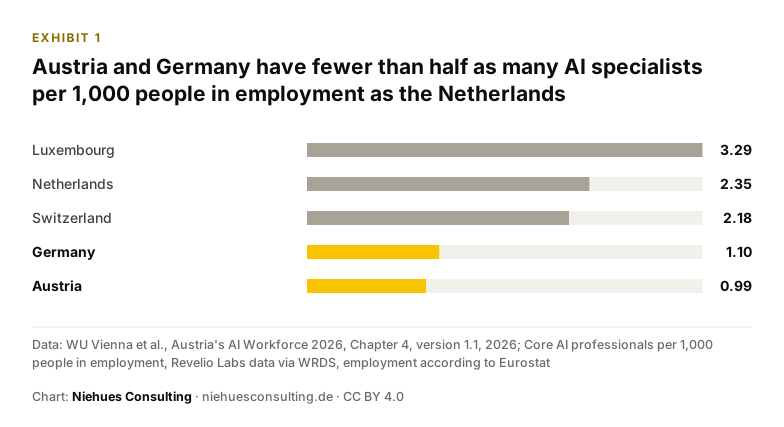
Austria has many specialists relative to its AI workforce, though few relative to its total employment. On the share of Core AI professionals among all AI workers, the country ranks 3rd of 38 European countries at 40.8 percent, behind Germany at 42.5 percent and Switzerland at 41.9 percent. On the number of Core AI professionals per 1,000 people in employment, Austria ranks 19th at 0.99, as Chapter 4 of the study shows.
Exhibit 1
Austria and Germany have fewer than half as many AI specialists per 1,000 people in employment as the Netherlands
The authors describe Austria's position as high technical depth on a narrow base, so the gap to the leading countries arises in deployment across the economy. To match Germany's density, Austria would need 361 additional Core AI professionals according to the study.
AI professionals cluster in large companies, while 97 percent have no AI staff
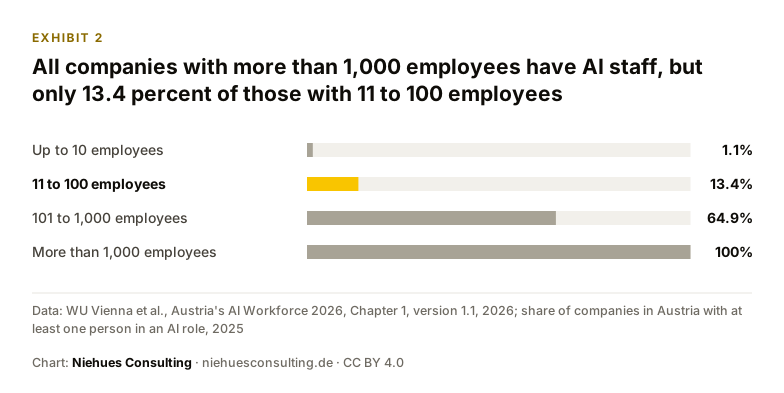
Only 3,190 out of 123,226 Austrian companies employ anyone in an AI role, which is 2.6 percent. The share depends on size, because all companies with more than 1,000 employees have AI staff, but only 13.4 percent of those with 11 to 100 employees.
Exhibit 2
All companies with more than 1,000 employees have AI staff, but only 13.4 percent of those with 11 to 100 employees
Data and download
The share of companies with AI staff has barely changed since 2018, while the share of Core AI professionals in the workforce of these companies almost doubled from 0.72 to 1.34 percent. Growth therefore happens in companies that already have AI staff. The authors accordingly call diffusion the binding constraint and recommend shared infrastructure, advisory services and transfer centers for companies with 10 to 250 employees, because not every company needs its own AI team. Can Tihanyi sums up the finding in the press release: “Technologie-Adaption scheitert fast nie an der Technologie” (technology adoption almost never fails because of the technology).
At the same time the authors call for more university training capacity, because the Build tier, with 1,302 professionals, is scarce. In our assessment, the finding on diffusion weighs more heavily for a company outside the technology sector, because its bottleneck lies in deploying available systems in its own workflows. The prerequisites are described in AI Readiness: Technology, Data and Organization.
Only 6 percent of AI workers are at entry level, the workforce grows through career changers
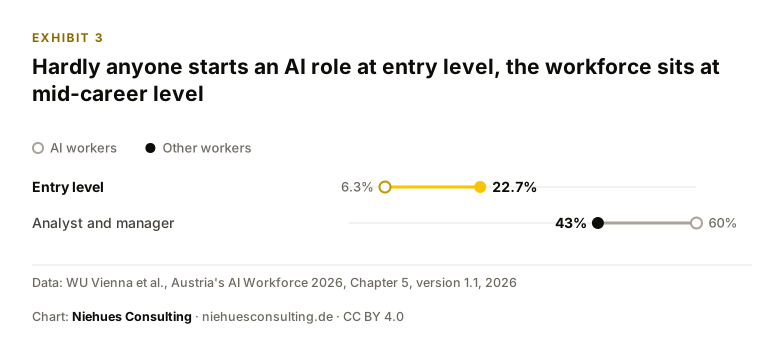
Austria's AI workforce is built from experienced professionals coming from other roles, because hardly any career starters begin directly in AI roles. According to Chapter 5 of the study, 6.3 percent of AI workers are at entry level, compared with 22.7 percent in the rest of the labor market. Analyst and manager levels together account for 60 percent of AI workers, against 43 percent elsewhere. The authors conclude that the workforce was assembled through lateral hiring, moves from adjacent functions and the international recruitment of experienced professionals.
Exhibit 3
Hardly anyone starts an AI role at entry level, the workforce sits at mid-career level
The first years of a career are also the phase in which professionals leave, because according to WU 44 percent of all departures happen in the first year of employment. The study recommends apprenticeships, rotation programs and partnerships between universities and companies that prepare graduates of technical subjects for AI roles within one to two years. In the authors' view the entry-level share should be monitored annually, because measures become urgent below 8 percent. At 6.3 percent, Austria is already below that mark.
By our calculation there is one Core AI professional for every 27 companies in Austria
By our calculation there is one Core AI professional for every 27 companies in Austria, so any approach that gives every company its own specialists fails on the size of the pool. According to Chapter 1, the net addition was around 300 professionals in 2025 after 476 in 2024. The study calls the 2025 figure preliminary, because the data provider records new hires with a delay.
If every net addition went to a company without AI staff, at around 300 a year it would take 400 years until each of the 120,036 companies without AI staff had one professional. The thought experiment exaggerates, because many small companies need no specialist of their own. It shows the order of magnitude, because the specialist market grows by hundreds while the gap spans tens of thousands of companies. At Austria's density, a company with 300 employees accounts on average for 0.3 Core AI professionals, at Germany's for around 0.33, although such a company wants to use AI in almost every business unit.
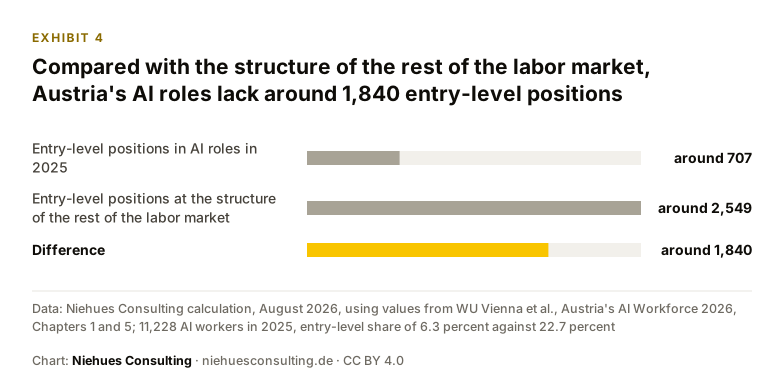
The gap in young talent can be quantified in the same way. If the 11,228 AI workers had the same distribution across levels as the rest of the labor market, around 2,549 of them would be at entry level. At 6.3 percent it is around 707, which means around 1,840 fewer entry-level positions.
Exhibit 4
Compared with the structure of the rest of the labor market, Austria's AI roles lack around 1,840 entry-level positions
Data and download
Data as table
| Label | Value |
|---|---|
| Entry-level positions in AI roles in 2025 | around 707 |
| Entry-level positions at the structure of the rest of the labor market | around 2,549 |
| Difference | around 1,840 |
Chart: Niehues Consulting, CC BY 4.0. Data: Niehues Consulting calculation, August 2026, using values from WU Vienna et al., Austria's AI Workforce 2026, Chapters 1 and 5; the source's terms apply.
In our assessment the German Mittelstand faces the same bottleneck in breadth
Germany shows the same pattern of high specialization and low density in the WU analysis, so in our assessment the findings can be transferred to the German Mittelstand. At 42.5 percent Germany has the highest share of Core AI professionals among the 38 countries, while on density it is only slightly ahead of Austria at 1.10. The study does not report diffusion by company size or the entry-level share for Germany. Transferring these two findings is therefore our own assessment, based on the similar structure of both countries.
For a company there are three routes to AI skills that can be aligned with the tiers of the WU study. They are not mutually exclusive, yet they require different decisions from the executive team.
The integrator route suits the Mittelstand because people with process knowledge already work in the business units and the company can enable them instead of searching for them on the market. Because the Integrate tier has the highest absolute outflows according to the study, the role needs a development path. How to tier skills by role is covered in Building AI capabilities in the organization. How AI reaches daily use is shown in Change management for AI adoption.
Executive teams should first appoint AI integrators in the business units
Executive teams in the Mittelstand can translate the findings into six steps that start with existing staff:
- Take stock: within four weeks, HR and the heads of department record who embeds AI in workflows today and which tier of the WU study the work corresponds to. The step is complete when this figure is available for every unit.
- Appoint integrators: within eight weeks, the executive team and heads of department choose one person with process knowledge per business unit and give them a fixed share of time, such as one day a week. The metric is the number of workflows per unit running with AI in regular operation after six months. Why initiatives without this anchoring stay in the pilot stage is shown in Why AI Pilots Fail to Reach Operations.
- Share specialist expertise: within three months, the head of IT arranges access to specialists through partners, universities or transfer centers. The metric is the time from a business unit's request to the first prototype.
- Redesign entry-level roles: for the 2027 training year, HR and those responsible for vocational training add AI tasks to apprenticeships and trainee roles, with a rotation through two business units and an integrator as mentor. The metrics are the share of entry roles with AI tasks and retention after two years.
- Retain the middle level: within six months, HR defines a specialist career path for integrators alongside the management track, as the study recommends for experienced AI professionals. The metric is turnover in AI roles compared with the rest of the workforce. The role of this level is described in Strengthening middle management.
- Review after twelve months: the executive team and advisory board compare the values from step 1 with actual results. The target is one integrator in every business unit with at least one workflow in regular operation. How managers build the skills themselves is described in AI training programs for executives.
Niehues Consulting connects organization design with building AI skills
Niehues Consulting supports executive teams and heads of department in building organizations that deliver reliably. Organization design creates the roles, career paths and decision paths through which AI skills can take effect in the business units. Where AI enters the workflows, a business case and a prototype come first, followed by introduction with integrators in the business units. In delivery management, a delivery manager or product owner steers the program until the change has arrived in operations.
The approach follows the Niehues Delivery Model with its phases Understand, Build and Introduce. In Understand it establishes who embeds AI in which workflows today and where this role is missing. In Build it defines roles, time allocations and career paths, in Introduce it enables integrators and young talent. Founder Marin Niehues, a management consultant from the delivery side, builds organizations that deliver. His projects range from venture-backed scale-ups to DAX 40 groups, with assignments in 20+ countries on six continents. In the free 30-minute initial consultation you assess together in which business units of your company integrators can advance the use of AI: book a consultation.
Frequently asked questions
When did WU Vienna present the study “Austria's AI Workforce 2026”?
WU Vienna presented the results in a press release on August 24, 2026. The study page stateofai.at gives April 2026 as the month of publication and August 2026 as the month of the update.
How many companies in Austria employ AI professionals?
3,190 out of 123,226 companies employ at least one person in an AI role, which is 2.6 percent. All companies with more than 1,000 employees have AI staff, compared with 13.4 percent of those with 11 to 100 employees.
Why are there so few career starters in AI roles?
According to the study, the AI workforce was built through experienced career changers and international recruitment. 6.3 percent of AI workers are at entry level, against 22.7 percent in the rest of the labor market.
Can the results be transferred to German companies?
Germany shows a similar profile in the same study, with a Core AI share of 42.5 percent and 1.10 professionals per 1,000 people in employment. The study contains no German figures on diffusion by company size or on the entry-level share, so transferring these is our own assessment.
What should Mittelstand companies do now?
They should appoint one integrator with a fixed share of time per business unit, share specialist expertise through partners and universities and redesign entry roles with AI tasks. Success shows in workflows with AI in regular operation and in the retention of young talent.
Let’s talk about your initiative.
In 30 minutes we clarify where your organization stands and which step will pay off most now.
Request a consultation30 minutes · free · no obligation