PwC Midsize AI Study 2026: Savings Come From Integrated Processes
PwC's study “Vom Pilot zur Wertschöpfung: Wie der Mittelstand KI skalierbar macht” (From Pilot to Value Creation: How Midsize Companies Make AI Scalable), published on November 17, 2026, shows that 74 percent of midsize companies in Germany have already engaged actively with AI and use tools from external vendors, while only 23 percent have integrated AI into their internal processes. Close to 70 percent of the 400 companies surveyed saw no effect of AI on their costs over the past year. Among companies with integrated AI processes, 21 percent report lower costs, compared with 11 percent across all respondents. Executive teams should therefore start by building AI fully into a small number of high-volume processes. Our example calculation for invoice processing at a midsize company shows that the integrated process saves 42 percent of processing time, while an AI tool at the desk saves 4 percent.
Three in four German midsize companies use AI tools, only 23 percent have built AI into processes
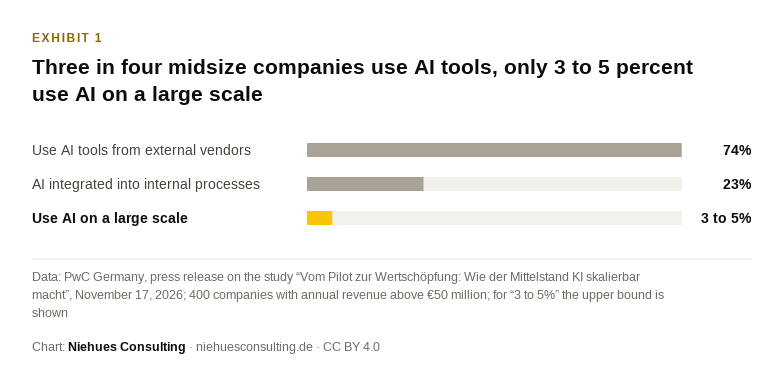
AI is widespread among Germany's midsize companies (the Mittelstand) but rarely built into their workflows. On November 17, 2026, PwC Germany presented the study “Vom Pilot zur Wertschöpfung: Wie der Mittelstand KI skalierbar macht” in Frankfurt, based on a survey of 400 midsize companies with annual revenue above €50 million. According to the PwC press release (in German), 74 percent of the companies have already engaged actively with AI and use tools from external vendors. Only 23 percent have integrated AI into internal processes.
Just 3 to 5 percent of respondents use AI on a large scale. About a third use it selectively in areas such as sales or marketing. In PwC's assessment, many midsize companies remain stuck in a phase of evaluation, experiments and pilots. Few have made the leap to productive use.
Exhibit 1
Three in four midsize companies use AI tools, only 3 to 5 percent use AI on a large scale
Data and download
Data as table
| Label | Value |
|---|---|
| Use AI tools from external vendors | 74% |
| AI integrated into internal processes | 23% |
| Use AI on a large scale | 3 to 5% |
Chart: Niehues Consulting, CC BY 4.0. Data: PwC Germany, press release on the study “Vom Pilot zur Wertschöpfung: Wie der Mittelstand KI skalierbar macht”, November 17, 2026; the source's terms apply.
That leaves a gap of 51 percentage points between use and integration. The gap describes the share of past spending on licenses, training and pilots that is not yet working in any workflow. It is the first figure an executive team should know for its own company before it approves the AI budget for 2027.
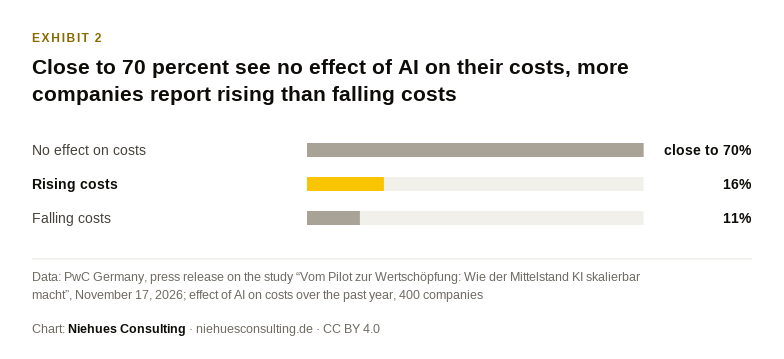
Close to 70 percent of midsize companies see no effect of AI on their costs
For most respondents, the financial effect has not yet materialized. Close to 70 percent saw no effect of AI on their costs over the past year. Falling costs are reported by 11 percent, rising costs by 16 percent. For every two companies that save money with AI, about three have seen their costs go up.
Exhibit 2
Close to 70 percent see no effect of AI on their costs, more companies report rising than falling costs
Data and download
Data as table
| Label | Value |
|---|---|
| No effect on costs | close to 70% |
| Rising costs | 16% |
| Falling costs | 11% |
Chart: Niehues Consulting, CC BY 4.0. Data: PwC Germany, press release on the study “Vom Pilot zur Wertschöpfung: Wie der Mittelstand KI skalierbar macht”, November 17, 2026; the source's terms apply.
Rising costs are to be expected at this stage. Licenses, integration and training are paid for up front, while relief arrives only once a workflow changes. A company that hands out tools to many employees without redesigning a single process pays these costs with nothing to offset them.
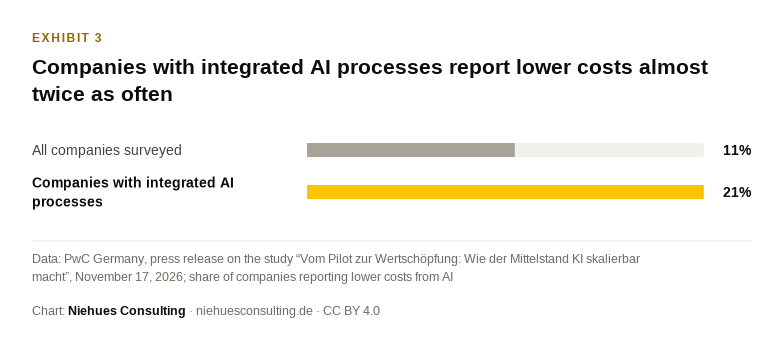
Companies with integrated AI processes stand out. In this group the share reporting lower costs is 21 percent, almost twice the rate across all respondents. PwC sees this as a sign of how much the depth of implementation matters for recouping AI investments. A survey alone cannot tell whether integration causes the savings, since companies with integrated AI may be further ahead in other respects as well. The direction matches what can be calculated for a single workflow.
Exhibit 3
Companies with integrated AI processes report lower costs almost twice as often
Data and download
Data as table
| Label | Value |
|---|---|
| All companies surveyed | 11% |
| Companies with integrated AI processes | 21% |
Chart: Niehues Consulting, CC BY 4.0. Data: PwC Germany, press release on the study “Vom Pilot zur Wertschöpfung: Wie der Mittelstand KI skalierbar macht”, November 17, 2026; the source's terms apply.
Data security, a shortage of skilled staff and a confusing tool market slow the move into processes
Respondents name mainly organizational challenges as obstacles. 71 percent have concerns about data security and ethical issues, 69 percent point to a shortage of skilled staff with AI-specific expertise. Almost 60 percent find the tool market and the fast pace of the AI ecosystem confusing. PwC lists further difficulties: the added value of AI is hard to quantify, custom AI solutions take a lot of effort and the data foundation is not reliable. According to the study, only a minority of respondents shy away from the necessary investment.
These barriers grow as AI moves from a tool into a process. An assistant that rewrites a paragraph needs no master data. A process that checks invoices against purchase orders needs clean supplier and order data, controlled access rights and employees who can judge discrepancies.
This suggests a sequence. Once a company has quantified the benefit of a process in hours and euros, it can complete the data work and the security review for that one process. It also only has to evaluate the tools that this process needs, which makes the confusing choice manageable. The barriers then become tasks with a scope and a deadline. The company does not have to solve them for every department at once.
An example calculation in finance shows the gap between tool and process
Finance and controlling is a good place for the calculation, because the function handles many similar transactions. According to PwC, only 10 percent of respondents have built AI-based solutions into their finance and controlling processes. Another 43 percent have not yet engaged actively with the topic there. Bastian de Hesselle, partner for midsize companies and technology at PwC, considers this function the best starting point for productive use of AI. Any executive team can replace the assumptions below with its own figures.
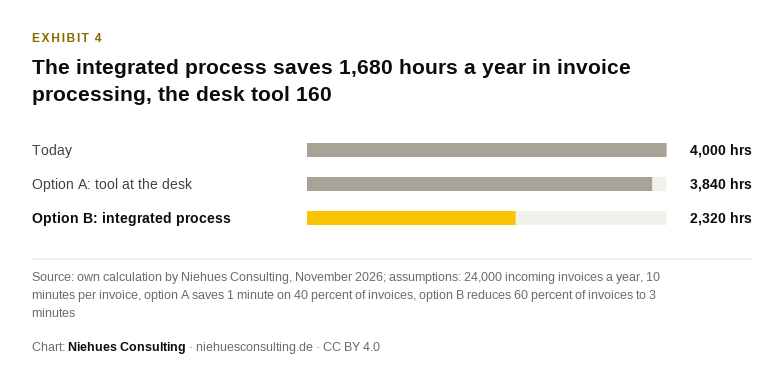
Under option A, the company saves 9,600 minutes or 160 hours a year, 4 percent of processing time. That time is spread in single minutes across the accounts payable team and never shows up in a cost center. Under option B, the effort for the 14,400 invoices without discrepancies falls from 2,400 to 720 hours. The company saves 1,680 hours or 42 percent, a little more than one full-time position.
Exhibit 4
The integrated process saves 1,680 hours a year in invoice processing, the desk tool 160
The company can redeploy the freed capacity to controlling for cash flow planning and variance analysis. It can also leave the position unfilled at the next departure. Either way, the effect can be measured in hours and euros. That measurability is what the close to 70 percent of respondents who see no effect on their costs are missing. Respondents have not seen broad job cuts from AI so far: 10 percent report that AI has led to more employees, 5 percent the opposite.
Option B requires more groundwork. Master data has to be correct, the connection to the accounting and ERP systems has to be built and someone has to define the approval rules for discrepancies. As long as a company only hands out tools, this work does not happen and the measurable relief does not arrive. Which finance use cases are suited for a first step is covered in AI in Finance: Controlling, Reporting, Forecasts.
Midsize companies should first rebuild a few high-volume processes completely
For the executive team, the study and the calculation point to shifting the AI budget from breadth to depth. First come two or three processes with many similar transactions, clear rules and measurable processing time, such as invoice processing, quote preparation, order entry or complaint handling. Each of these processes gets a business case with hours, euros and a review date before anything is built, as described in AI Business Case for the Decision.
The redesign starts with the process itself. Christine Flath, partner for assurance and tech and AI transformation at PwC Germany, advises companies to develop new business models and optimize processes first and only then use AI applications, because otherwise automation with AI can multiply existing inefficiencies. In invoice processing, that means cleaning up approval levels and posting rules before the AI applies them.
Moving from pilot to regular operations requires an owner in the business unit, a metric and a date on which management decides whether to expand or stop. The steps are covered in From Pilot to Scale: Embedding AI in Regular Operations, the overall framework in the AI implementation guide.
Tools rolled out broadly keep their value, because they are how employees learn to work with AI. Their cost therefore belongs in the training budget, the savings targets in the process projects. That way management can see in its controlling reports which part of AI spending is expected to lower costs.
Executive teams should choose their processes before the 2027 budget
Executive teams at midsize companies can derive five steps from the study that move AI from broad use into individual processes with a measurable effect:
- Take stock: by mid-December 2026, the head of IT lists which AI tools are in use, what they cost and in which workflows they deliver results. Success means management knows the gap between use and integration for its own company.
- Select processes: by the end of January 2027, management and department heads choose two or three high-volume processes and measure current processing time there. The metric is minutes per transaction.
- Build the business case: controlling and the business unit quantify the saving, the effort for data and integration and a review date for each process. Success means every process is in the 2027 budget with a target value.
- Clarify data and security per process: by the end of March 2027, data protection, information security and the business unit review data, access rights and vendors for the selected processes. The metric is the share of error-free master data in the process.
- Measure the effect monthly: from go-live, the business unit reports minutes per transaction and the share of transactions without rework every month. After six months, management decides whether to expand or stop.
Niehues Consulting takes AI from the business case into regular operations
Niehues Consulting helps executive teams and department heads use AI where it pays off. In AI management, the team analyzes workflows, writes the requirements and calculates the business case before any money goes into technology. Prototypes then prove the benefit in the real workflow. Together with your internal or external teams, the result goes into operations, with new workflows, clear responsibilities and people who work with it confidently. In delivery management, Niehues Consulting steers the program as delivery manager, project manager or product owner through to delivery.
The approach has three phases. In Understand, we establish which processes have enough volume and how success will be measured. In Build, the integrated process is created first as a prototype with real documents. In Introduce, it goes into regular operations with metrics and owners. In a first call we work out with you where your company stands and which process is worth tackling first: book a call.
Frequently asked questions
When did PwC publish the study “Vom Pilot zur Wertschöpfung”?
PwC Germany published the study “Vom Pilot zur Wertschöpfung: Wie der Mittelstand KI skalierbar macht” on November 17, 2026. It surveyed 400 midsize companies in Germany with annual revenue above €50 million.
How many midsize companies in Germany use AI?
According to the PwC study, 74 percent of the midsize companies surveyed have engaged actively with AI and use tools from external vendors. Only 23 percent have integrated AI into internal processes. Just 3 to 5 percent use it on a large scale.
Does AI lower costs for midsize companies?
So far, only 11 percent of the midsize companies surveyed report falling costs from AI. Close to 70 percent saw no effect on their costs over the past year, while 16 percent report rising costs. Among companies with integrated AI processes, 21 percent report lower costs.
Why do companies using AI tools save so little?
A tool at the desk saves individual employees a few minutes that are spread across many people and never reach a cost center. In our example calculation for invoice processing, that is 160 hours a year, while the integrated process saves 1,680 hours.
What keeps midsize companies from building AI into processes?
In the PwC study, 71 percent have concerns about data security and ethical issues and 69 percent point to a shortage of skilled staff with AI-specific expertise. Almost 60 percent find the tool market confusing. Added value that is hard to quantify, the effort for custom solutions and an unreliable data foundation add to this.
Which processes are suited for getting started with AI?
Good starting points are processes with many similar transactions, clear rules and measurable processing time. Examples include invoice processing, quote preparation, order entry and complaint handling.
How much time does AI save in invoice processing?
That depends mainly on the share of invoices without discrepancies. In our example with 24,000 invoices a year and 60 percent without discrepancies, the integrated process saves 42 percent of processing time (1,680 hours).
How does a company measure the benefit of AI in a process?
A company measures the benefit of AI in a process by minutes per transaction and the share of transactions without rework, before and after the redesign. A fixed review date after six months shows whether the business case holds and the process should be expanded.
Let’s talk about your initiative.
In 30 minutes we clarify where your organization stands and which step will pay off most now.
Request a consultation30 minutes · free · no obligation