NIS2 and AI applications: what the cybersecurity obligations mean for your AI
NIS2 covers every AI application that an in-scope company operates for its services, with the same risk management and incident reporting obligations as any other IT system. The directive contains no AI-specific provisions, yet its obligations apply in full. This article shows when your AI falls within scope, which measures follow in practice and how management provides the evidence. This article provides an overview and does not constitute legal advice.
Who does NIS2 apply to?
NIS2 applies to medium-sized and large companies in 18 sectors listed in two annexes of the directive, and to certain entities regardless of their size. Medium-sized companies are those with 50 or more employees or with annual turnover and balance sheet total above 10 million euros. In Germany, the NIS2 implementation act transposes the directive and reorganises the obligations within the BSI Act.
The directive distinguishes essential and important entities, which German law calls particularly important and important entities. Essential entities are mainly large companies in highly critical sectors such as energy or health, together with operators of critical facilities. Important entities are medium-sized companies in those sectors and companies in the other sectors, including large parts of manufacturing such as machinery or motor vehicles. The German government's explanatory memorandum estimates that around 29,500 entities will be supervised by the Federal Office for Information Security (BSI).
Check first whether the company as a whole is in scope; sector and size decide, the use of AI does not. If it is, the next question is which AI applications support your services.
When does an AI application fall under NIS2?
An AI application falls under NIS2 as soon as the in-scope company operates or uses it within the network and information systems through which it provides its services. The directive is technology-neutral.
In practice, three categories help, and they differ in the depth of obligations:
- AI in the service process: The application steers a service for which the company falls under NIS2, such as forecasts in grid operations or quality inspection in manufacturing. All measures apply in full here, and an outage can be a reportable incident.
- AI in support processes: Assistants for writing or internal analysis. They process company data and create access paths to other systems. Access control and data leakage are the main concerns.
- Unapproved AI: Tools that employees use without review. They are also subject to risk management because the obligation to maintain an asset inventory covers all systems in use. How to detect such use is described in the article Shadow AI: detecting and managing uncontrolled use.
Providers are a special case. Anyone who delivers AI as a cloud service or as a managed IT service to other companies belongs to a NIS2 sector in their own right from medium size upwards.
What obligations does NIS2 impose on AI applications?
For AI applications, NIS2 brings the ten minimum risk management measures, including supply chain security, together with the reporting obligations for significant incidents. The measures must be proportionate to the risk and take the state of the art into account. For AI, this means explicitly including the known attack paths against language models and agents in the risk analysis.
Two points deserve particular attention. The first is the supply chain. The directive requires companies to take into account the vulnerabilities of each direct supplier and the quality of its security practices, including secure development procedures. For most companies, the model provider is the most important new supplier. The second point is agents. An AI that calls systems and triggers transactions on its own needs its own identities with tightly limited permissions. The typical attack paths are described in the article AI security: prompt injection and new attack surfaces.
In its publication on generative AI models, the German Federal Office for Information Security recommends carrying out a dedicated risk analysis before integrating such models into workflows. That analysis is at the same time the evidence NIS2 expects. The principles of securing generative AI are summarized in the article Information security for generative AI.
How quickly must an AI incident be reported?
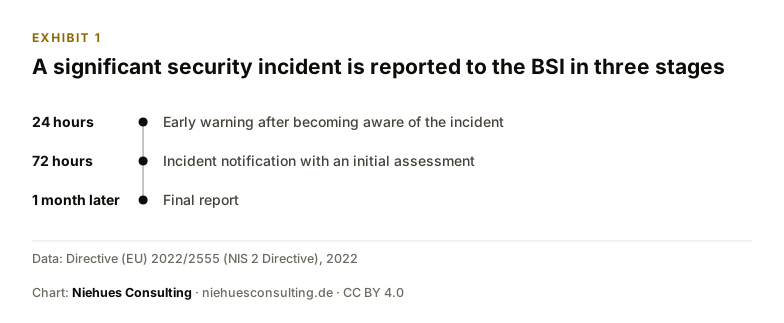
A significant incident must be reported as an early warning within 24 hours of becoming aware of it, followed by an incident notification with an initial assessment within 72 hours and a final report no later than one month after that. In Germany, reports go to the Federal Office for Information Security.
Exhibit 1
A significant security incident is reported to the BSI in three stages
Data and download
Data as table
| Date | Event |
|---|---|
| 24 hours | Early warning after becoming aware of the incident |
| 72 hours | Incident notification with an initial assessment |
| 1 month later | Final report |
Chart: Niehues Consulting, CC BY 4.0. Data: Directive (EU) 2022/2555 (NIS 2 Directive), 2022; the source's terms apply.
An incident is significant if it has caused or is capable of causing severe operational disruption of the services or financial loss, or if it causes considerable damage to other persons. For AI applications, four scenarios need to be thought through:
- Outage: The AI application in the service process fails, and the service is restricted.
- Data leakage: Confidential data leaves the company through answers or interfaces.
- Manipulation: Attackers alter outputs through crafted inputs or documents.
- Supplier incident: The model provider or platform reports a security incident.
The 24-hour deadline can only be met if it is settled in advance who assesses and reports an AI incident. Appoint an operational owner for every AI application in the service process and rehearse the procedure once before go-live.
What does NIS2 mean for management?
Management must approve the risk management measures and oversee their implementation, it must attend training regularly, and it can be held liable for infringements. This makes cybersecurity a leadership task whose oversight remains with management even when IT implements it.
Three requirements follow for governance. Management needs a complete list of AI applications with owners. It needs a fixed date on which it approves the measures. And it needs metrics that show whether the measures are working. These requirements match what functioning AI management delivers in any case. The overall framework is described in the article AI management: what executive leadership must steer.
NIS2, the AI Act and ISO standards interlock
NIS2, the EU AI Act and the relevant ISO standards address different questions and can be met within a single management system. NIS2 governs the security of the entity and its services. The AI Act regulates AI systems according to their risk and explicitly requires an appropriate level of robustness and cybersecurity for high-risk systems. The article EU AI Act provides an overview.
For many companies, ISO/IEC 27001 already forms the information security management system on which the NIS2 measures build. ISO/IEC 42001 adds a management system for AI with roles and impact assessment. Keep both in one register listing each AI application with its NIS2 relevance, AI Act risk class and accountable person.
How Niehues Consulting brings NIS2 requirements into AI operations
Niehues Consulting anchors NIS2 obligations in the portfolio and in the operating concept of every AI application, so that security is part of delivery from the start. The basis is the Niehues Delivery Model with its phases Understand, Build and Embed. Three of its review questions matter most for NIS2. Who decides, who delivers, who uses? The answer determines who approves an AI application and who operates it. Which roles, decision paths and interfaces do operations need? The answer provides the shutdown path and reporting chain. Who owns operations from day one? The answer ensures that the 24-hour deadline can be met from go-live onwards.
Marin Niehues combines AI management with delivery management, in projects ranging from VC-funded scale-ups to DAX 40 corporations and in assignments in 20+ countries across six continents. Legal classification remains with your legal department or law firm, technical safeguards with your information security function. The starting point is a free 30-minute initial consultation in which you clarify which of your AI applications fall under NIS2 and what follows from that.
Frequently asked questions
Does NIS2 apply to AI systems?
NIS2 applies to AI systems as soon as an in-scope company operates or uses them for its services. The directive is technology-neutral and does not distinguish AI from other information systems. What matters is whether the company itself falls within scope.
How do I know whether my company falls under NIS2?
Check sector and size: companies with 50 or more employees or with annual turnover and balance sheet total above 10 million euros in one of the directive's 18 sectors are in scope. In Germany, the Federal Office for Information Security provides an online scope check for this purpose. In-scope entities must register with the authority.
Is an AI provider a supplier under NIS2?
A model provider or AI platform that you use for your services is a direct supplier whose security you must take into account in risk management. This includes assessing its security practices and a plan for its outage.
What counts as a reportable incident for an AI application?
An incident is reportable if it causes or can cause severe operational disruption of the services or financial loss, or considerable damage to others. For AI applications, typical cases are an outage in the service process or data leakage through answers. The early warning is due within 24 hours.
Are directors personally liable under NIS2?
Management can be held liable for breaches of the risk management obligations. It must approve the measures and oversee their implementation. Delegating to IT does not release management from its oversight duty.
How do NIS2 and the AI Act relate to each other?
NIS2 governs the cybersecurity of the entity and its services, while the AI Act regulates AI systems according to their risk. Both apply side by side and can be met with a shared register of AI applications. For high-risk AI, the AI Act adds its own requirements for robustness and cybersecurity.
Is ISO 27001 certification enough for NIS2?
ISO 27001 certification covers a large part of the NIS2 measures, yet it replaces neither the reporting obligations nor the duties of management. For AI applications, the scope of the management system must explicitly include the models and their suppliers.
What does NIS2 compliance for AI applications cost?
Costs depend on the number of AI applications in the service process and on the maturity of existing security management. According to the fee study of the German Association of Management Consultants (BDU), external consulting in the German market is typically billed at around 1,000 to 2,500 euros per consultant day. Where an ISO 27001 system is already in place, the effort essentially comes down to the register and reporting channels for the AI applications.
Let’s talk about your initiative.
In 30 minutes we clarify where your organization stands and which step will pay off most now.
Request a consultation30 minutes · free · no obligation