Glasl's Conflict Escalation Model: The Nine Stages and When Management Must Step In
According to Friedrich Glasl, a conflict escalates through nine stages, and management must step in at the latest when the parties form coalitions at stage 4 and play only to win. Up to that point, the people involved can resolve the conflict with their manager moderating. Beyond it they need a neutral third party, and from stage 7 only a decision from above will help. This article shows how to recognize each stage at work, which intervention fits and how to remove the structural causes of recurring conflict.
Where the article touches on transfers, dismissals and the role of the works council: This article provides an overview and does not constitute legal advice.
What Glasl's escalation model describes
The model developed by the Austrian conflict researcher Friedrich Glasl describes how a conflict intensifies over nine stages and how the options open to the parties shrink as it does. Glasl first set it out in 1980 in his handbook on conflict management, which has since run to many editions and is regarded as a standard work on conflict resolution in the German-speaking world.
Two ideas make the model valuable for executives. Glasl describes escalation as a descent: each stage takes the parties into a more primitive form of confrontation, and each step down makes the way back harder. He also groups the stages into three levels, each with its own logic of resolution.
- Stages 1 to 3, the “win-win” level: both sides can still gain and remain willing to talk.
- Stages 4 to 6, the “win-lose” level: one side is meant to win and the other to lose. Reputation and followers become the currency.
- Stages 7 to 9, the “lose-lose” level: both sides accept losses of their own as long as the opponent loses more.
What are Glasl's nine stages of conflict escalation?
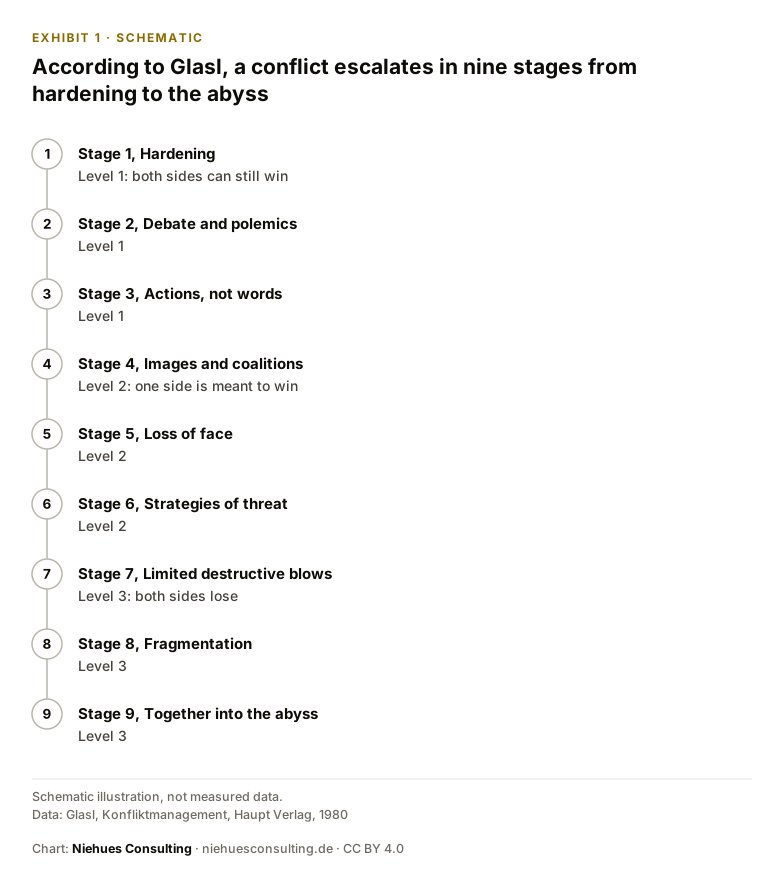
Glasl's model runs through nine stages, from the hardening of positions to a joint plunge into the abyss. The overview below gives, for each stage, the signal by which you will recognize it in an organization.
Exhibit 1 · Schematic
According to Glasl, a conflict escalates in nine stages from hardening to the abyss
Source: Glasl, Konfliktmanagement, Haupt Verlag, 1980
Data and download
Data as table
| No. | Step | Description |
|---|---|---|
| 1 | Stage 1, Hardening | Level 1: both sides can still win |
| 2 | Stage 2, Debate and polemics | Level 1 |
| 3 | Stage 3, Actions, not words | Level 1 |
| 4 | Stage 4, Images and coalitions | Level 2: one side is meant to win |
| 5 | Stage 5, Loss of face | Level 2 |
| 6 | Stage 6, Strategies of threat | Level 2 |
| 7 | Stage 7, Limited destructive blows | Level 3: both sides lose |
| 8 | Stage 8, Fragmentation | Level 3 |
| 9 | Stage 9, Together into the abyss | Level 3 |
Chart: Niehues Consulting, CC BY 4.0. Data: Glasl, Konfliktmanagement, Haupt Verlag, 1980; the source's terms apply.
Level 1: both sides can still win
Stage 1: Hardening. Positions harden, and the same arguments collide meeting after meeting. Signal: an item appears on every agenda and is never decided.
Stage 2: Debate and polemics. The parties polarise and want to win the argument. Signal: long email threads with an ever-growing list of recipients.
Stage 3: Actions, not words. Talking is seen as pointless, the parties create facts on the ground and empathy declines. Signal: one function launches an initiative without the alignment the other would have blocked.
Level 2: one side is meant to win
Stage 4: Images and coalitions. Enemy images form, the parties recruit allies and neutral colleagues come under pressure to take sides. Signal: pre-meetings in which majorities are organized in advance.
Stage 5: Loss of face. Attacks target the moral integrity of the other side, often in front of an audience. Signal: accusations of dishonesty in committees.
Stage 6: Strategies of threat. Demands are tied to sanctions and deadlines. Every threat must be carried out to remain credible. Signal: ultimatums with a threatened resignation.
Level 3: both sides lose
Stage 7: Limited destructive blows. The parties accept damage to themselves if the opponent suffers more. Signal: deliberate sabotage of the other side's projects.
Stage 8: Fragmentation. The aim is to destroy the opponent's power base, such as their function or their standing.
Stage 9: Together into the abyss. The parties accept their own downfall. In companies this stage ends with the loss of key people or customers.
When should management step in?
Management must step in as soon as a conflict reaches the threshold of stage 4, that is, when camps form and uninvolved colleagues are pushed to take sides. From this point on the parties want to win, and neither can back down without losing face in front of its own allies.
At stages 1 to 3 responsibility lies with the line manager. They moderate, make the substantive question visible and ensure a decision is taken. At stage 3 they also examine the structure, because facts on the ground tend to be created where decision rights are unclear.
From stage 4 the next level of management takes over. It commissions a neutral process facilitator, sets the frame and makes clear that the company expects a resolution. From stage 7 the authority above both parties decides on responsibilities, transfers or separations. Such measures are subject to employment law requirements and to the participation rights of the works council, which you should plan for early.
Which intervention fits which stage?
Glasl assigns a specific form of intervention to each section of the escalation, with the ranges overlapping. The further a conflict has progressed, the more control the third party takes over.
- Moderation, stages 1 to 3: a manager structures the conversation and the parties work out the solution themselves.
- Process facilitation, stages 3 to 5: a neutral facilitator works with the parties on perceptions and procedures.
- Socio-therapeutic process facilitation, stages 4 to 6: it addresses deeper injuries and enemy images.
- Mediation, stages 5 to 7: a mediator leads the parties to an agreement they can no longer reach directly.
- Arbitration or court proceedings, stages 6 to 8: a third party decides on the substance.
- Power intervention, stages 7 to 9: the higher authority imposes a solution, even against the will of the parties.
Glasl also distinguishes hot from cold conflicts. Hot conflicts are fought openly and with conviction. Cold conflicts show up as withdrawal and obstruction through formalities. Because there is no open dispute, management frequently overlooks cold conflicts until they have reached a high stage.
Which conflicts harm performance
Besides the stage, the type of conflict matters, because research shows that disagreement on substance does not, on average, harm performance. Organizational psychology distinguishes task conflict about content, relationship conflict between people and process conflict about responsibilities.
A meta-analysis of 30 studies initially found that both task and relationship conflict were associated with lower team performance, particularly on complex tasks. A later meta-analysis of 116 studies covering some 8,880 groups paints a more precise picture. Relationship and process conflict are consistently associated with poorer outcomes. Task conflict does not reliably harm performance on average and tends to be positive in top management teams, provided it does not turn personal.
The guidance for leaders is therefore clear: encourage open disagreement on substance and prevent the shift to the personal. Glasl's stage 4 marks precisely that shift. Teams with high psychological safety handle task conflict openly without it escalating. The article on psychological safety and team performance describes how leaders create this condition.
Why the same conflicts keep coming back
Recurring conflicts in organizations almost always have a structural cause. Process conflict arises where two roles are responsible for the same decision, or none is. Goal conflict arises where the targets of two functions cannot be met at the same time. Resource conflict arises where there is no prioritization rule.
One test separates structural from personal causes: would the same conflict arise again with different people in the same positions? If the answer is yes, any mediation treats only the symptom. The pattern is especially common with dual reporting lines, as the article on the matrix organization explains.
Prevention follows from the cause. Clear decision rights for recurring decisions, a target system without built-in contradictions and an escalation path with deadlines stop conflicts from growing beyond stage 3. How these elements fit together is set out in the article characteristics and metrics of a high-performing organization.
What does an escalated conflict cost?
An escalated conflict costs above all management time, delay and staff turnover, and these costs exceed those of an early intervention many times over. The calculation needs only figures every company already has.
There are reliable market ranges for external support. The mediation rules of a major German chamber of commerce provide for hourly fees of 150 to 350 euros and daily fees of 1,200 to 2,800 euros for commercial mediation. For organizational consulting that works on structures and roles, daily rates according to the fee survey of the German Association of Management Consultants are around 1,000 to 2,500 euros.
Niehues Consulting as a partner for structural conflict
You end recurring conflicts by changing the structure, and for that you need a partner who combines organization design with accountability for delivery.
Niehues Consulting, based in Düsseldorf, works on this from a delivery perspective. Founder Marin Niehues builds organizations that deliver and, where needed, takes on the role of delivery manager, project manager or product owner himself. His projects range from VC-backed scale-ups to DAX 40 corporations, with assignments in 20+ countries on six continents.
The approach follows the Niehues Delivery Model with its three phases Understand, Build, Implement. Two review questions matter most for structural conflict. In the Understand phase: who decides, who delivers, who uses? In the Build phase: which roles, decision paths and interfaces does operation require? In a free 30-minute initial consultation you can clarify whether your conflict has a structural cause and which step comes first. Book an appointment.
Frequently asked questions
What is Glasl's model of conflict escalation?
Friedrich Glasl's model describes in nine stages how a conflict intensifies from hardened positions to mutual destruction. The stages are grouped into three levels on which first both sides, then one side and finally neither side can win. For each section Glasl names a suitable form of intervention.
What do win-win, win-lose and lose-lose mean in Glasl's model?
They are the three levels of the model. At stages 1 to 3 the parties look for a solution in which both gain. At stages 4 to 6 each side wants to win at the other's expense, and from stage 7 both accept losses of their own as long as the opponent loses more.
At what stage of conflict is a mediator needed?
According to Glasl, mediation is the appropriate intervention at stages 5 to 7. From stage 4 a neutral process facilitator is already advisable, because the parties can no longer resolve the conflict alone. The earlier the third party is brought in, the more room the parties retain.
What is the difference between hot and cold conflicts?
Hot conflicts are fought openly and with conviction, and the parties seek confrontation. Cold conflicts show up as withdrawal and obstruction through rules and formalities. They are harder for management to detect and are therefore often further escalated than they appear.
How much does workplace mediation cost?
Commercial mediation in Germany is typically billed at 150 to 350 euros an hour or 1,200 to 2,800 euros a day. The mediator and the parties agree the scope in a preliminary meeting, and chamber procedures add an administrative fee. The total is far below what a persistent conflict costs in management time and delay.
Is conflict in teams always harmful?
Task conflict about content does not, on average, harm team performance according to current research and tends to be positive in top management teams. Relationship and process conflict, by contrast, are consistently associated with poorer outcomes. The leader's task is to keep the dispute on the substance.
Let’s talk about your initiative.
In 30 minutes we clarify where your organization stands and which step will pay off most now.
Request a consultation30 minutes · free · no obligation