EU AI Act Support in NRW and Bavaria: Start With an AI Inventory

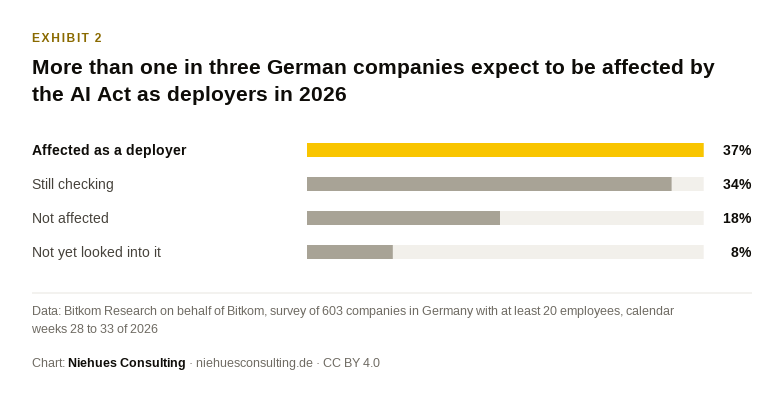
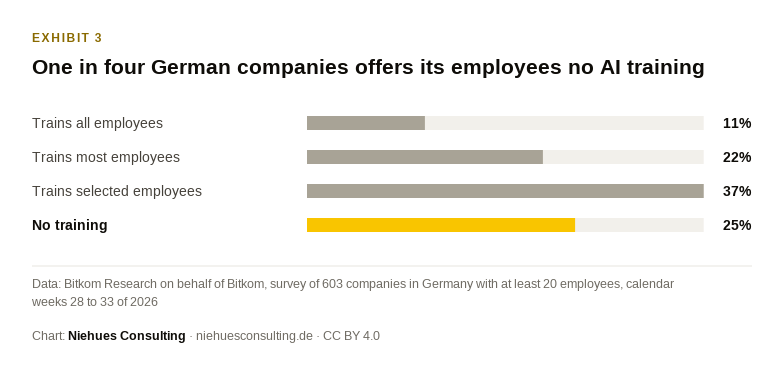
North Rhine-Westphalia and Bavaria want to make the EU AI Act easier to implement and will share regulatory sandbox methods, tools, training, guidelines and audit catalogs. Their joint letter of intent of November 20, 2026 is aimed at small and medium-sized enterprises, start-ups and public bodies. A company gets value from this support only once it knows which AI systems it uses, in which role and at what level of risk. In a Bitkom survey from September 2026, more than one in three German companies expected to be affected as a deployer. One in four does not yet train its staff in the use of AI.
NRW and Bavaria will share sandboxes, tools, training and audit catalogs for the AI Act
The NRW Ministry for Economic Affairs, Industry, Climate Action and Energy and the Bavarian State Ministry for Digital Affairs have agreed a joint letter of intent to help companies use AI. According to the NRW ministry's press release of November 20, 2026, the aim is to reduce the effort and cost of implementing the EU AI Act as far as possible. The declaration targets small and medium-sized enterprises, start-ups and public bodies and names four areas of cooperation:
- Regulatory sandboxes: the states exchange methods and experience so that test environments can be set up quickly. In these environments, AI systems are to be tested under real conditions in close coordination with supervisory authorities.
- Tools: they share technical aids and processes that allow the AI Act to be implemented in a partly automated way.
- Training: they exchange courses that build AI literacy.
- Development, testing and certification: they exchange methods and provide guidance material such as guidelines and audit catalogs.
The cooperation covers only open, free offerings that have been or are being developed under publicly funded programs. Delivery partners are the appliedAI Institute for Europe, which leads the consortium behind Bavaria's AI innovation accelerator (KI-Innovationsbeschleuniger). The second partner is KI.NRW with its project ZERTIFIZIERTE KI (certified AI). NRW economics minister Mona Neubaur said the state wants mid-sized companies and start-ups to be able to comply with the EU's AI rules without investing more time and money than necessary. Till Klein, Head of AI Regulation at appliedAI, said that companies need concrete compliance support they can apply immediately.
The Digital Omnibus pushed back the high-risk deadlines, while AI literacy has applied since February 2025
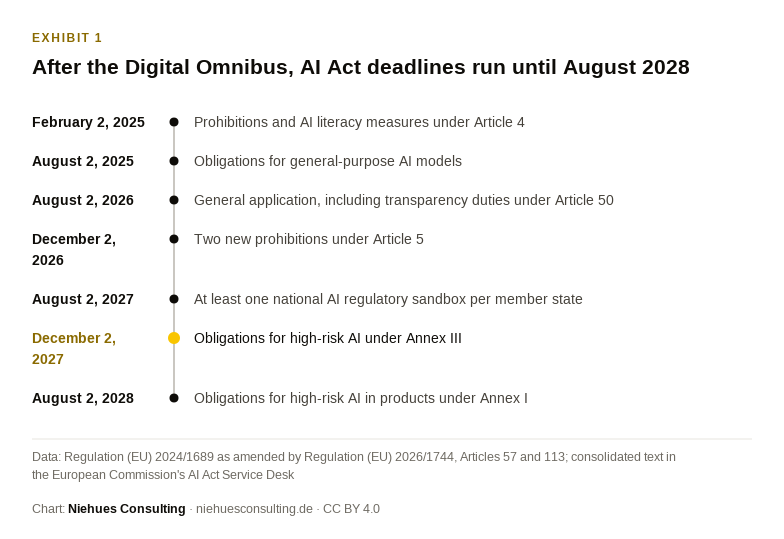
The states' initiative comes as the obligations of the AI Act, Regulation (EU) 2024/1689, draw closer but take effect later than originally planned. The Digital Omnibus on AI, Regulation (EU) 2026/1744, postponed the deadlines for high-risk AI and has been in force since July 27, 2026. Under the amended Article 113, the requirements for high-risk systems under Annex III apply from December 2, 2027. According to the European Commission, these include use cases in biometrics, education and employment. High-risk AI embedded in products under Annex I, such as elevators or toys, follows on August 2, 2028.
The obligation in Article 4, which the Omnibus rewrote, has applied since February 2, 2025. Providers and deployers of AI systems must take measures to support the AI literacy of their staff, taking into account technical knowledge, experience, education and the context in which the systems are used. Under the new wording they are not required to guarantee any specific level of AI literacy for an individual. The transparency obligations in Article 50 have applied since August 2, 2026. They require deployers, for example, to disclose that a deepfake has been artificially generated. How to build labeling into your workflow is covered in Labeling AI-generated content.
Exhibit 1
After the Digital Omnibus, AI Act deadlines run until August 2028
Data and download
Data as table
| Date | Event |
|---|---|
| February 2, 2025 | Prohibitions and AI literacy measures under Article 4 |
| August 2, 2025 | Obligations for general-purpose AI models |
| August 2, 2026 | General application, including transparency duties under Article 50 |
| December 2, 2026 | Two new prohibitions under Article 5 |
| August 2, 2027 | At least one national AI regulatory sandbox per member state |
| December 2, 2027 | Obligations for high-risk AI under Annex III |
| August 2, 2028 | Obligations for high-risk AI in products under Annex I |
Chart: Niehues Consulting, CC BY 4.0. Data: Regulation (EU) 2024/1689 as amended by Regulation (EU) 2026/1744, Articles 57 and 113; the source's terms apply.
A further deadline matters for the states' sandboxes. Under Article 57, each member state must have at least one national AI regulatory sandbox operational by August 2, 2027. In Germany, the Federal Network Agency (Bundesnetzagentur) has been the market surveillance authority, single point of contact and complaints office for the AI Act since July 29, 2026 (Bundesnetzagentur, July 29, 2026). It is setting up an AI sandbox focused on small and medium-sized enterprises. Its AI service desk offers an online tool for a first assessment of a system's risk class and guidance on building AI literacy. The states' offerings add to these federal services.
More than one in three German companies expect to be affected while most implementations are at an early stage
A Bitkom survey shows the need the states are responding to. In the survey published September 14, 2026, which covered 603 companies with at least 20 employees, 37 percent expected to be affected by the AI Act as deployers, up from 23 percent a year earlier. Another 34 percent are still checking. Among those that are affected or still checking, 89 percent expect a high implementation effort and 51 percent a very high one. Bitkom president Ralf Wintergerst said the AI Act was meant to create trust but is causing widespread uncertainty.
Exhibit 2
More than one in three German companies expect to be affected by the AI Act as deployers in 2026
Data and download
Data as table
| Label | Value |
|---|---|
| Affected as a deployer | 37% |
| Still checking | 34% |
| Not affected | 18% |
| Not yet looked into it | 8% |
Chart: Niehues Consulting, CC BY 4.0. Data: Bitkom Research on behalf of Bitkom, survey of 603 companies in Germany with at least 20 employees, calendar weeks 28 to 33 of 2026; the source's terms apply.
Deloitte's study The Future of Compliance 2026/27, published November 5, 2026, measures how far companies have come. Among 325 compliance professionals, only 5 percent report that AI Act implementation is fully complete. The survey ran from April 23 to June 5, 2026, before the Omnibus entered into force. Many organizations have started, but according to Deloitte comprehensive and documented governance is often still missing.
One in four German companies provides no AI training, although the AI literacy duty already applies
The AI literacy obligation is already in effect, yet the Bitkom survey shows a clear gap. 70 percent of all companies train their staff in using AI: 11 percent train everyone, 22 percent most employees and 37 percent selected employees. 25 percent offer no training at all. 66 percent rate their employees' AI skills as low and 28 percent as high.
Exhibit 3
One in four German companies offers its employees no AI training
Data and download
Data as table
| Label | Value |
|---|---|
| Trains all employees | 11% |
| Trains most employees | 22% |
| Trains selected employees | 37% |
| No training | 25% |
Chart: Niehues Consulting, CC BY 4.0. Data: Bitkom Research on behalf of Bitkom, survey of 603 companies in Germany with at least 20 employees, calendar weeks 28 to 33 of 2026; the source's terms apply.
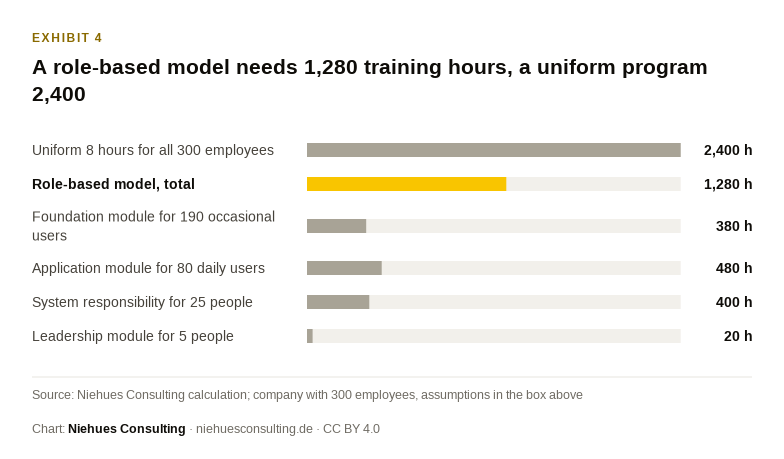
This is where the states' third area, shared training, comes in. Article 4 requires companies to take the knowledge, experience and context of use of their staff into account. A tiered model by role follows that standard and takes less working time than uniform training for everyone. The following calculation shows the difference for one company. Any executive team can replace the assumptions with its own figures.
Exhibit 4
A role-based model needs 1,280 training hours, a uniform program 2,400
Data and download
Data as table
| Label | Value |
|---|---|
| Uniform 8 hours for all 300 employees | 2,400 h |
| Role-based model, total | 1,280 h |
| Foundation module for 190 occasional users | 380 h |
| Application module for 80 daily users | 480 h |
| System responsibility for 25 people | 400 h |
| Leadership module for 5 people | 20 h |
Graphic and data: Niehues Consulting, CC BY 4.0. Free to use with attribution and a link.
In this calculation the tiered model saves 1,120 hours, around 47 percent. Per person, the 25 system owners receive the most time, because under Article 26 they perform human oversight of high-risk systems and need the competence, training and authority to do so. Companies that use open offerings from the states or the federal government for the foundation module only have to build the modules for their own systems. How to set up and document a tiered model is covered in AI literacy under Article 4 of the AI Act.
State support only works once a company knows its AI systems, roles and risk classes
All four areas assume that a company knows which obligations apply to it. No state tool can answer that question, because the answer depends on the company's own systems. A mid-sized company that uses an AI system to filter or rank job applications is running an employment use case under Annex III. As a deployer it must, from December 2, 2027, follow the instructions for use, assign oversight to competent people and keep automatically generated logs for at least six months, among other duties under Article 26. Before using the system in the workplace, it informs workers' representatives and the employees affected.
The same company can be a provider of a customer service chatbot if it builds the chatbot itself. Article 50(1) then requires it to make sure customers are told they are interacting with an AI system. For an internal writing assistant, the AI literacy duty is the main obligation. The order of work follows from this: the AI inventory with purpose, role and provisional risk class comes before choosing any support. The Bundesnetzagentur's online tool fits into this first step. The classification of high-risk use cases is explained in High-risk AI under the AI Act.
The tasks in the right-hand column need fixed responsibilities for the inventory, approvals and training, so that they do not depend on individual people. How to set up the bodies, policies and responsibilities is covered in Building AI governance.
Executive teams should build an AI inventory by the end of March 2027 and then choose the support they need
Executive teams in mid-sized companies can derive a five-step approach from the letter of intent and the deadlines. It starts with the inventory and uses the states' offerings where they save effort:
- Build the AI inventory (by the end of January 2027, an owner appointed by the executive team): record every AI system with purpose, business unit, vendor and number of users, including AI features in existing software. The success measure is the share of systems with a named owner.
- Classify role and risk (by the end of March 2027, the owner with business units and data protection): record for each system whether the company is the provider or the deployer and whether it is an Annex III use case. The Bundesnetzagentur tool serves as a first assessment. The success measure is the number of systems with a documented classification.
- Tier AI literacy by role (from February 2027, HR development): use open offerings from the states or the federal government for the foundation module, add modules for in-house systems and record participation. The success measure is the share of trained employees per role.
- Prepare high-risk applications (by the end of September 2027, the business unit with IT and the works council): plan oversight, logging and employee information under Article 26 for each Annex III use case and use the states' audit catalogs as a checklist. The success measure is the number of open gaps per system, which should reach zero by December 2, 2027.
- Choose state offerings selectively (ongoing, the owner): use sandboxes for in-house development and tools once the inventory holds more systems than can be maintained by hand. The success measure is the effort per system compared with the previous year.
For companies in Germany, co-determination comes on top. The works council has a say on software that can record employees' performance or behavior. Article 26(7) also requires workers' representatives and affected employees to be informed before high-risk AI is used in the workplace. This assessment does not constitute legal advice.
Niehues Consulting combines AI management, implementation and organizational design
Niehues Consulting supports executive teams and heads of department with AI strategy and portfolio management, with AI implementation and adoption and with organizational design. In AI strategy we analyze processes, write the requirements, calculate the business case and steer the AI portfolio with clear metrics. That portfolio becomes the inventory every classification under the AI Act requires. In implementation we mature prototypes and introduce AI with new processes, clear responsibilities and people who work with it confidently. In organizational design we shape structures, roles and decision paths, for example for approving and overseeing AI systems.
Our approach has three phases: Understand, Build and Adopt. In Understand we establish which AI systems are in use and who owns them. In Build we deliver the most important element first, such as an inventory with role and risk class. In Adopt we embed training and approvals in day-to-day operations so that they last beyond our engagement. Founder Marin Niehues has worked as delivery lead and business analyst on projects ranging from venture-backed scale-ups to DAX 40 groups. On other projects he was responsible for organizational design, governance and process architecture. In an introductory call we clarify where your company stands on the AI Act and which step will pay off now: book an introductory call.
Frequently asked questions
What have NRW and Bavaria agreed on the EU AI Act?
The economics ministry of North Rhine-Westphalia and the Bavarian State Ministry for Digital Affairs have agreed a joint letter of intent. They plan to exchange methods for AI regulatory sandboxes, tools for partly automated compliance and AI literacy training as well as guidelines and audit catalogs. The offerings are to be open and free of charge.
When did NRW and Bavaria publish the letter of intent?
The NRW economics ministry published the joint letter of intent in a press release on November 20, 2026.
When do the high-risk AI obligations apply after the Digital Omnibus?
For high-risk systems under Annex III, for example in employment, the obligations apply from December 2, 2027. For high-risk AI in products under Annex I, the date is August 2, 2028. The Digital Omnibus has been in force since July 27, 2026.
Does the AI literacy duty under Article 4 already apply?
The duty has applied since February 2, 2025. Providers and deployers of AI systems must take measures to support the AI literacy of their staff. Since the Omnibus rewrote Article 4, they are not required to guarantee a specific level of AI literacy for any individual.
What is an AI regulatory sandbox?
An AI regulatory sandbox is an environment in which companies develop and test new AI systems under real conditions in coordination with supervisory authorities. Under Article 57, each member state must have at least one national sandbox operational by August 2, 2027.
Which authority supervises the AI Act in Germany?
The Federal Network Agency (Bundesnetzagentur) has been the market surveillance authority, single point of contact and complaints office for the AI Act since July 29, 2026. In sectors such as finance, the existing supervisors remain responsible, for example BaFin.
How many German companies expect to be affected by the AI Act?
In Bitkom's survey published September 14, 2026, 37 percent of companies expected to be affected as deployers, up from 23 percent a year earlier. Another 34 percent are still checking.
What should mid-sized companies do now?
Mid-sized companies should first build an AI inventory with purpose, role and risk class for each system. They then tier AI literacy by role, prepare high-risk applications before December 2, 2027 and use the states' offerings where they save effort. This assessment does not constitute legal advice.
Part of the guide: AI management: the guide for executive and divisional leadership
Let’s talk about your initiative.
In 30 minutes we clarify where your organization stands and which step will pay off most now.
Request a consultation30 minutes · free · no obligation