ChatGPT in the workplace: setting up approval, rules and co-determination properly

Using ChatGPT safely in a company means making three decisions: which version to approve, which rules apply and how the works council is involved. Use is happening anyway. Almost three in ten employees who use AI at work rely on tools their employer has not provided. A company that decides nothing has therefore chosen the riskiest option. This article answers the core questions on co-determination and the AI Act, assesses a ban and sets out a roadmap for orderly approval. This article provides an overview and does not constitute legal advice.
Why the decision on ChatGPT cannot wait
Generative AI arrived in German workplaces before most companies had rules for it. A representative establishment panel shows for 2025 that just under a quarter of establishments use generative AI, and 90% of them rely on publicly available models. Only 21% of user establishments have developed internal rules, while a further 22% are planning them.
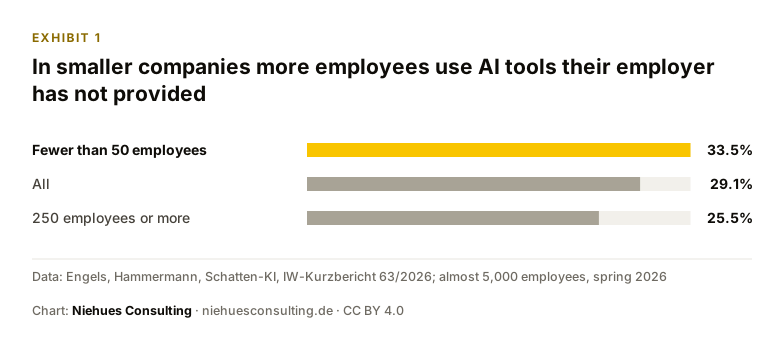
Employees are moving faster than their employers. A representative survey of almost 5,000 employees from spring 2026 shows that 29.1% of those using AI at work use tools their employer has not provided, typically private chatbot accounts. In companies with fewer than 50 employees the share is 33.5%, in those with 250 or more it is 25.5%. On the company side, an association survey found that in 2025 only 23% of companies with 20 to 99 employees officially provided generative AI, against 43% of companies with 500 or more.
Exhibit 1
In smaller companies more employees use AI tools their employer has not provided
The starting point is clear. Without a decision, company data flows through private accounts into services whose contract terms the company has never reviewed. The question is therefore in what form ChatGPT is used. How to detect uncontrolled use is described in Shadow AI: detecting and steering it.
Is ChatGPT at work subject to works council co-determination?
If the employer provides ChatGPT through company accounts, co-determination should regularly be assumed in German establishments with a works council. The relevant right covers technical equipment suitable for monitoring employees' conduct or performance (Section 87(1) No. 6 of the Works Constitution Act). Under settled case law, objective suitability for monitoring is sufficient. No intention on the employer's part is required. Company accounts with an admin console and stored chat histories generally meet this test.
A frequently cited exception concerns a different set of facts. In 2024 a German labor court ruled in summary proceedings that the works council had no co-determination right in a specific case. The employer had permitted the use of generative AI via the browser, employees used their own private accounts, and the employer had no insight into use or inputs. A works agreement on the browser already existed. The court classed the usage guidelines as work performance conduct, which is not subject to co-determination. The decision rests expressly on the particular features of that case. Once a company provides its own licenses with logging, its basis falls away.
Independently of this, the works council has information rights. It must be informed in good time when work procedures and workflows are planned, including the use of AI. If it calls in an expert to assess AI, that expert is deemed necessary. For project planning one rule is enough: every approval of ChatGPT with company accounts is a participation topic with a date in the plan. How participation works in practice is described in Works agreements on AI.
Can an employer ban the use of ChatGPT?
Yes, an employer may ban the use of ChatGPT for work, because its right to issue instructions covers which work tools are used. This also applies to entering company data into private accounts. Breaching a clearly communicated ban can have employment law consequences.
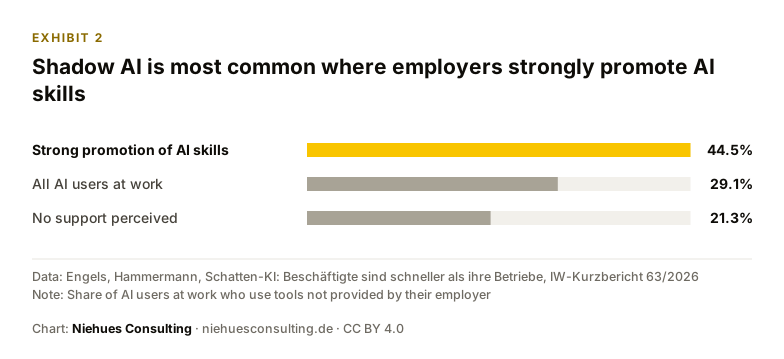
Whether a ban is wise is a management question. The shadow AI survey shows that where employers strongly promote AI skills, 44.5% of AI users also use tools that have not been provided. Where employees perceive no support, the figure is 21.3%. The authors conclude that bans mainly hit committed employees and do not remove demand. A study of AI use at work also shows that formally introduced tools are used regularly almost twice as often as informally used ones.
Exhibit 2
Shadow AI is most common where employers strongly promote AI skills
Note: Share of AI users at work who use tools not provided by their employer
Data and download
Data as table
| Label | Value |
|---|---|
| Strong promotion of AI skills | 44.5% |
| All AI users at work | 29.1% |
| No support perceived | 21.3% |
Chart: Niehues Consulting, CC BY 4.0. Data: Engels, Hammermann, Schatten-KI: Beschäftigte sind schneller als ihre Betriebe, IW-Kurzbericht 63/2026; the source's terms apply.
A temporary ban makes sense as a transition until an enterprise license and policy are in place. As a permanent solution it pushes use into private accounts and costs productivity.
Does the AI Act apply to ChatGPT in a company?
Yes, the AI Act also applies to companies that merely use ChatGPT, although with manageable obligations. The obligations for the underlying general-purpose AI model lie with the provider. The using company acts as a deployer. Three obligations are particularly relevant to this role.
- AI literacy. Deployers must ensure that staff working with AI systems have sufficient AI literacy. Training and documentation are therefore part of every approval.
- Transparency. Disclosure obligations apply to certain content, such as deepfakes and AI-generated text published to inform the public on matters of public interest without editorial review.
- High-risk purposes. If a company uses ChatGPT for purposes the AI Act classifies as high-risk, such as screening job applications or evaluating employee performance, considerably more extensive deployer obligations apply. These include informing workers' representatives and affected employees before use in the workplace.
For the policy this sets a clear boundary. Personnel decisions and performance evaluations do not belong in a generally approved chat assistant. The full framework is explained in EU AI Act.
Data protection: what must be settled before approval
If personal data is processed, the company needs a data processing agreement with the provider and a legal basis for any transfer to third countries. Neither exists with private accounts. Enterprise licenses typically offer data processing agreements, exclusion of inputs from model training and account administration. The data protection team checks these commitments against the actual contract terms before approval.
Companies already using AI name data protection requirements as their biggest barrier, at 66% in a 2026 association survey. Data protection is therefore a work package with its own deadline.
Four routes compared
Companies have four options: a ban, tolerating private accounts, approval with an enterprise license, and a bespoke solution built on a language model. For most companies, approval with an enterprise license is the right starting point. A bespoke solution pays off once applications need to access company data sets or data must not leave the company.
What belongs in a ChatGPT policy
A ChatGPT policy sets out which tools are permitted, which data may be entered and who remains responsible for results. It is short and written with examples. The following checklist covers the points that regularly come up in discussions with the works council and data protection.
A detailed template with an introduction path is provided in AI policy for employees.
Roadmap for orderly approval
Orderly approval works in four steps that can be completed in around three months if the works council and data protection are involved from the first step.
- Define use cases and data classes. Which tasks should become faster or better, and with which data? The output is a short description that serves as the basis for the works council and data protection.
- Select the license and agree the framework. Selection is made against known requirements on contract and logging. The draft policy is produced in parallel.
- Pilot with a defined group. A pilot group of 30 to 100 people works for eight to twelve weeks within the agreed framework. Results are measured against a baseline, such as processing time per case.
- Live operation. Lessons from the pilot feed into a works agreement, the policy becomes binding and training becomes a precondition for access.
How this approval fits into AI management as a whole is described in the article AI management: what executive leadership must steer.
How Niehues Consulting sets up ChatGPT approval
Niehues Consulting runs the approval as a project with a plan and a measured result. The basis is the Niehues Delivery Model with three phases: Understand, Build and Implement. For ChatGPT, three review questions matter most. Who decides, who delivers, who uses? Which roles, decision paths and interfaces does operation require? Are users enabled and processes adapted?
In the Understand phase, use cases with data classes and the short description for the first meeting with the works council are produced. In the Build phase, the pilot runs within the agreed framework, with a baseline and business case. In the Implement phase, delivery management handles the transition into live operation, with training and operational ownership from day one. The starting point is a free 30-minute initial consultation.
Frequently asked questions
Does the works council have to agree to the introduction of ChatGPT?
If the employer provides ChatGPT through company accounts, a co-determination right should regularly be assumed, because the accounts are suitable for monitoring conduct or performance. A works agreement setting out purposes and limits on analysis is customary. Without a works council there is no co-determination, but data protection and AI Act obligations remain.
Can employees use ChatGPT with a private account for work?
Only if the employer expressly permits it. For company data this is the riskiest option, because there is no data processing agreement and the company has no insight. The policy should exclude private accounts for work purposes as soon as an enterprise license is available.
Is ChatGPT GDPR compliant for business use?
Yes, with an enterprise license, a data processing agreement and clear rules on entering personal data. Before approval, the data protection team reviews the contract terms and the legal basis for transfers to third countries. With private accounts, compliant processing of personal company data cannot be achieved.
Can the employer read employees' chat histories?
Company accounts often allow technical access to usage data, but data protection and co-determination set narrow legal limits. Who may view which data for what purpose therefore belongs in the works agreement. Performance monitoring via chat histories should be expressly excluded.
Do employees need training to use ChatGPT?
Yes, the AI Act requires deployers of AI systems to ensure sufficient AI literacy among staff. Basic training on how the tools work and where their limits lie, together with the policy, should therefore be a precondition for access. Participation is documented.
Does text created with ChatGPT have to be labeled?
There is no general labeling obligation for text used internally. Disclosure obligations apply in certain cases, such as deepfakes and published text on matters of public interest without editorial review. Many companies also label AI content towards customers voluntarily.
Who is liable for errors in ChatGPT output?
Towards customers, the company is liable for its work results, whichever tool produced them. A review duty therefore belongs in every policy. Results are checked before use by a person who is accountable for them.
Let’s talk about your initiative.
In 30 minutes we clarify where your organization stands and which step will pay off most now.
Request a consultation30 minutes · free · no obligation