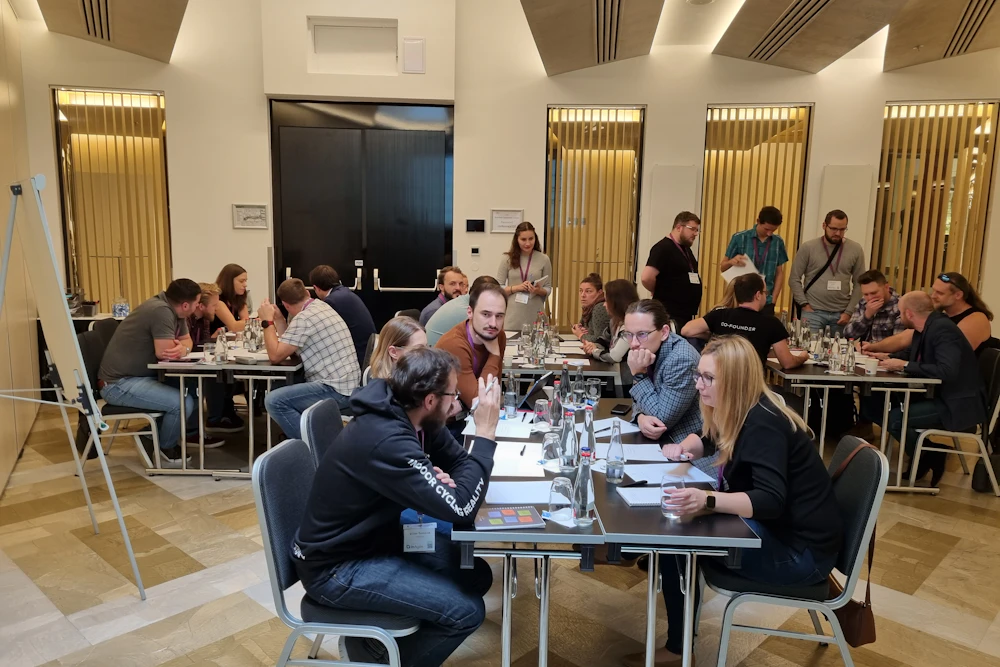
Delegation Poker: Clarifying Decision Rights in Your Team with Seven Levels

Delegation Poker settles in a single session who in the team makes which decision. Each person secretly picks one of seven levels of delegation that Jurgen Appelo described for Management 3.0. The joint reveal shows where managers and team hold different assumptions. The RACI matrix assigns roles to a task, while the delegation levels describe how much say the team has in a single decision.
Why decision rights stay unclear in teams
Often it only becomes clear after a decision who was allowed to make it. The manager assumes the team picks its own tools. The team waits for approval. In the opposite case the team decides and the manager reads about it in a status report. Each side acts logically on its own assumption. The damage comes from the gap between the assumptions: decisions sit unresolved, get made twice or are corrected later.
Org charts and job descriptions rarely fix this, because they regulate responsibility for areas and leave individual decisions open. The article Role clarity in job profiles shows how to record accountability in job profiles. Delegation Poker works one level below that and asks, for each single decision, how much influence the team has over it.
The seven levels of delegation
The seven levels run from the manager's instruction to full delegation to the team. A higher level is not better by default. Which level fits depends on the topic, on the knowledge in the team and on the risk of the decision. A high level suits a team that has the knowledge and the accountability for the topic. Where legal or financial risk is involved, a low level can be the right one.
On levels 1 to 3 the manager decides and gathers different amounts of feedback first. Level 4 splits the decision between both sides. From level 5 it rests with the team. The levels differ in whether the manager gives advice beforehand or asks afterward. The levels describe the decision and do not judge any person.
How does a round of Delegation Poker work?
A round needs a list of concrete decision areas, the seven cards and, following the Management 3.0 description, a group of three to seven people. The sequence is always the same:
- The group collects in advance the cases for which it wants a delegation policy.
- One person reads out a case or tells a situation from experience, for example choosing new tools.
- Each person secretly picks one of the seven cards.
- Everyone reveals together.
- The people with the highest and the lowest card explain their choice.
- The group agrees on one level and records it on the Delegation Board.
The Delegation Board lists the decision areas vertically and shows the seven levels horizontally. In the Let's get it Done tool the board can be copied as text, for example into the team wiki. Management 3.0 also provides a points game, which stays optional. On sensitive topics we advise against it, because points tempt people to pick the level of the majority.
The manager picks in secret like everyone else and names the level only after the reveal. A manager who speaks first sets an anchor for the team. The round then shows nothing but agreement. If the manager picks level 3 while two team members pick level 6, the team has a decision in mind that the manager has not handed over. The conversation about that gap is where the round pays off. Agreeing on a number records its result.
Delegation Poker and the RACI matrix compared
The RACI matrix assigns tasks and decisions to four roles: Responsible performs the work, Accountable owns the result, Consulted is asked beforehand and Informed hears the outcome. Each row has exactly one Accountable. That settles who has the last word but not how much say the team gets beforehand. Delegation Poker answers exactly that question. The limits of the matrix are covered in Clarifying decision rights: RACI, RAPID and their limits.
The two methods complement each other. A Delegation Poker round settles the level first. The result can then be transferred into the matrix: on levels 1 to 3 the manager is Accountable, from level 5 a role in the team is. Level 4 means both decide together, which does not fit the rule of a single A. Here the matrix has to say who decides when they disagree.
Neither method says by when a decision has to be made or where it goes when people disagree. The article Measuring and increasing decision speed shows how to measure decision time.
When a session pays off
A session pays off when a team wants to clarify with its manager who makes which decisions. Typical occasions are a new team, a change in leadership, disputes over responsibilities and the move to self-organized work. The article Self-organization: what holacracy and similar models deliver describes the models available and what they achieve. Where managers in agile teams keep deciding themselves is the subject of Agile leadership: what managers still decide in agile teams.
The method is less suited where the framework is fixed, for example for decisions set by law or contract. There is nothing to negotiate then. A round also achieves little without trust between team and manager, because hardly anyone picks openly. Department heads prepare the first round with five questions.
Levels change with the experience of the team. We therefore recommend going through the board again after a few weeks. An agreement without an entry on the board is quickly forgotten. An agreement that nobody reviews goes stale.
Decision paths as part of organizational design
Niehues Consulting designs structures, roles and decision paths in delivery management and organizational design, so that an organization delivers reliably in day-to-day business and in transformation. The levels of delegation belong to the operating model. They are defined together with responsibilities and workflows and complemented with deadlines and an escalation path. Marin Niehues steers initiatives as delivery manager, project manager or product owner and knows from projects ranging from VC-funded scale-ups to DAX 40 groups where decisions stall in practice.
The approach follows the Niehues Delivery Model with its phases understand, build and implement. For decision rights the first question counts: who decides, who delivers, who uses? It leads to a catalog of decisions with level, role and deadline, which is then introduced together with those involved. The entry point is the free initial consultation of 30 minutes.
Frequently asked questions
What is Delegation Poker?
Delegation Poker is an exercise from Management 3.0 by Jurgen Appelo that teams use to clarify who has how much say in which decision. For one concrete decision area, each person secretly picks one of seven levels. The joint reveal shows differing expectations.
What are the seven levels of delegation?
The levels are 1 Tell, 2 Sell, 3 Consult, 4 Agree, 5 Advise, 6 Inquire and 7 Delegate. On level 1 the manager decides alone, on level 4 both decide together and on level 7 the team decides.
What is a Delegation Board?
The Delegation Board lists the decision areas vertically and the seven levels horizontally. The group records the agreed level for each area there. It can hang on a wall or sit in a wiki as a table.
How many people should play?
Management 3.0 recommends groups of three to seven people. In larger teams you can split the round by decision area. The online tool from Let's get it Done takes up to 50 people per room.
What is the difference between Delegation Poker and RACI?
Delegation Poker sets how much influence the team has over a decision. The RACI matrix sets who performs a task, who owns it, who is asked beforehand and who is informed afterward. The two can be combined.
How do you assign decision rights in a team?
Start by collecting the recurring decisions that hold up initiatives. Settle the level for each decision, for example with Delegation Poker. Write it down, add a deadline and an escalation path and review the agreement after a few weeks.
Does the manager vote too?
Yes. The manager picks in secret like everyone else and names the level only after the reveal. Otherwise the team follows the manager's pick. The round no longer shows what the team expects.
Is there a free online tool for Delegation Poker?
Yes. Let's get it Done offers Delegation Poker in the browser for free, without sign-up. The team shares a link, picks on their own devices and can copy the Delegation Board as text.
Part of the guide: Organizational design and delivery management: the guide for organizations that deliver
Let’s talk about your initiative.
In 30 minutes we clarify where your organization stands and which step will pay off most now.
Request a consultation30 minutes · free · no obligation