Make or buy: building, buying or adapting AI

Whether a company builds, buys or adapts AI is decided per application against three test questions that are answered before any budget is committed. For standard processes buying is the right route, for applications tied to the company's own process adapting is, and building pays off only for a genuine competitive advantage backed by proprietary data and a team of its own to run it. This article sets out the decision model, positions the three options with examples and shows how to compare costs over the entire period of use.
What distinguishes buying from adapting and building?
The three options differ in how much of the solution the company builds and owns itself. Buying means licensing a finished application from a vendor. Benefits arrive early, while influence over functionality remains limited. Adapting means configuring an available model or platform with the company's own data and rules so that it maps a specific process. Building means creating data preparation and application logic along with the interface yourself, as a rule on top of an available foundation model. Training a model of your own pays off only for companies with unique data at large scale and their own AI research.
In the market, a three-way split into takers, shapers and makers has become established for these levels. The taker uses finished tools through their interface or API, which corresponds to buying. The shaper connects available models with its own data and systems, which corresponds to adapting and to building an application on a third-party model. The maker builds its own foundation model, a route for very few companies. The terms help when talking to vendors, while the decision itself is made against the test questions.
The wrong decision rarely originates in the technology. It originates when the option is chosen before the application. A company resolves to build everything itself, or to buy everything from now on, and applies that rule to applications with entirely different characteristics. The delivery perspective reverses the sequence: first the application and its operation are understood, then the option is chosen. How make or buy fits into the wider AI management of an organization is described in the article AI management: what executive leadership must steer.
The decision model: three test questions per application
Every application runs through the same three test questions, and the answers are recorded in writing. This makes the decision traceable for senior management and the business unit.
- Differentiation value: does the application create a competitive advantage that a competitor could not reach with standard software? The higher the value, the stronger the case for building.
- Data position: is the required data available in sufficient quality, and does it belong to the company? Proprietary, well-maintained data favors adapting or building. Where it is missing, a vendor with its own data base offers the faster route.
- Operational readiness: is there a team that monitors and develops the solution after launch and can be reached when faults occur? Without this responsibility, even the technically best custom build loses quality and usage after launch.
The recommendation follows from the combination. High differentiation value with a good data position and existing operational readiness favors building. A standardized process without competitive advantage favors buying. Everything in between leads to adapting. For applications tied to the company's own process this is the standard route, because it combines the strength of available models with the company's knowledge.
Should you train your own AI model?
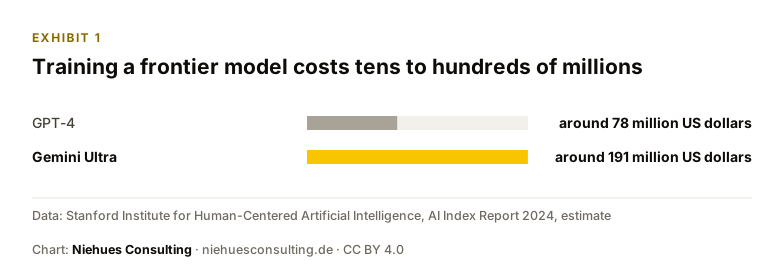
Training your own foundation model pays off for almost no company outside the AI industry. The compute required for leading models runs into tens to hundreds of millions: an annual AI report from a US university estimates the compute cost of training GPT-4 at around 78 million US dollars and of Gemini Ultra at around 191 million US dollars. On top come data acquisition and a dedicated research team as well as the ongoing race against vendors who improve their models at short intervals.
Exhibit 1
Training a frontier model costs tens to hundreds of millions
Data and download
Between a finished model and training your own lie two levels of adaptation. With retrieval from a knowledge base (retrieval augmented generation) the model remains unchanged and receives matching documents from the company's own holdings at run time. With fine-tuning, an existing model is further trained on the company's own examples so that it reliably hits a style or a fixed format. The decision rule: where current knowledge is the issue, retrieval from a knowledge base is the route, because documents can be swapped without new training. Where a recurring output format or a narrowly defined task with many examples is the issue, fine-tuning pays off. Training from scratch remains reserved for companies whose product is the model itself.
Is it cheaper to buy AI or to build it?
For standard processes buying is cheaper over a five-year period of use, and for differentiating applications with an operation of their own adapting is. Development effort is visible, operation initially is not. Models are updated, and the quality of results must be measured continuously. Interfaces change, and usage costs rise as adoption spreads across the company. Purchased solutions shift part of this load to the vendor, but create dependency on functional scope and price development.
The same question applies to every item: who is responsible, internally or externally? An option becomes comparable only once all five items have an answer. Usage fees deserve particular attention, because for bought and adapted solutions they grow with every additional user and every request. An application that is cheap in the pilot changes its economics once it is extended to the whole company. The approach for the full calculation is described in AI business case: calculating benefits and costs reliably.
Vendor lock-in belongs in every decision
Vendor lock-in arises when data and customizations are tied to a vendor so tightly that switching becomes disproportionately expensive. With AI it shows first in proprietary formats for the knowledge base and configuration. Prompts tuned to a specific model come on top, as do pricing models that rise after rollout. The countermeasure is an architecture with an interchangeable model layer. The application addresses the model through an interface of its own, the knowledge base and evaluation data stay with the company, and every contract negotiation includes rules on data return.
Adapting succeeds when the business unit becomes the owner of the application. It defines what a good result looks like and decides on changes. Without this role, the outcome is a configured solution that nobody develops further and that loses acceptance within a few months. Set-up is faster than a custom build, because model and platform are ready to use. The effort concentrates on the knowledge base and the integration including quality measurement.
How Niehues Consulting supports the decision
Niehues Consulting supports make-or-buy decisions from the delivery perspective. In AI management, business analysis and requirements form the basis of the business case. The selection and sequencing of applications follow the decision model described above. Steering the AI portfolio with metrics then shows whether the chosen option delivers the expected benefit.
The approach follows the Niehues Delivery Model with the phases understand, build and implement. Three test questions matter for make or buy. In the build phase: does the prototype prove the benefit in the real workflow with real data? Only then is the decision between building and buying made, because the prototype shows whether a standard product solves the task. Also in this phase: is the business case confirmed with real values? This means the five-year view works with measured usage and operating costs. In the implement phase: who is responsible for operation from day one? This question settles the third test question of the decision model in binding form.
The entry point is the free initial consultation of 30 minutes. You can request it via contact.
Frequently asked questions
When is it worth building AI yourself?
Building AI yourself is worthwhile when the application creates a lasting competitive advantage and proprietary data is available in good quality. A team that takes over operation after launch is also required. If one of these criteria is missing, adapting or buying delivers a result faster and at lower risk.
What is the difference between takers, shapers and makers in AI?
Takers use finished AI tools, shapers connect available models with their own data and systems, and makers train their own foundation models. For most companies the shaper role is the standard route for differentiating applications. The maker role remains reserved for companies whose product is the model itself.
What does adapting mean for AI solutions?
Adapting means configuring an existing model or platform with proprietary data and rules and connecting it to the process. The company designs an application that fits its workflow and builds no model of its own. This route combines a short time to benefit with a high functional fit.
What are examples of make or buy in AI?
Translation and transcription are typical cases for buying, a knowledge assistant in customer service for adapting and price optimization on proprietary data for building. In each case the deciding question is whether the process runs the same in every company or creates an edge of its own.
Fine-tuning or retrieval: which is better for adapting AI?
For current company knowledge retrieval from a knowledge base is better, for a fixed output format or a narrowly defined task fine-tuning is. Retrieval can be updated without new training and shows the source of every answer. Fine-tuning requires many good examples and has to be repeated with every model change.
How do you avoid vendor lock-in with AI?
You avoid vendor lock-in with an interchangeable model layer and data that stays with the company. The application addresses the model through an interface of its own, and the knowledge base and evaluation data remain under your control. Contracts settle data return and price adjustments before signature.
Who should make the make-or-buy decision?
Senior management or the head of the business unit decides on the basis of a proposal that the business unit and IT prepare together with procurement. The business unit supplies benefit and requirements, IT assesses operation and integration, and procurement assesses the vendor side.
Let’s talk about your initiative.
In 30 minutes we clarify where your organization stands and which step will pay off most now.
Request a consultation30 minutes · free · no obligation