Model Context Protocol and A2A: What the Standards for AI Agents Mean for Your Architecture

MCP is the open standard through which AI agents access systems and data, and A2A is the standard through which agents work with one another. Together they define how an agent architecture is wired across the enterprise. Decision-makers need answers to three questions: what the standards solve, where they help with legacy systems, and which rules their use requires.
These answers belong in the architecture decision before the first agent initiative goes live. Introducing the standards without an authorization model opens company data to tools nobody has reviewed. Where the article touches on data protection: This article provides an overview and does not constitute legal advice.
What is the Model Context Protocol (MCP)?
The Model Context Protocol is an open protocol that defines how an AI application uses tools and data from other systems in a uniform way. Anthropic introduced it in November 2024. Since December 2025 it has been held by the Agentic AI Foundation, a body under the umbrella of the Linux Foundation supported by several large technology providers. MCP is therefore a vendor-neutral standard that no single provider controls.
The architecture has three roles. The host is the application in which the agent works, such as an assistant or a business application. The client inside the host maintains the connection to one server. The server is the bridge to a system, for example the ERP, the document archive or the ticketing platform. A server offers three kinds of building blocks:
- Tools: functions the agent calls, such as “create order” or “check stock level”
- Resources: content the agent reads, such as documents or records
- Prompts: prepared instructions for recurring tasks
Technically, client and server exchange messages in JSON-RPC 2.0 format. Locally they communicate via standard input and output, across the network via HTTP. For protected remote servers, the specification bases authorization on OAuth 2.1, the widely used framework for delegated access rights.
What is A2A, and how does it differ from MCP?
A2A (Agent2Agent) is an open protocol through which agents from different vendors and teams hand tasks to one another and work on them together. Google introduced it in April 2025, and since June 2025 it has been run as a Linux Foundation project. MCP connects an agent to systems, A2A connects agents to each other.
A2A's building blocks reflect this purpose. Each agent publishes an Agent Card, a machine-readable description of its capabilities, its address and the authentication it requires. A requesting agent uses the card to find a suitable partner and hands it a task. The task passes through defined states until completion and returns its results as artefacts. One property matters most for architecture: under A2A, agents remain opaque to each other. They share neither their memory nor their internal tools. This makes A2A suitable for collaboration across departmental and company boundaries.
The standards complement each other. An agent network uses A2A for the division of labor between agents and MCP for each agent's access to its systems.
Does MCP help with legacy systems?
MCP helps with legacy systems as soon as the system offers an interface for reading or writing, because the MCP server translates that interface into a form every agent understands. The legacy system stays unchanged, and the server sits in front of it as a thin layer. The decisive factor is the access route the legacy system provides. Four cases follow:
- An API exists (REST, SOAP, RFC): the MCP server exposes selected functions as tools. This is the simplest case.
- Database access only: the server reads through defined, approved queries. Write operations continue to run through the system's application logic.
- File exchange or batch only: the server works with exports and imports. Real-time capability does not arise this way.
- User interface only: a connection requires UI automation as an intermediate layer. Here it pays to check first whether retrofitting an interface is cheaper.
MCP solves the format problem. Data quality and permissions remain tasks the company must resolve itself. An agent that accesses incomplete master data via MCP simply produces wrong results faster. How companies integrate AI into established landscapes is explored in the article on legacy systems and AI.
The integration arithmetic shows the value of the standards
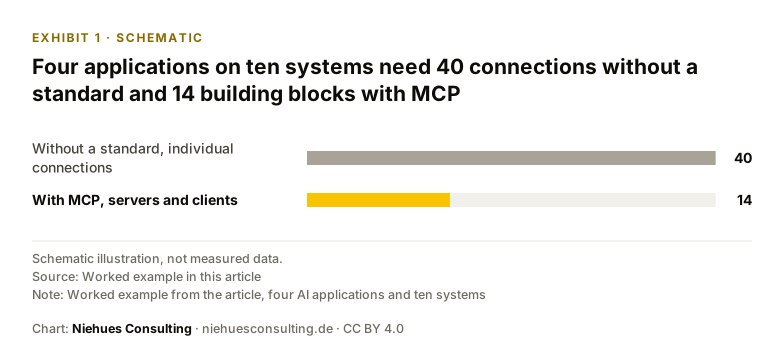
Without a common standard, every AI application needs its own connection to every system. With MCP, one server per system and one client per application suffice. Multiplication becomes addition.
Exhibit 1 · Schematic
Four applications on ten systems need 40 connections without a standard and 14 building blocks with MCP
Source: Worked example in this article
Note: Worked example from the article, four AI applications and ten systems
From three applications accessing overlapping systems onwards, a shared inventory of MCP servers becomes an architecture decision with clear value. How such a platform is built and owned is described in the article on IT architecture for AI.
Security and permissions determine approval
A standard that simplifies access also simplifies misuse. The security question is therefore which rights an agent receives through a server and who approves them.
Three risks are typical for MCP and A2A. First, indirect prompt injection: an agent reads text through a tool that contains hidden instructions and executes them. Second, manipulated tool descriptions: a third-party server describes its tools in a way that leads the agent to misuse them. Third, excessive rights: a server runs under a service account that may do more than the requesting employee. The MCP specification explicitly prohibits passing access tokens through to downstream systems unchecked. The OWASP security community has published a dedicated list of the most important risks for agentic applications, which provides a reference for reviews. The attack patterns are explained in the article on prompt injection and new attack surfaces.
If any of these points does not hold, the server stays in the test environment. AI governance keeps a register of all servers and agents with owner and approval status.
When is it worth using MCP and A2A?
MCP is worth using as soon as a company plans more than one AI application with access to its own systems. A2A is worth using as soon as agents from different teams or vendors need to hand tasks to one another. Clear criteria govern the sequence:
- One agent, few systems, one team: MCP for system access, A2A is not yet needed.
- Several applications on the same systems: a shared inventory of MCP servers, approved centrally and used locally.
- Several agents with their own accountability, for example one per business function: A2A for handovers, MCP for each agent's system access.
- Collaboration with agents of suppliers or customers: A2A with contractually agreed Agent Cards, authentication and logging.
MCP servers shipped by software vendors shorten the path, yet often expose more tools than a use case needs. Restricting them to what is necessary is part of the architecture work. How agent initiatives fit into the management of the AI portfolio is set out in the article AI management: what executive leadership must steer.
Niehues Consulting as a partner for agent architecture
The standards solve the technology of the connection. Whether an agent creates value in operation depends on the choice of workflow and the accountability for each connection. This requires a partner who owns the architecture together with the business case and the rollout.
Niehues Consulting, based in Düsseldorf, combines AI management with building prototypes and taking them into operation. Marin Niehues is a management consultant with a delivery perspective: he builds organizations that deliver and brings AI into operation. His projects range from VC-funded scale-ups to DAX 40 corporations, with engagements in 20+ countries across six continents.
The approach follows the Niehues Delivery Model with its phases Understand, Build and Embed. For agent architectures, three of its review questions matter most. In Understand: Who decides, who delivers, who uses? In Build: Does the prototype prove its value in the real workflow with real data, and which roles, decision paths and interfaces does operation require? The free 30-minute initial consultation clarifies which of your systems need a standardized connection first and which workflow shows value fastest. Book the appointment via the contact form.
Frequently asked questions
What are MCP and A2A in simple terms?
MCP is an open standard through which AI agents access the tools and data of other systems. A2A is an open standard through which agents hand tasks to one another. MCP governs the link between agent and system, A2A the link between agent and agent.
How do MCP and A2A work together in multi-agent systems?
In a multi-agent system, A2A governs the division of labor and MCP governs each agent's access to its systems. An orchestrating agent finds suitable partners through their Agent Cards and hands them tasks. Each partner retrieves the data it needs through its MCP servers and reports the result back.
Is MCP secure?
MCP is as secure as the approval of its servers and the rights they run with. The specification provides OAuth 2.1 authorization for remote servers and prohibits passing access tokens through unchecked. The largest risks are servers from unvetted sources and overly broad rights.
Is MCP GDPR compliant?
MCP is a transport protocol and in itself neither compliant nor non-compliant with the GDPR. What matters is which personal data an agent retrieves through a server, which model receives it and where that model runs. Every server with access to personal data therefore belongs in the company's data protection review.
Who should own MCP servers in a company?
Technical ownership of an MCP server lies with the team that runs the connected system, while approval sits with AI governance. The system team knows the data and rights best and keeps the server current when the system changes. Governance maintains the register of all servers and decides on new approvals.
How much does it cost to connect a system via MCP?
The cost is determined by the system's access route: a server in front of a documented API with a few read-only tools takes days, a server in front of a legacy system with write tools takes weeks. According to the German Association of Management Consultants (BDU), external consulting and development is typically billed at around 1,000 to 2,500 euros per consultant day. Authorization design and operation come on top.
Let’s talk about your initiative.
In 30 minutes we clarify where your organization stands and which step will pay off most now.
Request a consultation30 minutes · free · no obligation