Building High-Performance Teams: The Factors with the Greatest Impact

High-performance teams emerge when the organization creates five conditions: purpose, composition, psychological safety, decision rights and environment. According to a rule of thumb from team researcher J. Richard Hackman, around 60 percent of a team's effectiveness comes from the design of these conditions, so the most effective lever sits before the first working day. This article ranks the factors by impact and gives benchmarks for how long building such a team takes.
What is the difference between a team and a high-performance team?
A high-performance team delivers results that the receiving unit accepts and becomes better as a team in the process, while an ordinary team completes its tasks without gaining capability. J. Richard Hackman, long a professor at Harvard University, describes team effectiveness in “Leading Teams” by three criteria. First, the recipients judge the output good enough for their purpose. Second, the work strengthens the team's capability to work together in the future. Third, the work fosters the learning and well-being of the individual members.
This yields a yardstick that goes beyond utilization. A team is strong when it delivers results that are accepted and works together better afterwards than before. A fully utilized team that misses deadlines or loses members meets none of the criteria in full.
Which factors have the greatest impact on team performance?
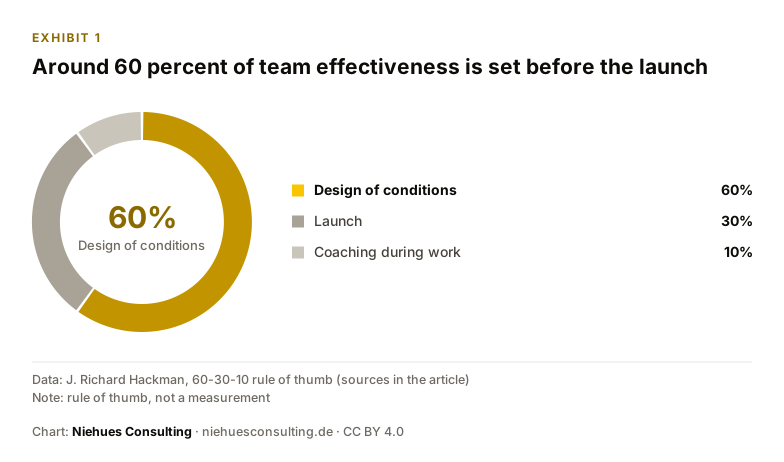
The design of conditions has the greatest impact on team performance, followed by the launch and only then by ongoing coaching. Hackman sums this up in the 60-30-10 rule of thumb: around 60 percent of team effectiveness comes from design, 30 percent from the launch and 10 percent from coaching once work is under way. In “Leading Teams” he names five conditions for effective teams: a real team with clear boundaries, a compelling direction, an enabling structure, a supportive organizational context and competent coaching.
Exhibit 1
Around 60 percent of team effectiveness is set before the launch
Note: rule of thumb, not a measurement
The following framework connects these findings with research on psychological safety and translates them into five levers for leaders with delivery responsibility. The overall framework of structure and delivery capability is described in the article characteristics and metrics of a high-performing organization.
Purpose and composition
A team goal works when it describes a result that someone outside the team accepts. “Improve collaboration” cannot be accepted; “hand over the new billing process to the business units” can. The goal gives the team a basis for setting priorities, and it makes performance visible.
Composition follows the task. A team needs the skills the goal demands and a membership that stays stable over its lifetime, because every new member first has to learn the way of working. Size is a design decision with a clear upper limit. Hackman recommends fewer than ten members, and the Scrum Guide says ten or fewer. The reason is arithmetic: five people have ten possible pairings, ten people already have 45, and each of them requires coordination. Within the limit, the rule is as small as the task allows. The trade-off is covered in the article Team size: why small teams deliver faster.
Psychological safety makes learning possible
Amy Edmondson, professor at Harvard Business School, described psychological safety as a shared belief within a team that it is safe to take interpersonal risks. Her study of 51 work teams in a manufacturing company linked this belief to the teams' learning behavior: where it was higher, teams learned more from their own work.
Google's research program Project Aristotle, which the company reports on via its re:Work platform, puts psychological safety first among five factors. The other four are dependability, structure and clarity, meaning of work and impact. More on this in the article Psychological safety and team performance.
Decision rights and environment
A team that passes every decision upwards delivers at the speed of its escalation chain. Decision rights therefore belong in a team charter. It sets out which decisions the team takes alone and which it takes together with another unit. It also covers a fixed rhythm for planning and review and a rule for resolving conflicts within the team.
The environment decides whether the structure works in daily practice. Information must reach the team in time, and resources must fit the remit. Incentives reward collaboration ahead of individual contribution, otherwise each member optimizes their own record.
How do you lead a high-performance team?
A high-performance team is led mainly by shaping its conditions and only secondarily by day-to-day intervention. The leader sets the team's goal and boundaries. They secure the membership and defend the decision rights towards the rest of the organization. In daily work their behavior counts: they name their own mistakes and ask questions before giving answers. They respond to objections with interest. Reviews after deliveries concentrate on processes and decisions, and individuals are not put up for judgment there.
According to Hackman and Ruth Wageman, coaching works at three points in time, each with its own function: at the start on motivation, at the midpoint on strategy and at the end on the team's learning. In practice this means a launch workshop, followed by a review at the midpoint of the delivery cycle and an evaluation after delivery. Coaching at other times reaches a team busy with its work far less effectively.
Tuckman describes stages, Hackman describes conditions
The best-known model of team development comes from Bruce Tuckman. It describes four stages, forming, storming, norming and performing, later extended by adjourning for the end of a team. The model explains why new teams experience friction at first and why ways of working need time to settle.
For building a high-performance team, the two views complement each other. Tuckman describes what happens inside a team. Hackman describes what the organization must design so that the team reaches the performing stage and stays there. Knowing only the stages means waiting for a team to find itself. Designing the conditions shortens the storming stage, because goal and decision rights are settled from the outset.
How long does it take to build a high-performance team?
A first measurable improvement shows after two to three delivery cycles, and a stable high-performance level after six to twelve months. Building the team follows three steps.
- Understand: the current-state review captures goal and membership, as well as decision paths and interfaces. The result is a finding per lever with an assessment of where the greatest impact lies.
- Build: the team charter records goal and membership, along with decision rights and the working rhythm. Environmental factors such as information flows and incentives are adjusted.
- Roll out: the leader is enabled for the role, and the team starts with a joint workshop. Reviews at fixed intervals then check the effect.
The lower end of six months applies to a team with stable membership and a clear remit. The upper end applies when membership or decision rights first have to be reorganised.
Niehues Consulting as a partner for building teams
Building high-performing teams is organization design and delivery management at the same time. Niehues Consulting designs structures and decision paths so that teams deliver reliably in daily business and in transformation. Founder Marin Niehues builds organizations that deliver, in projects from VC-funded scale-ups to DAX 40 groups and in 20+ countries on six continents. In the role of delivery manager, project manager or product owner he steers programs himself and knows the conditions a team needs.
The approach follows the Niehues Delivery Model with the phases Understand, Build and Roll out. Three checkpoint questions matter for building a team. Which business result should change measurably? Who decides, who delivers, who uses? Are the users enabled and the processes adapted? The entry point is a free initial consultation of 30 minutes, in which a specific team and its delivery remit are discussed.
Frequently asked questions
What makes a high-performance team?
A high-performance team delivers results that the receiving unit accepts and improves its collaboration in the process. According to Hackman, the third criterion is that the work fosters the learning and well-being of its members.
What is the difference between a team and a high-performance team?
A team completes its tasks; a high-performance team delivers accepted results and becomes more capable with every delivery cycle. The difference lies mainly in the conditions the organization sets, less in the abilities of individual members.
Which factors have the greatest impact on team performance?
The design of conditions has the greatest impact, around 60 percent according to Hackman's rule of thumb. The launch accounts for around 30 percent, ongoing coaching for around 10 percent. Google's Project Aristotle put psychological safety first.
What are the characteristics of a high-performance team?
A high-performance team has an acceptable result with a metric and fewer than ten members with stable membership. Members raise mistakes openly, and the metric improves over several delivery cycles.
How do you lead a high-performance team?
A high-performance team is led mainly by shaping its goal and decision rights. Coaching is applied at three points of a delivery cycle. In daily work, the leader's example in dealing with mistakes and objections counts.
What is the ideal size for a high-performance team?
A high-performance team should have fewer than ten members, as Hackman recommends, and the Scrum Guide says ten or fewer. Within that limit, the rule is as small as the task allows, with all the skills the goal requires.
What are the stages of team development?
According to Tuckman, a team goes through forming, storming, norming and performing, extended by adjourning when it disbands. Clear goals and decision rights from the outset shorten the storming stage.
How long does it take to build a high-performance team?
A first measurable improvement shows after two to three delivery cycles, and a stable high-performance level after six to twelve months. It takes longer when membership or decision rights first have to be reorganised.
Let’s talk about your initiative.
In 30 minutes we clarify where your organization stands and which step will pay off most now.
Request a consultation30 minutes · free · no obligation