AI adoption in German companies: what the research shows and what follows from it

Just over a quarter of companies in Germany use artificial intelligence, according to official statistics for 2025. Among companies with 20 or more employees, a representative industry association survey from summer 2026 already reports 57%. The gap between studies is a matter of measurement. The real finding lies elsewhere: the breadth of use is growing fast, its depth hardly at all. Only 3% of companies using AI say they exploit its potential to a large extent. This article sets out the key surveys and derives what senior management should do with them.
How many companies in Germany use AI?
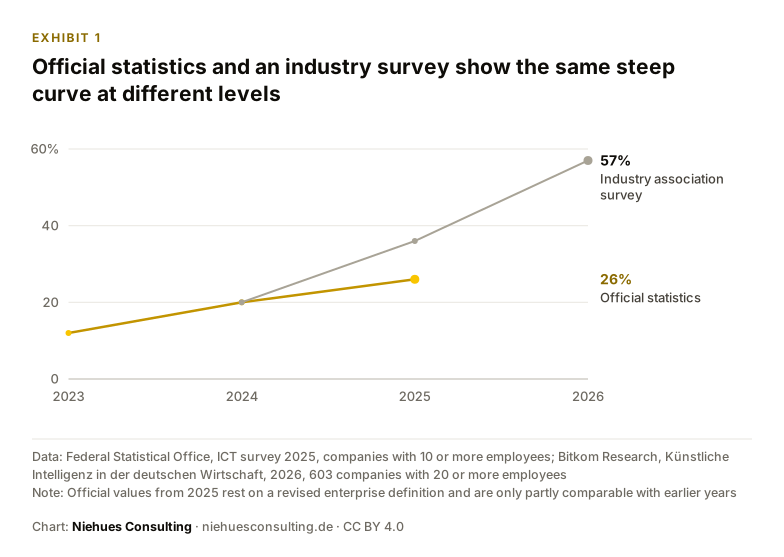
In 2025, 26% of companies in Germany with ten or more employees used at least one AI technology, according to the official ICT survey. The figure was 20% in 2024 and only 12% in 2023. From 2025 the values rest on a revised enterprise definition and are therefore only partly comparable with earlier years. The direction is nevertheless unambiguous.
Surveys from 2026 show a markedly higher level. A representative industry association survey of 603 companies with 20 or more employees reports AI use of 57% for summer 2026, up from 36% a year earlier and 20% two years before. A further 38% are planning or discussing adoption, and for only 4% is AI not on the agenda. The business survey of an economic research institute found 54.5% in May 2026, up from 40.9% a year earlier.
Exhibit 1
Official statistics and an industry survey show the same steep curve at different levels
Note: Official values from 2025 rest on a revised enterprise definition and are only partly comparable with earlier years
Among companies with 20 or more employees, those without AI are now a shrinking minority. Use alone is therefore no longer a competitive advantage. What matters is its effect on business results. Because the studies cite data protection and legal questions as barriers, please note: this article provides an overview and does not constitute legal advice.
Why the studies diverge so widely
Values between 24 and 57% do not contradict each other; they measure different things. Four characteristics explain the range.
- Population. Official statistics cover companies with ten or more employees, the association survey only those with 20 or more. The establishment panel counts individual sites including micro-businesses. Because adoption rises with size, any survey with a higher size threshold reports a higher share.
- Definition. Official statistics ask about a list of specific AI technologies. Surveys ask more openly whether the company uses AI. Studies on generative AI capture only a subset.
- Respondent. Those responsible for AI know of more applications than a management team that sees only officially introduced tools.
- Timing. With recent gains of more than 15 percentage points a year, spring 2025 and summer 2026 are different market phases.
For board papers, use official statistics as the lower bound and the latest representative association survey as the current edge.
How many companies in Germany use generative AI?
Just under a quarter of establishments in Germany used generative AI in 2025, up from around 5% in 2023. This is the result of the representative establishment panel of the Institute for Employment Research, which surveys around 15,000 establishments each year. A further 9% were planning to adopt it. Extrapolated, the establishments using it employ almost 40% of all employees subject to social insurance contributions.
The type of use is telling. 90% of user establishments rely on publicly available models. 16% further train purchased models with their own data, and 6% develop their own models. Adoption is broad; anchoring in company data is narrow. By sector, information and communication leads with 59%, followed by finance and insurance with 50%. In construction and healthcare the figure is only 13 to 15%.
How many mid-sized companies use AI?
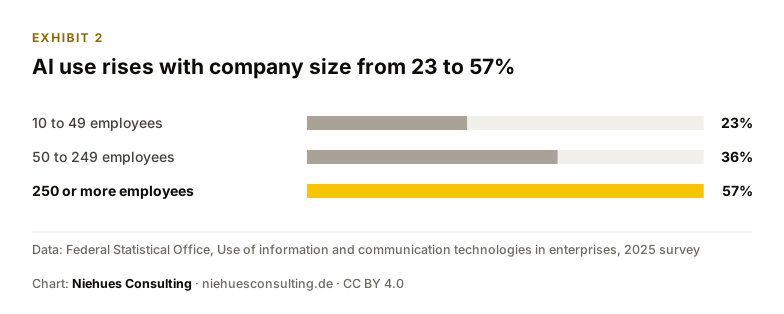
Between a quarter and just over a third of mid-sized companies use AI, well below large enterprises. According to official statistics, 23% of companies with 10 to 49 employees used AI in 2025. The share was 36% for 50 to 249 employees and 57% for 250 or more. For generative AI, the establishment panel shows the same pattern: 28% of establishments with 10 to 49 employees against 48% of those with 200 or more.
Exhibit 2
AI use rises with company size from 23 to 57%
Data and download
The gap has organizational causes. Larger companies more often provide tools officially and fund training. Smaller companies lack the capacity for selection and integration. How a mid-sized company can start on a limited budget is covered in AI in the Mittelstand.
How many companies already use AI agents?
Around one in ten companies with 20 or more employees already uses AI agents. In the 2026 association survey, 11% of companies that use, plan or discuss AI already deploy agents. 29% plan to deploy them and 31% are discussing them.
An AI agent completes multi-step tasks on its own, such as researching price comparisons and obtaining quotes. This shifts the management question. With assistants, the issue is enablement and rules. With agents, it is approval levels and operational accountability, because the software acts by itself.
Where AI is being used
Among companies using AI, customer contact is the most common area at 72%, followed by marketing and communications at 54%. Controlling and accounting come next at 25%, a marked rise from 17% a year earlier. Internal knowledge management doubled within a year to 22%. In sales the share rose from 5 to 14%.
For finance functions this means that around a quarter of companies using AI have brought it into controlling or accounting, and this area is growing faster than the traditional fields. Which applications pay off there first is the subject of AI in finance.
Where Germany stands in Europe
Germany is above the EU average in AI adoption but behind the Nordic countries. In 2025, 20% of EU companies with ten or more employees used AI, against 26% in Germany. Denmark led with 42%. Among large enterprises, Germany at 57% is roughly level with the EU figure of 55%.
Europe is falling behind the United States. An international comparative survey of workers shows that around 31% of employees in Germany used AI at work in 2025. It attributes most of the gap with the US to how strongly employers explicitly encourage use. The gap is therefore a leadership task.
The real gap lies in the depth of use
Figures on breadth obscure the more important finding. Only 3% of companies using AI say they exploit its potential to a large extent. 87% say they exploit it little or not at all. Two thirds of all companies rate their employees' AI skills as low, and a quarter provide no training at all.
The establishment panel confirms the picture. Of the establishments using generative AI, 21% have developed internal rules for its use and 27% offer training. Most therefore use the technology without a framework.
The barriers are clearly named. Companies that considered AI but did not introduce it most often cite lack of knowledge, at 72%, ahead of uncertainty about legal consequences at 62%. Companies already using AI cite data protection requirements at 66% and costs that are hard to estimate at 54%. Only 11% of users cite a lack of use cases. Ideas exist. What is missing is the path from tool to application with a business case.
Maturity model: four stages of AI use
The evidence translates into a stage model against which senior management can read its position.
- Experimenting. Employees use publicly available tools, often via private accounts, without rules or measurement. Most users sit here.
- Providing. The company provides licensed tools, has published rules and trains staff. Roughly a fifth of user establishments demonstrably reach this stage.
- Embedding. Individual core processes contain AI applications in live operation, with a baseline and a named owner.
- Steering. A portfolio prioritizes applications by value and feasibility. Business cases are confirmed with real figures.
Few make the step from stage 2 to stage 3. The causes are described in Why AI pilots fail to reach operations. A detailed method for assessing your position is set out in Determining AI maturity.
How to measure the depth of use in your company
A three-step calculation produces a metric that says more than any adoption rate.
- Step 1: List the company's core processes, typically eight to fifteen.
- Step 2: Count the processes in which an AI application runs in live operation and its impact is measured against a baseline.
- Step 3: Divide the second number by the first.
An example: a company with twelve core processes has AI with a metric live in two of them. Its depth of use is around 17%, even if 80% of employees use an AI assistant. If depth of use is below 20%, selecting the next two use cases with a business case belongs on senior management's agenda. Above that, portfolio steering moves to the fore. Where employees use publicly available tools without published rules, a policy and basic training take priority over any further pilot.
How these decisions fit into a complete steering model is described in the article AI management: what executive leadership must steer.
How Niehues Consulting moves companies from breadth to depth
Niehues Consulting works precisely where the evidence shows the widest gap: between widespread use and measured impact. The basis is the Niehues Delivery Model with three phases: Understand, Build and Implement. Three review questions are decisive for assessing your position. Which business result should change measurably? Does the prototype prove its value in the real workflow with real data? Which metric shows after 90 days that the solution is landing?
In the Understand phase, requirements, the business case and the selection and sequencing of applications are produced. In the Build phase, prototypes prove their value in the real workflow. In the Implement phase, delivery management handles the transition into operations, including user enablement. Marin Niehues has led engagements from VC-funded scale-ups to DAX 40 corporations in 20+ countries. The starting point is a free 30-minute initial consultation.
Frequently asked questions
What percentage of German companies use AI?
26% of companies with ten or more employees used AI in 2025 according to official statistics. Surveys of companies with 20 or more employees report 57% for summer 2026. The difference stems from size thresholds, definitions and timing.
Which study on AI adoption in Germany is the most reliable?
The official ICT survey provides the most reliable lower bound, because it uses a large sample and a method harmonized across the EU. Representative association surveys conducted each summer show the latest position. For board papers, cite both figures together.
How many finance departments already use AI?
Around a quarter of companies using AI deploy it in controlling or accounting. The 2026 association survey puts the figure at 25%, up from 17% a year earlier. This makes finance one of the fastest-growing areas of use.
How many companies are ready for AI?
Measured by use, most are ready; measured by depth, very few. Only 3% of companies using AI say they exploit its potential to a large extent. Two thirds of all companies rate their employees' AI skills as low.
Why do many companies still not use AI?
The most common reason is lack of knowledge. Among companies that considered AI but did not introduce it, 72% cite this reason and 60% cite data protection concerns. Only around a third cite excessive costs.
How many employees use AI at work in Germany?
Around 31% of employees in Germany used AI at work in 2025, according to an international comparative survey. The figure exceeds company-level values because employees also use AI without official provision. Company surveys therefore tend to show the lower bound of actual use.
Is Germany behind in AI compared with the rest of Europe?
No, Germany at 26% is above the EU average of 20%. The Nordic countries are clearly ahead. Compared with the United States, the gap in workplace use by employees is larger.
Let’s talk about your initiative.
In 30 minutes we clarify where your organization stands and which step will pay off most now.
Request a consultation30 minutes · free · no obligation